Liu Chaolong, Liu Jianping, Zhang Wenzhu, Wang Yong-Lei, Liu Qi, Song Bo, Yuan Jingli, Zhang Run
State Key Laboratory of Fine Chemicals School of Chemical Engineering Dalian University of Technology Dalian 116024 China.
Australian Institute for Bioengineering and Nanotechnology The University of Queensland, St. Lucia Brisbane QLD 4072 Australia.
Adv Sci (Weinh). 2020 May 29;7(14):2000458. doi: 10.1002/advs.202000458. eCollection 2020 Jul.
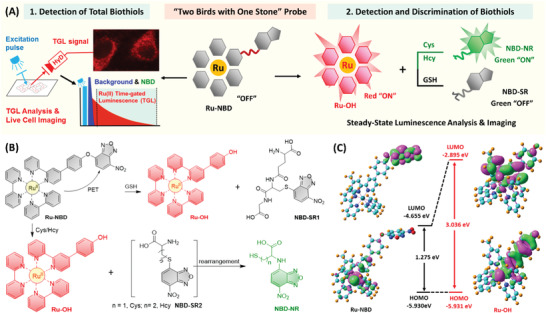
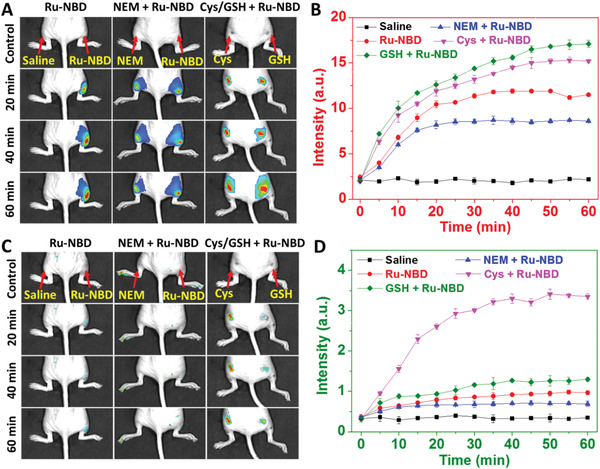
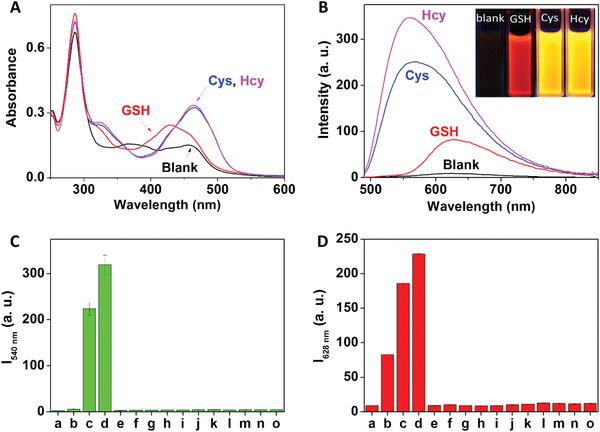
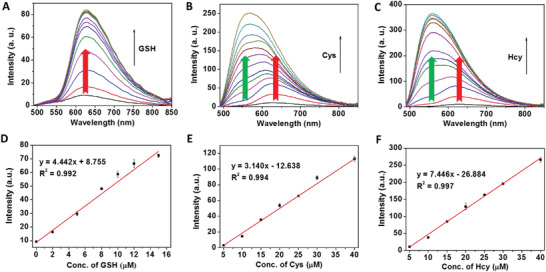
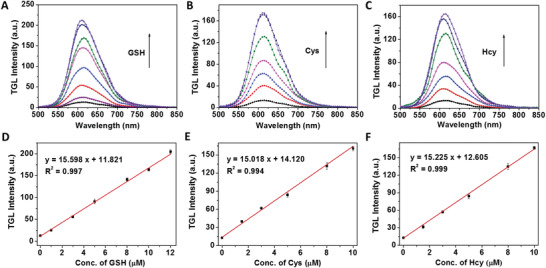
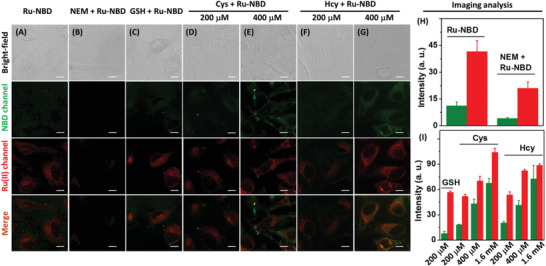
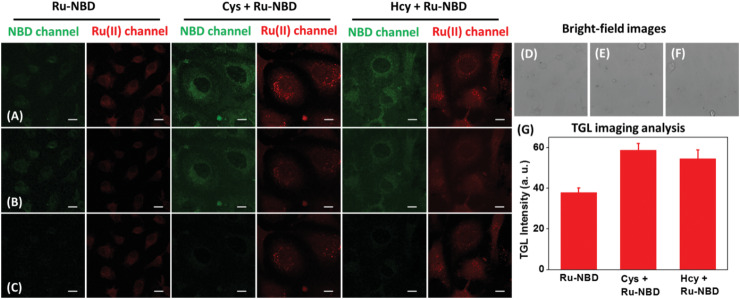
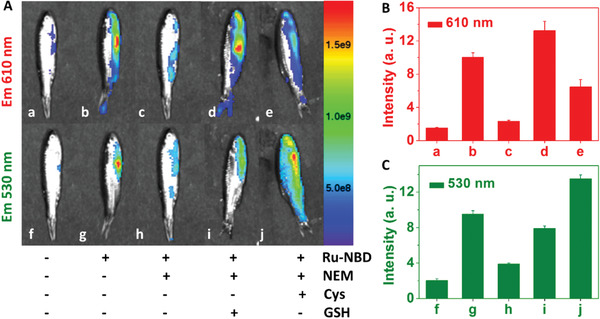
In this work, a "two birds with one stone" ruthenium(II) complex probe, Ru-NBD, is proposed as an effective tool for biothiols detection and discrimination in vitro and in vivo. Ru-NBD is nonluminescent due to the quenching of Ru(II) complex emission by photoinduced electron transfer (PET) from Ru(II) center to NBD and the quenching of NBD emission through 4-substitution with "O" ether bond. Ru-NBD is capable of reacting with Cys/Hcy to form long-lived red-emitting Ru-OH and short-lived green-emitting NBD-NR, while reacting with GSH to produce Ru-OH and nonemissive NBD-SR. The long lifetime emission of Ru(II) complex allows elimination of short lifetime background and NBD-NR fluorescence for total biothiols detection ("bird" one) by time-gated luminescence (TGL) analysis, and the remarkable difference in luminescence color response allows discrimination GSH and Cys/Hcy ("bird" two) through steady-state luminescence analysis. Ru-NBD features high sensitivity and selectivity, rapid luminescence response, and low cytotoxicity, which enables it to be used as the probe for luminescence and background-free TGL detection and visualization of biothiols in live cells, zebrafish, and mice. The successful development of this probe is anticipated to contribute to the future biological studies of biothiols roles in various diseases.
在本研究中,一种“一石二鸟”的钌(II)配合物探针Ru-NBD被提出作为一种在体外和体内检测和区分生物硫醇的有效工具。由于光诱导电子转移(PET)从Ru(II)中心到NBD导致Ru(II)配合物发射猝灭,以及通过“O”醚键的4-取代导致NBD发射猝灭,Ru-NBD不发光。Ru-NBD能够与半胱氨酸/同型半胱氨酸反应形成长寿命的红色发射体Ru-OH和短寿命的绿色发射体NBD-NR,同时与谷胱甘肽反应生成Ru-OH和不发光的NBD-SR。Ru(II)配合物的长寿命发射允许通过时间分辨发光(TGL)分析消除短寿命背景和NBD-NR荧光以进行总生物硫醇检测(“第一只鸟”),并且发光颜色响应的显著差异允许通过稳态发光分析区分谷胱甘肽和半胱氨酸/同型半胱氨酸(“第二只鸟”)。Ru-NBD具有高灵敏度和选择性、快速发光响应以及低细胞毒性,这使其能够用作发光和无背景TGL检测以及活细胞、斑马鱼和小鼠中生物硫醇可视化的探针。预计该探针的成功开发将有助于未来对生物硫醇在各种疾病中作用的生物学研究。