Spiwok Vojtěch, Kříž Pavel
Department of Biochemistry and Microbiology, University of Chemistry and Technology, Prague, Czechia.
Department of Mathematics, University of Chemistry and Technology, Prague, Czechia.
Front Mol Biosci. 2020 Jun 30;7:132. doi: 10.3389/fmolb.2020.00132. eCollection 2020.
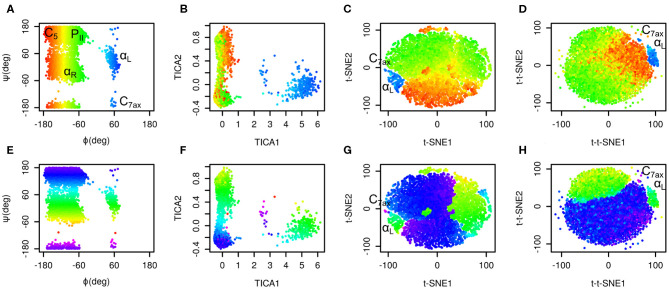
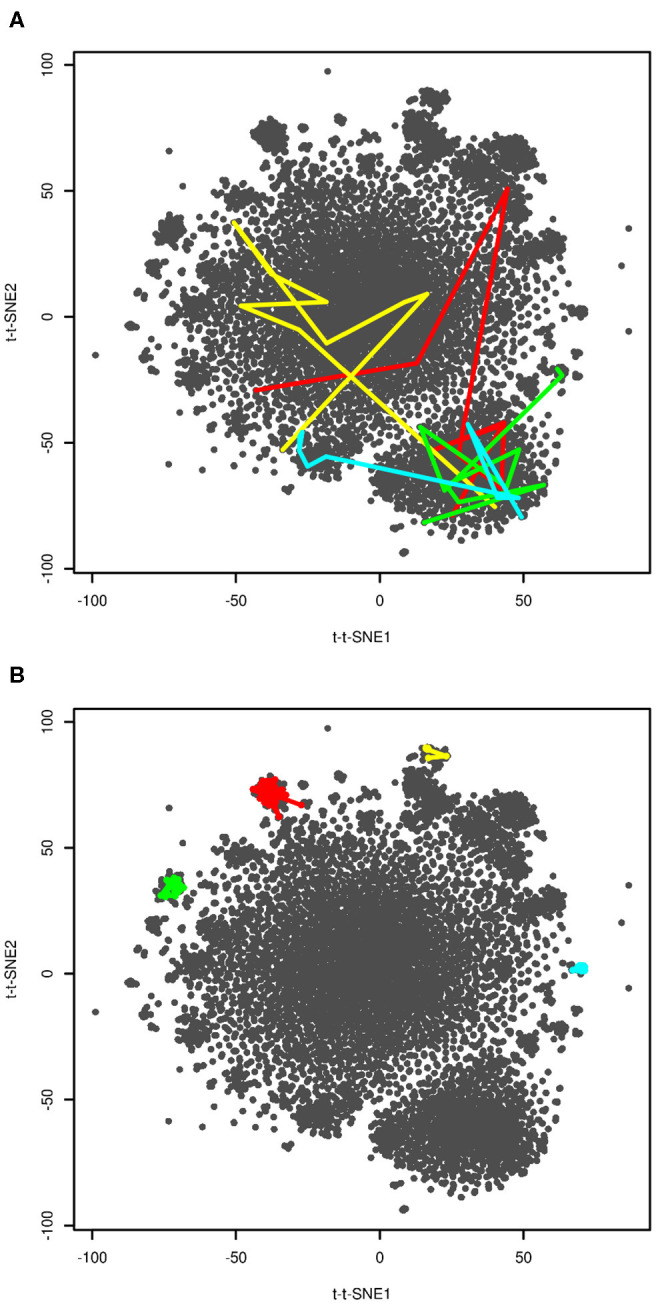
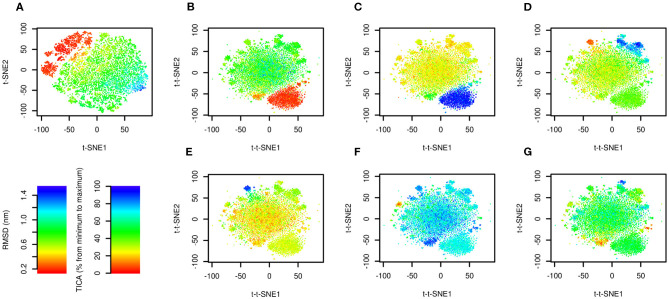
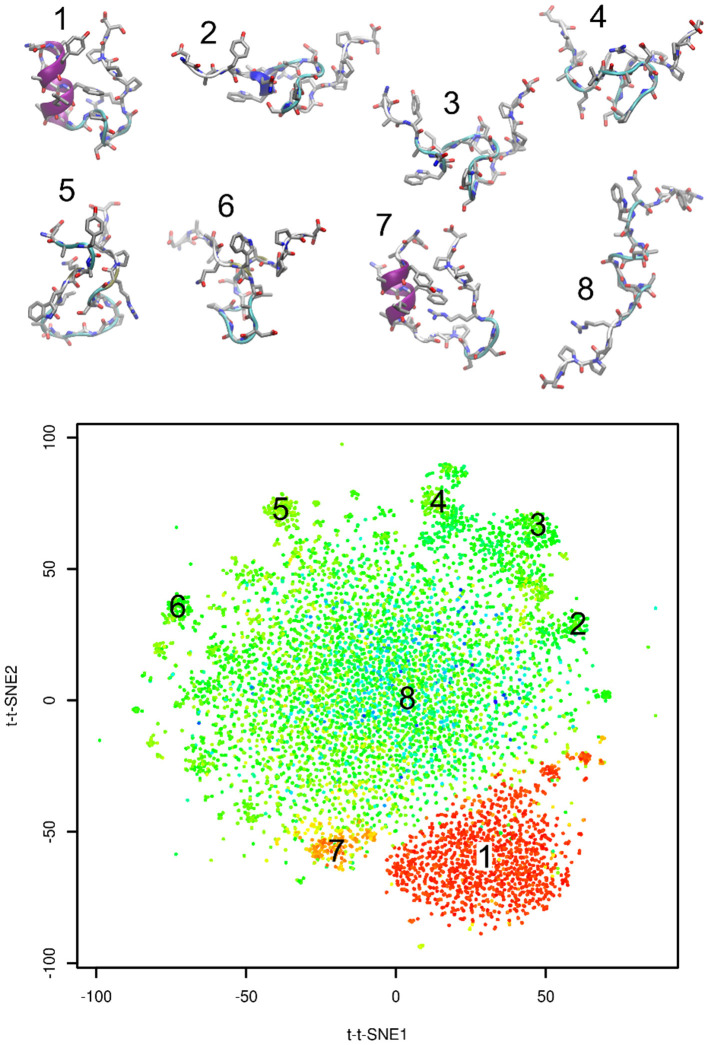
Molecular simulation trajectories represent high-dimensional data. Such data can be visualized by methods of dimensionality reduction. Non-linear dimensionality reduction methods are likely to be more efficient than linear ones due to the fact that motions of atoms are non-linear. Here we test a popular non-linear t-distributed Stochastic Neighbor Embedding (t-SNE) method on analysis of trajectories of 200 ns alanine dipeptide dynamics and 208 μs Trp-cage folding and unfolding. Furthermore, we introduce a time-lagged variant of t-SNE in order to focus on rarely occurring transitions in the molecular system. This time-lagged t-SNE efficiently separates states according to distance in time. Using this method it is possible to visualize key states of studied systems (e.g., unfolded and folded protein) as well as possible kinetic traps using a two-dimensional plot. Time-lagged t-SNE is a visualization method and other applications, such as clustering and free energy modeling, must be done with caution.
分子模拟轨迹代表高维数据。此类数据可通过降维方法进行可视化。由于原子运动是非线性的,非线性降维方法可能比线性方法更有效。在此,我们测试了一种流行的非线性t分布随机邻域嵌入(t-SNE)方法,用于分析200纳秒丙氨酸二肽动力学轨迹和208微秒色氨酸笼状蛋白折叠与解折叠轨迹。此外,我们引入了t-SNE的时间滞后变体,以便关注分子系统中很少发生的转变。这种时间滞后t-SNE能根据时间上的距离有效地分离状态。使用该方法,可以通过二维图可视化所研究系统的关键状态(例如,未折叠和折叠的蛋白质)以及可能的动力学陷阱。时间滞后t-SNE是一种可视化方法,在进行其他应用(如聚类和自由能建模)时必须谨慎。