Amankwaah Collins, Li Jianrong, Lee Jaesung, Pascall Melvin A
Department of Food Science and Technology, The Ohio State University, 2015 Fyffe Road, Columbus, Ohio, USA.
Department of Veterinary Biosciences, The Ohio State University, 1925 Coffey Road, Columbus, Ohio, USA.
Int J Food Sci. 2020 Jul 2;2020:3941924. doi: 10.1155/2020/3941924. eCollection 2020.
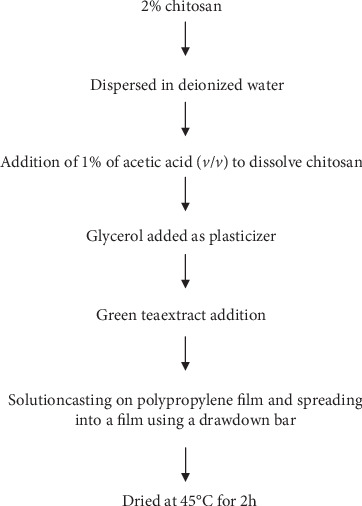
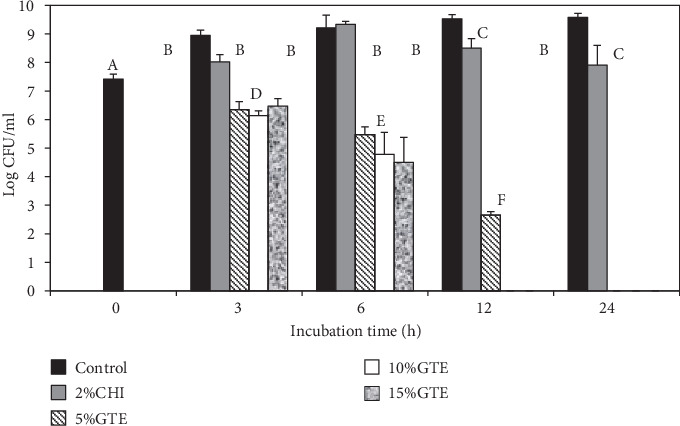
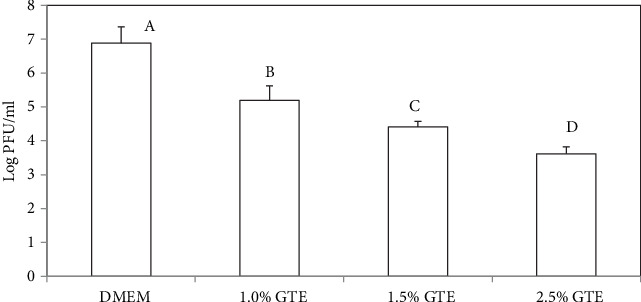
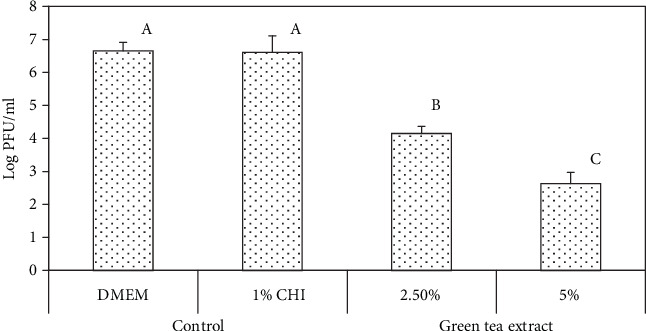
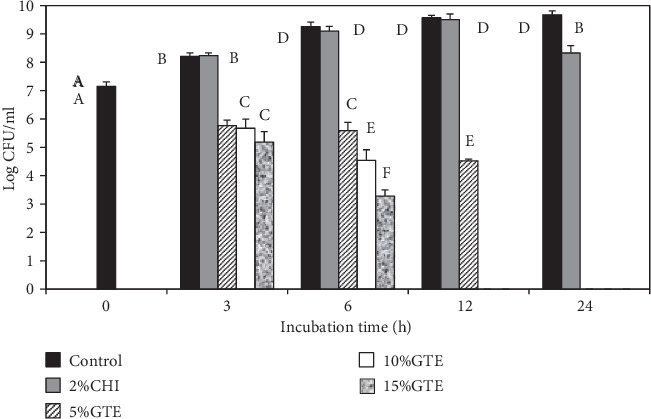
Edible films can be designed to serve as carriers of antimicrobial agents and be used to control pathogenic foodborne viruses and bacteria. This research tested this concept by dissolving green tea extract (GTE) in chitosan film-forming solutions (FFS) and using it to prepare dried chitosan edible films. As a control, the GTE was also dissolved in deionized water (DW). The FFS and the dried chitosan films with the GTE and the DW without chitosan were all evaluated against murine norovirus (MNV-1), K12, and . Both the FFS and the DW with GTE were incubated with ~10 PFU/ml of the virus suspensions for 3 h. The chitosan films with GTE were incubated for 4 and 24 h at 23 ± 1°C. The results showed that the DW containing 1, 1.5, and 2.5% aqueous GTE, significantly ( < 0.05) reduced MNV-1 plaques by 1.7, 2.5, and 3.3 logs after 3 h exposure, respectively. Similarly, FFS containing 2.5 and 5.0% GTE reduced MNV-1 counts by 2.5 and 4.0 logs, respectively, after 3 h exposure. The dried chitosan films with 5, 10, and 15% GTE were also effective against MNV-1 infectivity. After 24 h incubation, the 5 and 10% chitosan GTE films produced significant ( < 0.05) titer reductions of 1.6 and 4.5 logs, respectively. Chitosan films containing 15% GTE reduced MNV-1 plaques to undetectable levels in 24 h. All chitosan GTE films reduced . K12 and . populations to undetectable levels in tryptic soy broth after 24 h exposure. The results of this study showed that edible films enriched with GTE have potential to reduce both foodborne viruses and bacteria.
可食用薄膜可以设计成抗菌剂的载体,用于控制食源性病原体病毒和细菌。本研究通过将绿茶提取物(GTE)溶解在壳聚糖成膜溶液(FFS)中,并用于制备干燥的壳聚糖可食用薄膜,来验证这一概念。作为对照,GTE也溶解在去离子水(DW)中。对含有GTE的FFS、干燥的壳聚糖薄膜以及不含壳聚糖的含有GTE的DW,均针对鼠诺如病毒(MNV-1)、K12和[此处原文缺失一种细菌名称]进行了评估。将含有GTE的FFS和DW与约10 PFU/ml的病毒悬液孵育3小时。将含有GTE的壳聚糖薄膜在23±1°C下孵育4小时和24小时。结果表明,含有1%、1.5%和2.5%水相GTE的DW在暴露3小时后,分别显著(<0.05)降低MNV-1噬斑数1.7、2.5和3.3个对数级。同样,含有2.5%和5.0%GTE的FFS在暴露3小时后,分别降低MNV-1数量2.5和4.0个对数级。含有5%、10%和15%GTE的干燥壳聚糖薄膜对MNV-1感染性也有效。孵育24小时后,5%和10%壳聚糖GTE薄膜分别显著(<0.05)降低滴度1.6和4.5个对数级。含有15%GTE的壳聚糖薄膜在24小时内将MNV-1噬斑数降低到无法检测的水平。所有壳聚糖GTE薄膜在暴露24小时后,均将K12和[此处原文缺失一种细菌名称]数量降低到胰蛋白胨大豆肉汤中无法检测的水平。本研究结果表明,富含GTE的可食用薄膜有潜力减少食源性病毒和细菌。