Xu Liangliang, Xiang Mengmeng, Zhu Wei, Zhang Mengjie, Chen Hua, Huang Jin, Chen Youhua, Chang Qing, Jiang Jianping, Zhu Lifeng
Chengdu Institute of Biology, Chinese Academy of Sciences, Chengdu, China.
College of Life Sciences, Nanjing Normal University, Nanjing, China.
mSystems. 2020 Jul 28;5(4):e00626-20. doi: 10.1128/mSystems.00626-20.
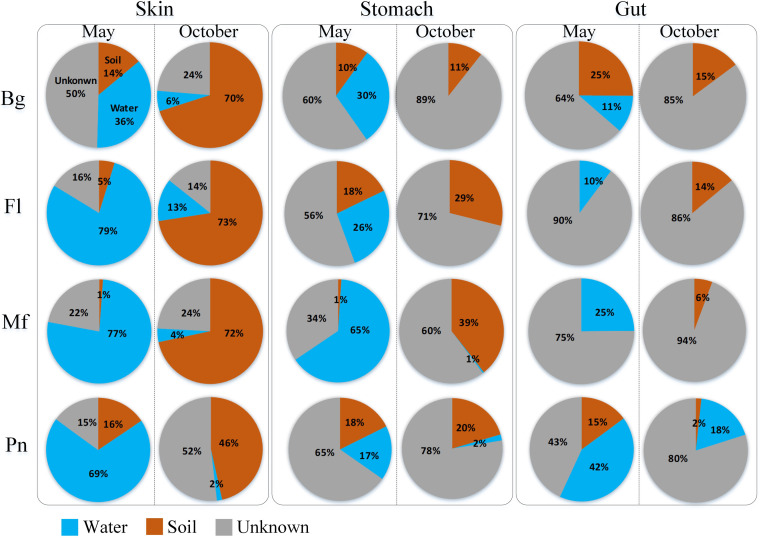
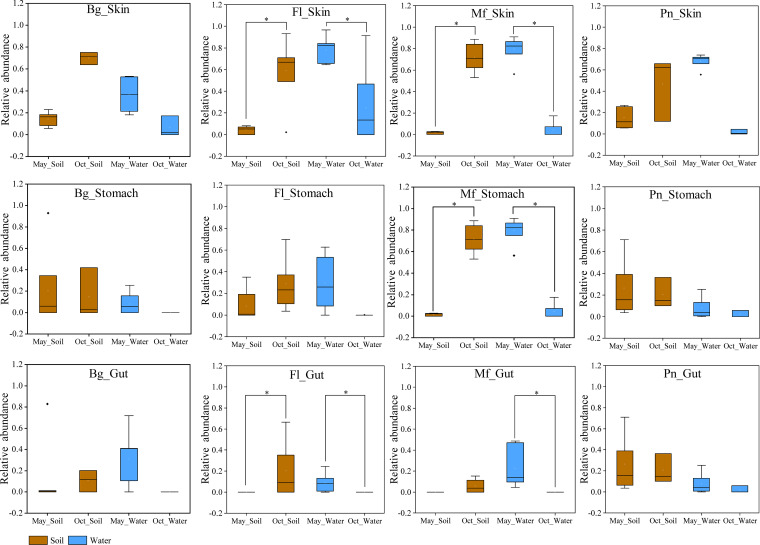
Seasonal dynamics in symbiotic microbiomes have been investigated in a number of vertebrates and are mainly caused by changes in the diet (in the gut microbiome) or the living environment (in the skin microbiome). Most amphibian microbiome studies focus on the skin, whereas internal microbiome structure and dynamics are often overlooked. The present study investigated the seasonal dynamics in three types of symbiotic microbiomes (the skin, stomach, and gut) across four wild frog species, belonging to different families, in May and October. The frogs harbored more water source microbes in May than in October. On the contrary, the frogs harbored more soil source microbes in October than in May. The frog species investigated tend to live in a water environment in May to maintain body surface humidity at high environmental temperatures and to breed. In October, these four species prefer to live on the land, as the environmental temperature decreases, to prepare for hibernation in caves or under stones. Thus, seasonal changes in the wild amphibian symbiotic microbiome may be caused by the difference in microbe transmission from their living environment due to specific behaviors. This study demonstrated that the behavior and living environment of wild amphibians shape their symbiotic microbiome externally (on the skin) and internally (in the stomach and gut). We revealed the potential association between specific behaviors in poikilothermic animals and host symbiotic microbiomes. Understanding the interactions between host behavior and microbiome dynamics remains an outstanding priority in the field of microbial ecology. Here, we provide the reader with a simple example of how the behavior and living environment of wild amphibians shape their symbiotic microbiome externally (on the skin) and internally (in the stomach and gut).
共生微生物群的季节性动态已在多种脊椎动物中得到研究,主要是由饮食变化(在肠道微生物群中)或生活环境变化(在皮肤微生物群中)引起的。大多数两栖动物微生物群研究集中在皮肤,而内部微生物群的结构和动态往往被忽视。本研究调查了5月和10月四种不同科的野生蛙类三种共生微生物群(皮肤、胃和肠道)的季节性动态。蛙类在5月比10月含有更多的水源微生物。相反,蛙类在10月比5月含有更多的土壤源微生物。被调查的蛙类物种在5月倾向于生活在水环境中,以在高环境温度下维持体表湿度并进行繁殖。在10月,随着环境温度下降,这四个物种更喜欢生活在陆地上,为在洞穴或石头下冬眠做准备。因此,野生两栖动物共生微生物群的季节性变化可能是由于特定行为导致其生活环境中微生物传播的差异引起的。本研究表明,野生两栖动物的行为和生活环境在外部(皮肤)和内部(胃和肠道)塑造了它们的共生微生物群。我们揭示了变温动物的特定行为与宿主共生微生物群之间的潜在关联。了解宿主行为与微生物群动态之间的相互作用仍然是微生物生态学领域的一个突出重点。在这里,我们为读者提供一个简单的例子,说明野生两栖动物的行为和生活环境如何在外部(皮肤)和内部(胃和肠道)塑造它们的共生微生物群。