Department of Biomedical Sciences and Human Oncology, University of Bari Aldo Moro Medical School, Piazza G. Cesare 11, I-70124 Bari, Italy.
Mediators Inflamm. 2020 Jul 16;2020:7527953. doi: 10.1155/2020/7527953. eCollection 2020.
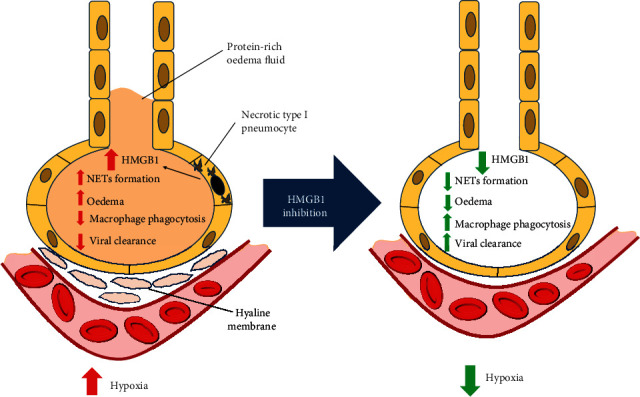
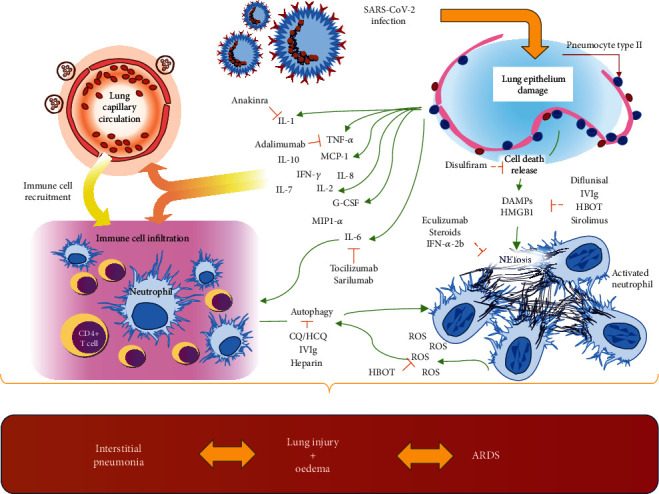
COVID-19 is a pandemic disease caused by the new coronavirus SARS-CoV-2 that mostly affects the respiratory system. The consequent inflammation is not able to clear viruses. The persistent excessive inflammatory response can build up a clinical picture that is very difficult to manage and potentially fatal. Modulating the immune response plays a key role in fighting the disease. One of the main defence systems is the activation of neutrophils that release neutrophil extracellular traps (NETs) under the stimulus of autophagy. Various molecules can induce NETosis and autophagy; some potent activators are damage-associated molecular patterns (DAMPs) and, in particular, the high-mobility group box 1 (HMGB1). This molecule is released by damaged lung cells and can induce a robust innate immunity response. The increase in HMGB1 and NETosis could lead to sustained inflammation due to SARS-CoV-2 infection. Therefore, blocking these molecules might be useful in COVID-19 treatment and should be further studied in the context of targeted therapy.
新型冠状病毒(SARS-CoV-2)引发的 COVID-19 是一种主要影响呼吸系统的大流行疾病。由此产生的炎症无法清除病毒。持续过度的炎症反应可能会导致一种非常难以控制且可能致命的临床症状。调节免疫反应在对抗这种疾病方面起着关键作用。其中一个主要的防御系统是中性粒细胞的激活,中性粒细胞在自噬的刺激下释放中性粒细胞胞外陷阱(NETs)。许多分子可以诱导 NETosis 和自噬;一些有效的激活剂是损伤相关分子模式(DAMPs),特别是高迁移率族蛋白 B1(HMGB1)。这种分子是由受损的肺细胞释放的,可以诱导强烈的先天免疫反应。由于 SARS-CoV-2 感染,HMGB1 和 NETosis 的增加可能导致持续的炎症。因此,阻断这些分子可能对 COVID-19 的治疗有用,应该在靶向治疗的背景下进一步研究。