College of pharmacy, Nanjing University of Chinese Medicine, Nanjing 210023, China.
Department of Pharmacy, the Affiliated Suzhou Hospital of Nanjing Medical University, Suzhou 215002, China.
Theranostics. 2020 Jul 9;10(18):8162-8178. doi: 10.7150/thno.45088. eCollection 2020.
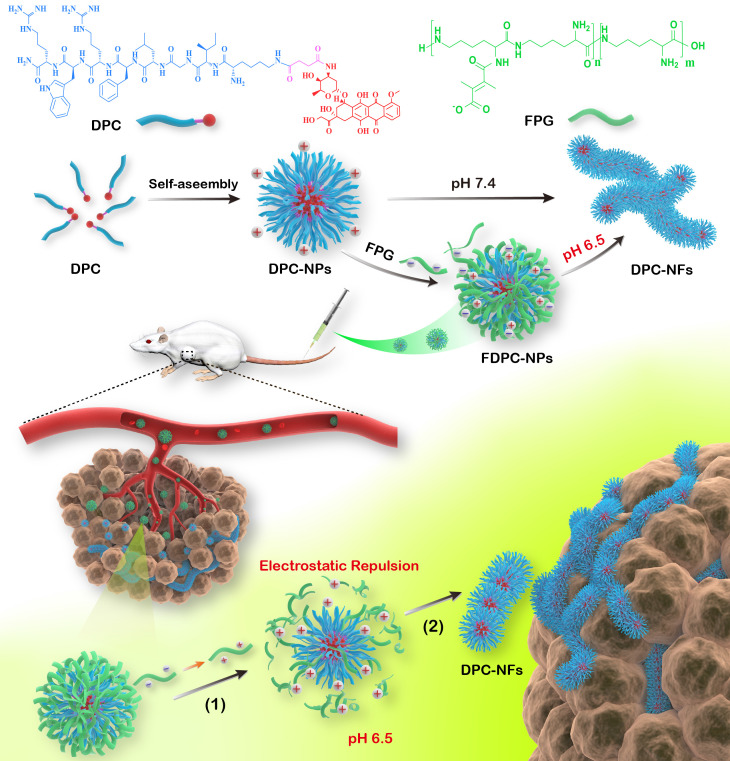
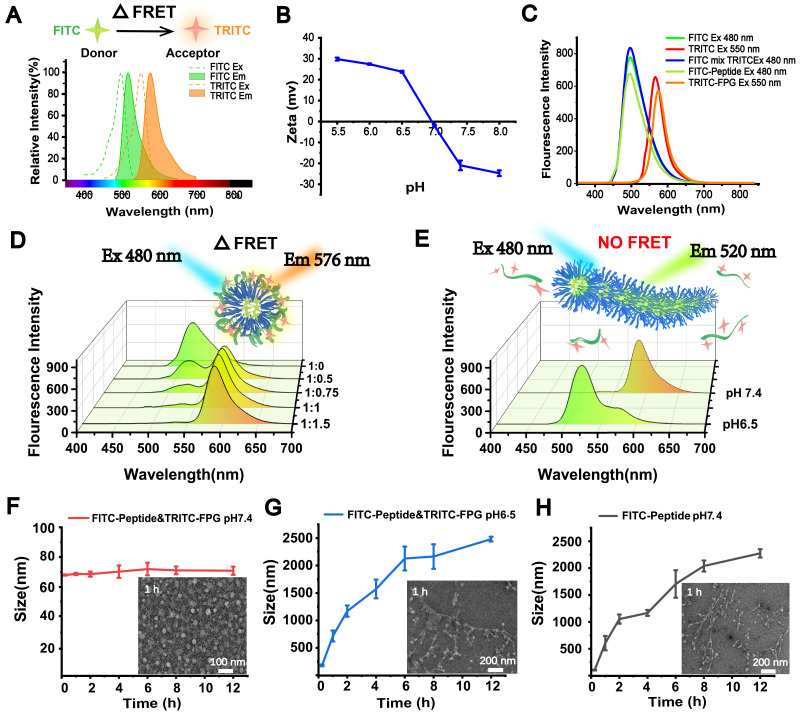
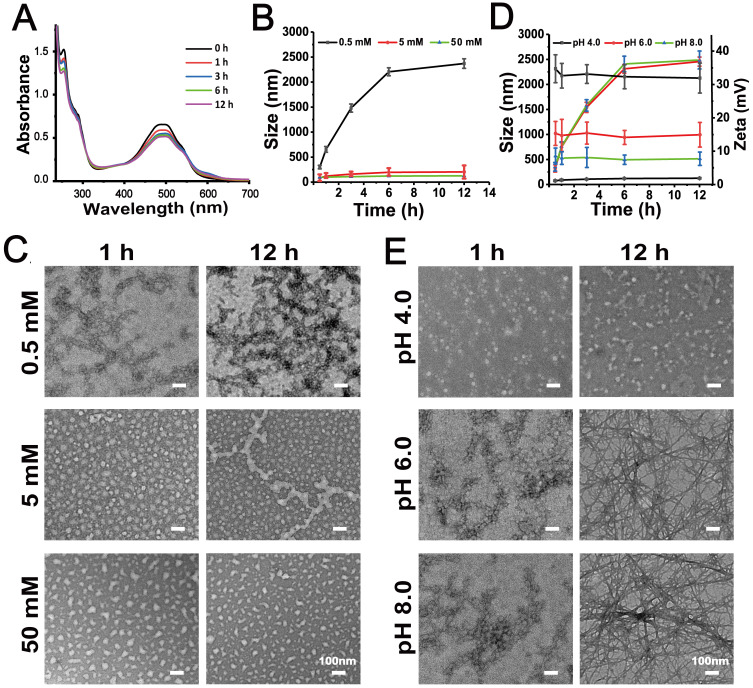
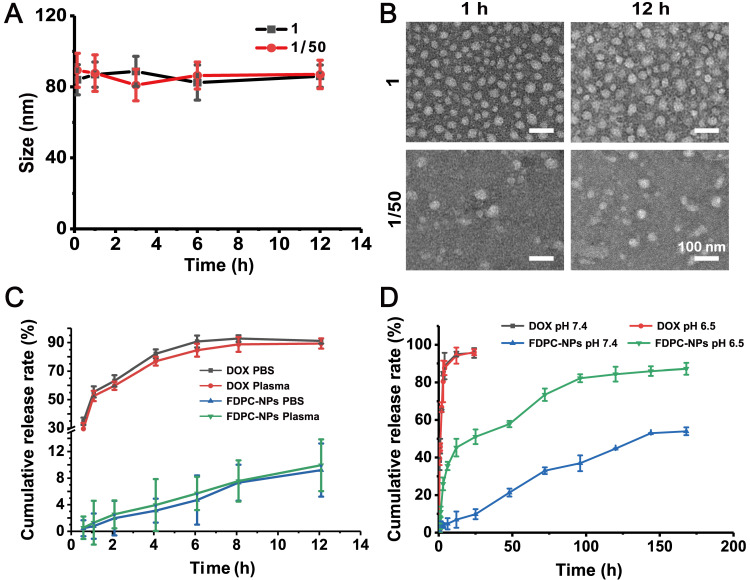
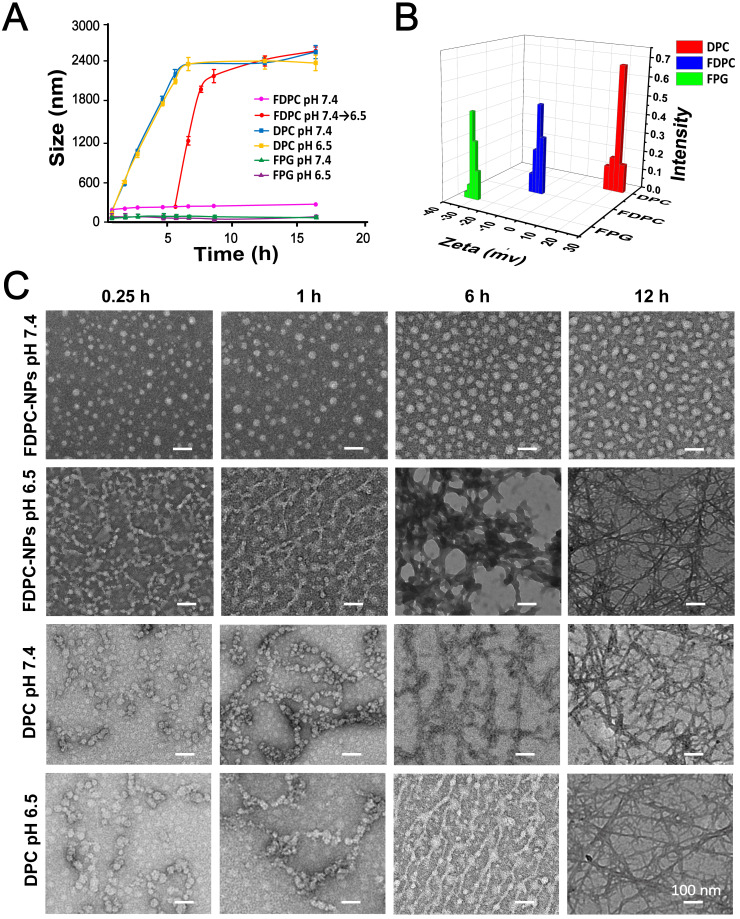
Both spatial accuracy and temporal persistence are crucial in drug delivery, especially for anti-tumor intravenous nanomedicines, which have limited persistence due to their small particle sizes and easy removal from tumors. The present study takes advantage of morphological transformation strategy to regulate intravenous nanomedicines to display different sizes in different areas, achieving high efficient enrichment and long retention in lesions. We designed and synthesized functional doxorubicin-peptide conjugate nanoparticles (FDPC-NPs) consisting of self-assembled doxorubicin-peptide conjugates (DPCs) and an acidic-responsive shielding layer named the functional polylysine graft (FPG), which can regulate the assembly morphology of the DPCs from spherical DPC nanoparticles (DPC-NPs) to DPC-nanofibers (DPC-NFs) by preventing the assembly force from π-π stacking and hydrogen bond between the DPC-NPs. The morphology transformation and particle changes of FDPC-NPs in different environments were determined with DLS, TEM and SEM. We used FRET to explore the enhanced retention effect of FDPC-NPs in tumor site . HPLC-MS/MS analytical method was established to analyze the biodistribution of FDPC-NPs in H22 hepatoma xenograft mouse model. Finally, the antitumor effect and safety of FDPC-NPs was evaluated. The FDPC-NPs were stable in blood circulation and responsively self-assembled into DPC-NFs when the FDPC-NPs underwent the acid-sensitive separation of the shielding layer in a mildly acidic microenvironment. The FDPC-NPs maintained a uniform spherical size of 80 nm and exhibited good morphological stability in neutral aqueous solution (pH 7.4) but aggregated into a long necklace-like chain structure or a crosslinked fiber structure over time in a weakly acidic solution (pH 6.5). These acidity-triggered transformable FDPC-NPs prolonged the accumulation in tumor tissue for more than 5 days after a single injection and improved the relative uptake rate of doxorubicin in tumors 31-fold. As a result, FDPC-NPs exhibited a preferable anti-tumor efficacy and a reduced side effect compared with free DOX solution and DOX liposomes. Morphology-transformable FDPC-NPs represent a promising therapeutic approach for prolonging the residence time of drugs at the target site to reduce side effect and enhance therapeutic efficacy. Our studies provide a new and simple idea for the design of long-term delivery systems for intravenous chemotherapeutic drugs.
在药物输送中,空间精度和时间持久性都至关重要,特别是对于抗肿瘤静脉纳米药物,由于其粒径小且易于从肿瘤中清除,因此持久性有限。本研究利用形态转变策略来调节静脉纳米药物,使其在不同区域显示不同的大小,从而实现高效富集和长时间保留在病变部位。我们设计并合成了由自组装阿霉素肽缀合物(DPCs)组成的功能阿霉素肽缀合物纳米粒(FDPC-NPs),并具有一种酸性响应性屏蔽层,称为功能聚赖氨酸接枝(FPG),可通过阻止组装力来调节 DPC 的组装形态从球形 DPC 纳米粒(DPC-NPs)到 DPC-纳米纤维(DPC-NFs)。通过 DLS、TEM 和 SEM 确定了 FDPC-NPs 在不同环境中的形态转变和颗粒变化。我们使用 FRET 来研究 FDPC-NPs 在肿瘤部位的增强保留效果。建立了 HPLC-MS/MS 分析方法来分析 FDPC-NPs 在 H22 肝癌异种移植小鼠模型中的生物分布。最后,评估了 FDPC-NPs 的抗肿瘤作用和安全性。FDPC-NPs 在血液循环中稳定,并且当 FDPC-NPs 在轻度酸性微环境中经历屏蔽层的酸敏感分离时,自组装成 DPC-NFs。FDPC-NPs 在中性水溶液(pH7.4)中保持均匀的球形尺寸为 80nm,并表现出良好的形态稳定性,但随着时间的推移,在弱酸性溶液(pH6.5)中聚集成长项链状链结构或交联纤维结构。这些酸度触发的可变形 FDPC-NPs 使药物在单次注射后在肿瘤组织中的积累时间延长了 5 天以上,并使肿瘤中阿霉素的相对摄取率提高了 31 倍。结果,FDPC-NPs 与游离 DOX 溶液和 DOX 脂质体相比,表现出更好的抗肿瘤疗效和降低的副作用。形态可变形 FDPC-NPs 代表了一种有前途的治疗方法,可延长药物在靶部位的停留时间,以减少副作用并增强治疗效果。我们的研究为设计静脉化疗药物的长效递送系统提供了一个新的简单思路。