Conway Marie C, McSorley Emeir M, Mulhern Maria S, Spence Toni, Wijngaarden Edwin van, Watson Gene E, Wahlberg Karin, Pineda Daniela, Broberg Karin, Hyland Barry W, Cobice Diego F, Strain J J, Yeates Alison J
Nutrition Innovation Centre for Food and Health (NICHE), School of Biomedical Sciences, Ulster University, Cromore Road, Coleraine, BT52 1SA, Northern Ireland, UK.
School of Medicine and Dentistry, University of Rochester, Rochester, USA.
Eur J Nutr. 2021 Apr;60(3):1415-1427. doi: 10.1007/s00394-020-02326-w. Epub 2020 Jul 28.
Long-chain polyunsaturated fatty acids (LCPUFA) can be synthesised endogenously from linoleic acid (LA) and α-linolenic acid (ALA) in a pathway involving the fatty acid desaturase (FADS) genes. Endogenous synthesis is inefficient; therefore, dietary intake of preformed LCPUFA from their richest source of fish is preferred. This study investigated the effect of fish consumption on PUFA concentrations in women of childbearing age while stratifying by FADS genotype. The influence of fish consumption on lipid profile, and markers of inflammation and oxidative stress was also examined.
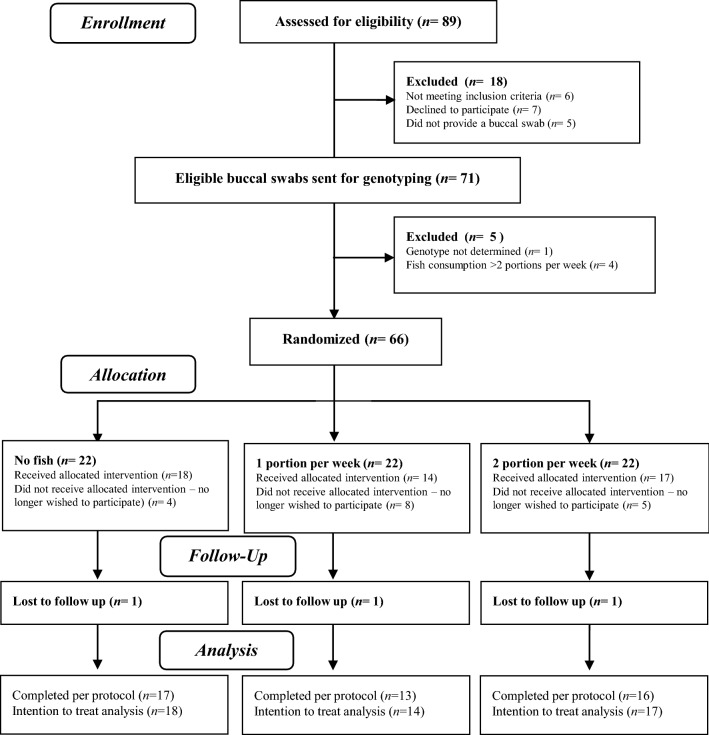
Healthy women (n = 49) provided a buccal swab which was analysed for FADS2 genotype (rs3834458; T/deletion). Participants were stratified according to genotype and randomised to an intervention group to receive either no fish (n = 18), 1 portion (n = 14) or 2 portions (n = 17) (140 g per portion) of fish per week for a period of 8 weeks. Serum PUFA was analysed at baseline and post-intervention. Lipid profile, and markers of inflammation and oxidative stress were also analysed.
Participants consuming 2 portions of fish per week had significantly higher concentrations of eicosapentaenoic acid (EPA), docosahexaenoic acid (DHA) and total n-3 PUFA, and a lower n-6:n-3 ratio compared to those in the no fish or 1 portion per week group (all p < 0.05). Fish consumption did not have a significant effect on biomarkers of oxidative stress, inflammation and lipid profile in the current study.
Consumption of 2 portions of fish per week has beneficial effects on biological n-3 PUFA concentrations in women of childbearing age; however, no effects on oxidative stress, inflammation or lipid profile were observed. This trial was registered at www.clinicaltrials.gov (NCT03765580), registered December 2018.
长链多不饱和脂肪酸(LCPUFA)可由亚油酸(LA)和α-亚麻酸(ALA)通过涉及脂肪酸去饱和酶(FADS)基因的途径内源性合成。内源性合成效率低下;因此,从最丰富的鱼类来源中通过饮食摄入预制的LCPUFA更为可取。本研究调查了鱼类消费对育龄妇女多不饱和脂肪酸(PUFA)浓度的影响,并按FADS基因型进行分层。还研究了鱼类消费对脂质谱、炎症和氧化应激标志物的影响。
49名健康女性提供颊拭子,用于分析FADS2基因型(rs3834458;T/缺失)。参与者根据基因型分层,并随机分为干预组,分别为每周不食用鱼类(n = 18)、食用1份(n = 14)或2份(n = 17)(每份140克)鱼类,为期8周。在基线和干预后分析血清PUFA。还分析了脂质谱、炎症和氧化应激标志物。
与每周不食用鱼类或食用1份鱼类的组相比,每周食用2份鱼类的参与者的二十碳五烯酸(EPA)、二十二碳六烯酸(DHA)和总n-3多不饱和脂肪酸浓度显著更高,n-6:n-3比值更低(所有p < 0.05)。在本研究中,鱼类消费对氧化应激、炎症和脂质谱的生物标志物没有显著影响。
每周食用2份鱼类对育龄妇女的生物n-3多不饱和脂肪酸浓度有有益影响;然而,未观察到对氧化应激、炎症或脂质谱的影响。该试验已在www.clinicaltrials.gov注册(NCT03765580),于2018年12月注册。