Waterhouse David M, Espirito Janet L, Chioda Marc D, Baidoo Bismark, Mardekian Jack, Robert Nicholas J, Masters Elizabeth T
Oncology Hematology Care/The US Oncology Network, 5053 Wooster Rd, Cincinnati, OH, 45226, USA.
McKesson Life Sciences, 10101 Woodloch Forest, The Woodlands, TX, 77380, USA.
Drugs Real World Outcomes. 2020 Dec;7(4):261-269. doi: 10.1007/s40801-020-00207-6.
Data are sparse concerning the sequential use of multiple anaplastic lymphoma kinase (ALK) inhibitors for ALK-positive locally advanced or metastatic non-small cell lung cancer (NSCLC).
This study investigated sequencing and outcomes among patients receiving multiple ALK inhibitors.
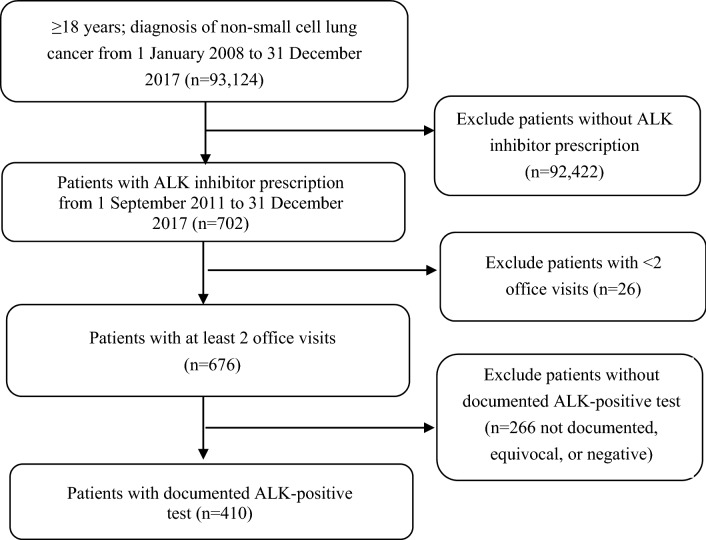
This was a retrospective observational cohort study of adult patients with ALK-positive NSCLC treated with available first- and second-generation ALK inhibitors from 1 September 2011 to 31 December 2017. Duration of therapy (DOT) and overall survival (OS) were assessed with the Kaplan-Meier method. A multivariable linear regression analysis was performed to assess if DOT with a preceding ALK inhibitor was predictive of DOT for subsequent ALK inhibitor treatments.
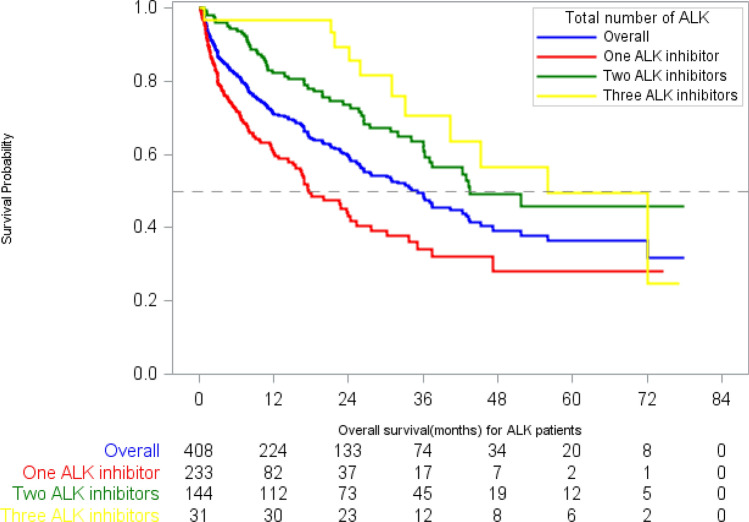
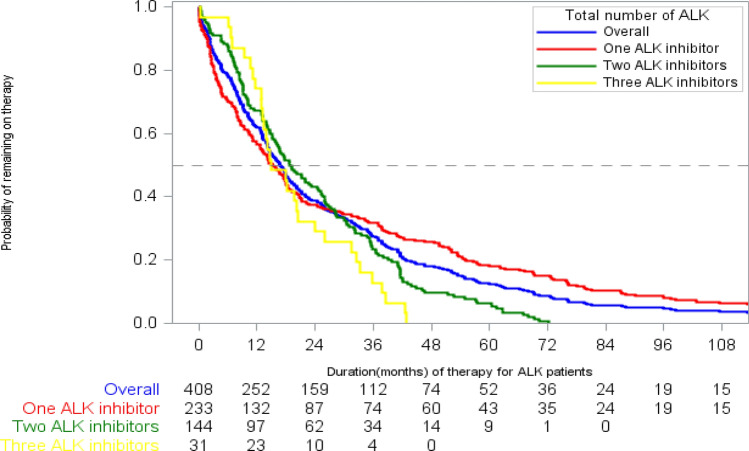
A total of 410 patients were analyzed: 57% received 1 ALK inhibitor; 35%, 2 ALK inhibitors; and 8%, 3-4 ALK inhibitors. Among those receiving > 1 ALK inhibitor (n = 177), 60% received a crizotinib-led sequence and 39% an alectinib-led sequence. Nearly 60% of the overall population received chemotherapy prior to their first ALK inhibitor. Median OS for the study population was 28 months, 15 months in patients who received 1 ALK inhibitor, 42 months in patients who received 2 ALK inhibitors, and 56 months in patients who received 3-4 ALK inhibitors. Longer DOT of the first ALK inhibitor was associated with increased DOT of the second (p < 0.0001), and longer DOT of the second ALK inhibitor was associated with increased DOT of the third (p < 0.0001).
This study provides initial information on real-world treatment patterns following the introduction of new ALK inhibitors, and supports the use of sequential ALK therapies.
关于间变性淋巴瘤激酶(ALK)阳性的局部晚期或转移性非小细胞肺癌(NSCLC)序贯使用多种ALK抑制剂的数据较少。
本研究调查了接受多种ALK抑制剂治疗的患者的用药顺序及治疗结果。
这是一项回顾性观察队列研究,研究对象为2011年9月1日至2017年12月31日期间接受可用的第一代和第二代ALK抑制剂治疗的ALK阳性NSCLC成年患者。采用Kaplan-Meier法评估治疗持续时间(DOT)和总生存期(OS)。进行多变量线性回归分析,以评估前一种ALK抑制剂的DOT是否可预测后续ALK抑制剂治疗的DOT。
共分析了410例患者:57%接受1种ALK抑制剂治疗;35%接受2种ALK抑制剂治疗;8%接受3 - 4种ALK抑制剂治疗。在接受>1种ALK抑制剂治疗的患者(n = 177)中,60%接受以克唑替尼为主的用药顺序,39%接受以阿来替尼为主的用药顺序。近60%的总体人群在首次使用ALK抑制剂之前接受过化疗。研究人群的中位OS为28个月,接受1种ALK抑制剂治疗的患者为15个月,接受2种ALK抑制剂治疗的患者为42个月,接受3 - 4种ALK抑制剂治疗的患者为56个月。第一种ALK抑制剂的DOT较长与第二种ALK抑制剂的DOT增加相关(p < 0.0001),第二种ALK抑制剂的DOT较长与第三种ALK抑制剂的DOT增加相关(p < 0.0001)。
本研究提供了关于新ALK抑制剂引入后真实世界治疗模式的初步信息,并支持序贯使用ALK疗法。