Department of Epidemiology, Care and Public Health Research Institute (CAPHRI).
Department of Epidemiology, GROW-School for Oncology and Developmental Biology, Maastricht University Medical Center+, Maastricht, The Netherlands.
Carcinogenesis. 2020 Oct 15;41(10):1368-1384. doi: 10.1093/carcin/bgaa080.
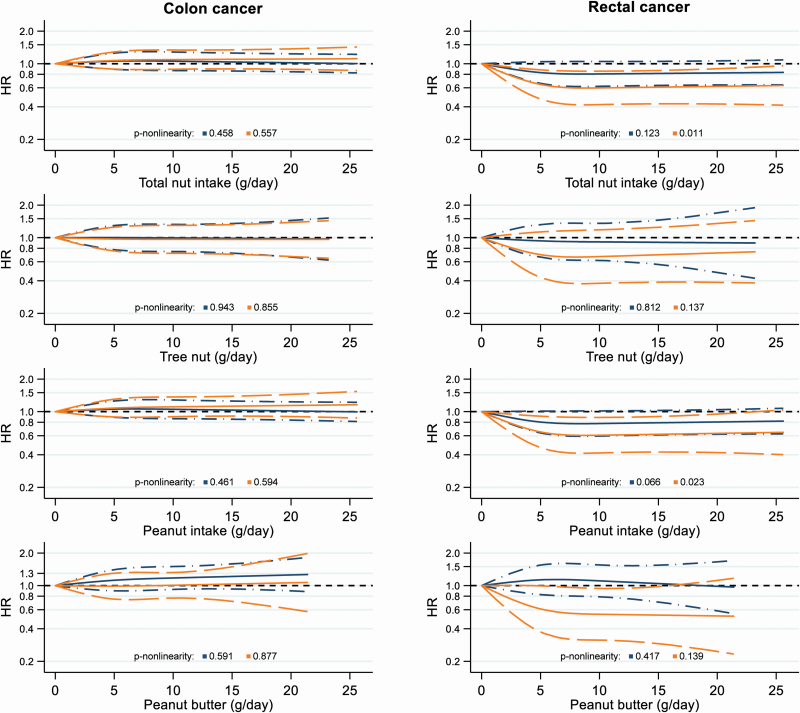
Nut intake has been associated with reduced total cancer-related mortality, but evidence for colorectal cancer (CRC) risk is inconclusive. We investigated the associations between nut and peanut butter intake and anatomical CRC subtypes. To account for molecular heterogeneity, associations between nut and peanut butter intake and colorectal tumors harboring APC, KRAS or BRAF mutations, p53 overexpression or microsatellite instability were examined in secondary analyses. In the Netherlands Cohort Study (n = 120 852), lifestyle habits were measured with a questionnaire in 1986. After 20.3 years follow-up, 3567 CRC cases were included in case-cohort analyses. For the analyses of molecular CRC subtypes, 574 cases were included after 7.3 years follow-up. In categorical analyses, total nut intake was not significantly associated with CRC [HR (95% CI) 10+ g/day versus non-consumers = 0.94(0.78-1.15) in men; 0.96(0.75-1.22) in women]. In restricted cubic spline analyses, significant non-linear inverse associations with rectal cancer were observed for total nut, peanut and peanut butter intake in women, and borderline significant non-linear inverse associations for total nut and peanut intake in men. Regarding the molecular CRC subtypes, peanut butter intake was significantly associated with an increased risk of colorectal tumors that did not develop through the serrated neoplasia pathway in men [HR (95% CI) per 5 g/day increment = 1.22(1.07-1.38)]. Nut and peanut butter intake are non-linearly inversely associated with rectal cancer risk in women. In men, nut intake is borderline significantly non-linearly associated with a reduced rectal cancer risk. Peanut butter is associated with an increased risk of colorectal tumors that do not develop through the serrated neoplasia pathway in men.
坚果摄入与总癌症相关死亡率降低有关,但结直肠癌(CRC)风险的证据尚无定论。我们研究了坚果和花生酱摄入与解剖 CRC 亚型之间的关联。为了考虑分子异质性,在二次分析中,还检查了坚果和花生酱摄入与结直肠肿瘤中 APC、KRAS 或 BRAF 突变、p53 过表达或微卫星不稳定性相关的关联。在荷兰队列研究(n = 120852)中,1986 年使用问卷测量了生活方式习惯。在 20.3 年的随访后,3567 例 CRC 病例纳入病例对照分析。对于分子 CRC 亚型的分析,在 7.3 年的随访后,纳入了 574 例病例。在分类分析中,总坚果摄入量与 CRC 无显著相关性[HR(95%CI)10+ g/天与非消费者=男性 0.94(0.78-1.15);女性 0.96(0.75-1.22)]。在限制三次样条分析中,女性总坚果、花生和花生酱摄入量与直肠癌呈显著非线性反比关系,男性总坚果和花生摄入量与直肠癌呈边缘显著非线性反比关系。关于分子 CRC 亚型,男性中,花生酱摄入量与非锯齿状肿瘤发生途径发展的结直肠肿瘤风险呈显著正相关[HR(95%CI)每增加 5 克/天=1.22(1.07-1.38)]。坚果和花生酱摄入与女性直肠癌风险呈非线性反比关系。在男性中,坚果摄入量与直肠癌风险呈边缘显著非线性反比关系。花生酱与非锯齿状肿瘤发生途径发展的结直肠肿瘤风险增加相关。