Bayraktar Gonca, Yuanxiang PingAn, Confettura Alessandro D, Gomes Guilherme M, Raza Syed A, Stork Oliver, Tajima Shoji, Suetake Isao, Karpova Anna, Yildirim Ferah, Kreutz Michael R
RG Neuroplasticity, Leibniz Institute for Neurobiology, Brenneckestr. 6, 39118, Magdeburg, Germany.
UK Dementia Research Institute at the University of Cambridge, Island Research Building, Cambridge Biomedical Campus, University of Cambridge, Cambridge, CB2 0AH, UK.
Neuropsychopharmacology. 2020 Nov;45(12):2120-2130. doi: 10.1038/s41386-020-0780-2. Epub 2020 Jul 29.
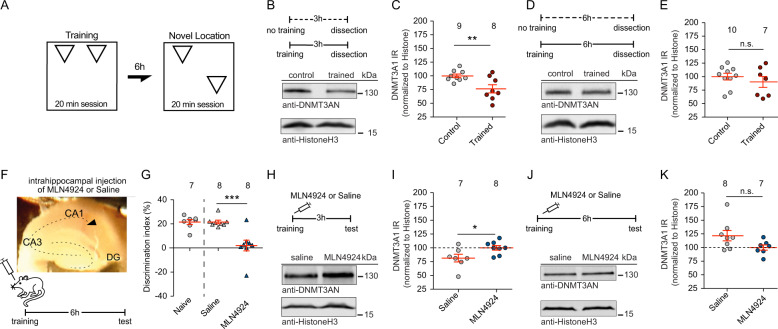
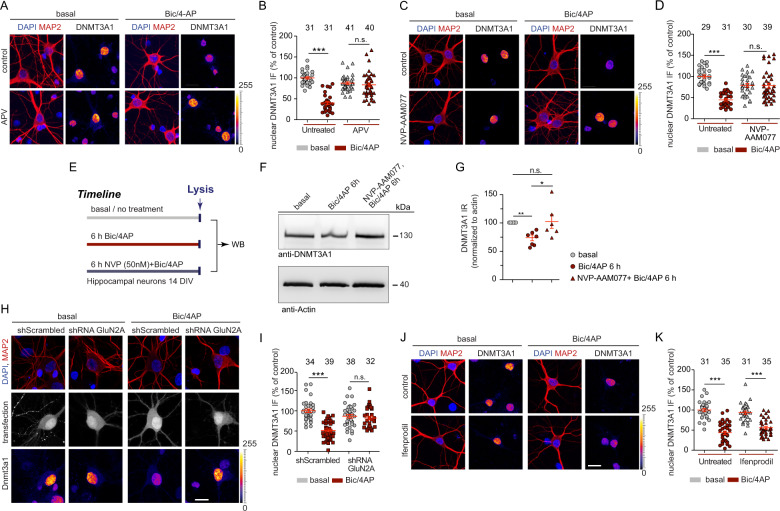
DNA methylation is a crucial epigenetic mark for activity-dependent gene expression in neurons. Very little is known about how synaptic signals impact promoter methylation in neuronal nuclei. In this study we show that protein levels of the principal de novo DNA-methyltransferase in neurons, DNMT3A1, are tightly controlled by activation of N-methyl-D-aspartate receptors (NMDAR) containing the GluN2A subunit. Interestingly, synaptic NMDARs drive degradation of the methyltransferase in a neddylation-dependent manner. Inhibition of neddylation, the conjugation of the small ubiquitin-like protein NEDD8 to lysine residues, interrupts degradation of DNMT3A1. This results in deficits in promoter methylation of activity-dependent genes, as well as synaptic plasticity and memory formation. In turn, the underlying molecular pathway is triggered by the induction of synaptic plasticity and in response to object location learning. Collectively, the data show that plasticity-relevant signals from GluN2A-containing NMDARs control activity-dependent DNA-methylation involved in memory formation.
DNA甲基化是神经元中活性依赖基因表达的关键表观遗传标记。关于突触信号如何影响神经元细胞核中的启动子甲基化,人们知之甚少。在本研究中,我们表明神经元中主要的从头DNA甲基转移酶DNMT3A1的蛋白质水平受到含有GluN2A亚基的N-甲基-D-天冬氨酸受体(NMDAR)激活的严格控制。有趣的是,突触NMDAR以一种依赖于NEDD8化的方式驱动甲基转移酶的降解。抑制NEDD8化,即小泛素样蛋白NEDD8与赖氨酸残基的缀合,会中断DNMT3A1的降解。这导致活性依赖基因的启动子甲基化缺陷,以及突触可塑性和记忆形成的缺陷。反过来,潜在的分子途径是由突触可塑性的诱导和对物体位置学习的反应触发的。总体而言,数据表明来自含有GluN2A的NMDAR的可塑性相关信号控制参与记忆形成的活性依赖DNA甲基化。