Department of Biology and Biotechnology "Charles Darwin", Sapienza University of Rome, 00185 Rome, Italy.
Department of Anatomical, Histological, Forensic Medicine and Orthopedic Sciences, Sapienza University, 00185 Rome, Italy.
Int J Mol Sci. 2020 Jul 27;21(15):5338. doi: 10.3390/ijms21155338.
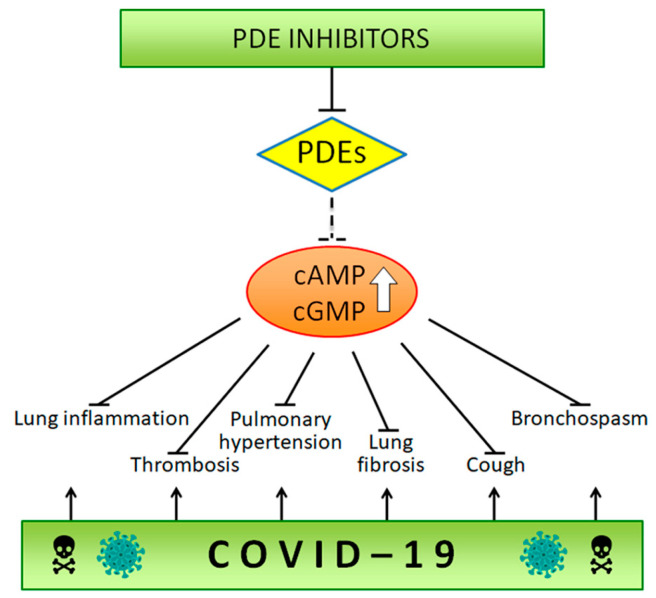
In March 2020, the World Health Organization declared the severe acute respiratory syndrome corona virus 2 (SARS-CoV2) infection to be a pandemic disease. SARS-CoV2 was first identified in China and, despite the restrictive measures adopted, the epidemic has spread globally, becoming a pandemic in a very short time. Though there is growing knowledge of the SARS-CoV2 infection and its clinical manifestations, an effective cure to limit its acute symptoms and its severe complications has not yet been found. Given the worldwide health and economic emergency issues accompanying this pandemic, there is an absolute urgency to identify effective treatments and reduce the post infection outcomes. In this context, phosphodiesterases (PDEs), evolutionarily conserved cyclic nucleotide (cAMP/cGMP) hydrolyzing enzymes, could emerge as new potential targets. Given their extended distribution and modulating role in nearly all organs and cellular environments, a large number of drugs (PDE inhibitors) have been developed to control the specific functions of each PDE family. These PDE inhibitors have already been used in the treatment of pathologies that show clinical signs and symptoms completely or partially overlapping with post-COVID-19 conditions (e.g., thrombosis, inflammation, fibrosis), while new PDE-selective or pan-selective inhibitors are currently under study. This review discusses the state of the art of the different pathologies currently treated with phosphodiesterase inhibitors, highlighting the numerous similarities with the disorders linked to SARS-CoV2 infection, to support the hypothesis that PDE inhibitors, alone or in combination with other drugs, could be beneficial for the treatment of COVID-19.
2020 年 3 月,世界卫生组织宣布严重急性呼吸系统综合征冠状病毒 2 (SARS-CoV2)感染为大流行病。SARS-CoV2 最初在中国被发现,尽管采取了限制措施,但疫情已在全球范围内蔓延,在很短的时间内成为大流行病。尽管人们对 SARS-CoV2 感染及其临床表现的了解不断增加,但尚未找到有效治愈方法来限制其急性症状和严重并发症。鉴于这种大流行带来的全球健康和经济紧急问题,绝对有必要确定有效的治疗方法并减少感染后的后果。在这种情况下,磷酸二酯酶(PDEs)作为新的潜在靶标出现。鉴于它们的广泛分布和对几乎所有器官和细胞环境的调节作用,已经开发出大量药物(PDE 抑制剂)来控制每个 PDE 家族的特定功能。这些 PDE 抑制剂已被用于治疗具有与 COVID-19 后状况完全或部分重叠的临床症状和体征的病症(例如,血栓形成、炎症、纤维化),而新的 PDE 选择性或泛选择性抑制剂目前正在研究中。这篇综述讨论了目前用磷酸二酯酶抑制剂治疗的不同病理状态的最新进展,强调了与 SARS-CoV2 感染相关的疾病之间存在许多相似之处,以支持这样一种假设,即 PDE 抑制剂单独或与其他药物联合使用可能对 COVID-19 的治疗有益。