Sistemes d'Informació dels Serveis d'Atenció Primària (SISAP), ICS, Barcelona, Catalunya, Spain.
IDIAP Jordi Gol, Universitat Autònoma de Barcelona, Barcelona, Catalunya, Spain.
BMJ Open. 2020 Jul 29;10(7):e039369. doi: 10.1136/bmjopen-2020-039369.
There is uncertainty about when the first cases of COVID-19 appeared in Spain. We aimed to determine whether influenza diagnoses masked early COVID-19 cases and estimate numbers of undetected COVID-19 cases.
Time-series study of influenza and COVID-19 cases, 2010-2020.
Primary care, Catalonia, Spain.
People registered in primary-care practices, covering >6 million people and >85% of the population.
Weekly new cases of influenza and COVID-19 clinically diagnosed in primary care.
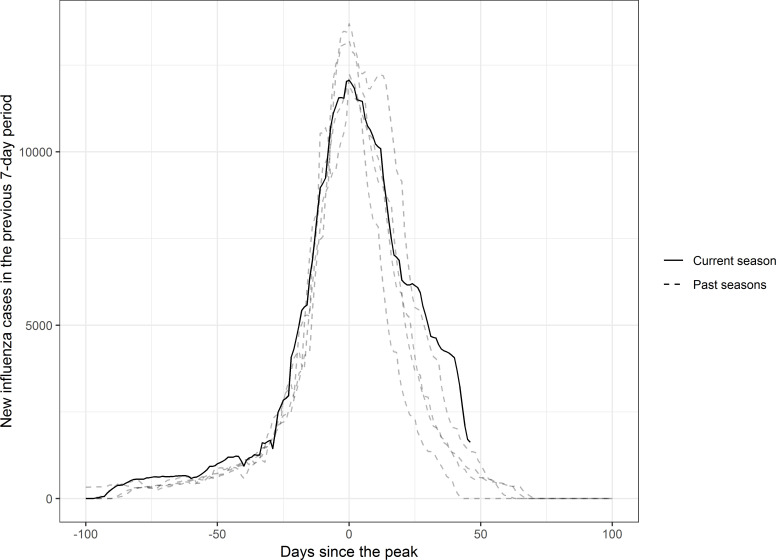
Daily counts of both cases were computed using the total cases recorded over the previous 7 days to avoid weekly effects. Epidemic curves were characterised for the 2010-2011 to 2019-2020 influenza seasons. Influenza seasons with a similar epidemic curve and peak case number as the 2019-2020 season were used to model expected case numbers with Auto Regressive Integrated Moving Average models, overall and stratified by age. Daily excess influenza cases were defined as the number of observed minus expected cases.
Four influenza season curves (2011-2012, 2012-2013, 2013-2014 and 2016-2017) were used to estimate the number of expected cases of influenza in 2019-2020. Between 4 February 2020 and 20 March 2020, 8017 (95% CI: 1841 to 14 718) excess influenza cases were identified. This excess was highest in the 15-64 age group.
COVID-19 cases may have been present in the Catalan population when the first imported case was reported on 25 February 2020. COVID-19 carriers may have been misclassified as influenza diagnoses in primary care, boosting community transmission before public health measures were taken. The use of clinical codes could misrepresent the true occurrence of the disease. Serological or PCR testing should be used to confirm these findings. In future, this surveillance of excess influenza could help detect new outbreaks of COVID-19 or other influenza-like pathogens, to initiate early public health responses.
关于西班牙出现首例 COVID-19 病例的确切时间尚不确定。本研究旨在确定流感诊断是否掩盖了早期 COVID-19 病例,并估计未检出的 COVID-19 病例数量。
2010-2020 年流感和 COVID-19 病例的时间序列研究。
西班牙加泰罗尼亚的初级保健机构。
在初级保健诊所登记的患者,覆盖人数超过 600 万,占人口的 85%以上。
初级保健中临床诊断的每周新流感和 COVID-19 病例。
使用前 7 天记录的总病例数计算每日病例数,以避免周效应。为了描述 2010-2011 至 2019-2020 年流感季节的情况,对两种疾病的流行曲线进行了特征描述。选择与 2019-2020 年季节具有相似流行曲线和高峰病例数的流感季节,使用自回归综合移动平均模型对总体和按年龄分层的预期病例数进行建模。每日流感超额病例定义为观察到的病例数减去预期病例数。
使用了 4 个流感季节曲线(2011-2012、2012-2013、2013-2014 和 2016-2017)来估计 2019-2020 年流感的预期病例数。2020 年 2 月 25 日报告首例输入性病例后,2020 年 2 月 20 日至 3 月 20 日期间,共发现 8017 例(95%CI:1841 至 14718)流感超额病例。15-64 岁年龄组的病例数最多。
当 2 月 25 日报告首例输入性病例时,COVID-19 病例可能已经在加泰罗尼亚人群中存在。COVID-19 携带者可能在初级保健中被误诊为流感诊断,在采取公共卫生措施之前加剧了社区传播。临床代码的使用可能会歪曲疾病的真实发生情况。应使用血清学或 PCR 检测来证实这些发现。在未来,这种对流感超额的监测有助于发现 COVID-19 或其他流感样病原体的新暴发,以便及早采取公共卫生应对措施。