Center for Biomedical Engineering and Rehabilitation Sciences, Louisiana Tech University, Ruston, LA, USA.
Institute for Micromanufacturing, Louisiana Tech University, Ruston, LA, USA.
Sci Rep. 2020 Jul 29;10(1):12777. doi: 10.1038/s41598-020-69636-1.
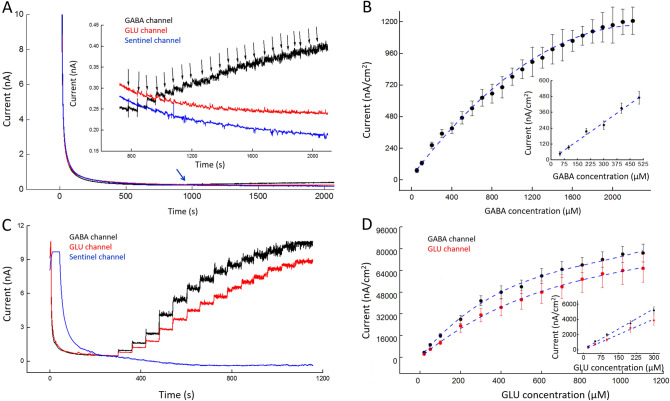
Glutamate (GLU) and γ-aminobutyric acid (GABA) are the major excitatory (E) and inhibitory (I) neurotransmitters in the brain, respectively. Dysregulation of the E/I ratio is associated with numerous neurological disorders. Enzyme-based microelectrode array biosensors present the potential for improved biocompatibility, localized sample volumes, and much faster sampling rates over existing measurement methods. However, enzymes degrade over time. To overcome the time limitation of permanently implanted microbiosensors, we created a microwire-based biosensor that can be periodically inserted into a permanently implanted cannula. Biosensor coatings were based on our previously developed GLU and reagent-free GABA shank-type biosensor. In addition, the microwire biosensors were in the same geometric plane for the improved acquisition of signals in planar tissue including rodent brain slices, cultured cells, and brain regions with laminar structure. We measured real-time dynamics of GLU and GABA in rat hippocampal slices and observed a significant, nonlinear shift in the E/I ratio from excitatory to inhibitory dominance as electrical stimulation frequency increased from 10 to 140 Hz, suggesting that GABA release is a component of a homeostatic mechanism in the hippocampus to prevent excitotoxic damage. Additionally, we recorded from a freely moving rat over fourteen weeks, inserting fresh biosensors each time, thus demonstrating that the microwire biosensor overcomes the time limitation of permanently implanted biosensors and that the biosensors detect relevant changes in GLU and GABA levels that are consistent with various behaviors.
谷氨酸 (GLU) 和 γ-氨基丁酸 (GABA) 分别是大脑中的主要兴奋性 (E) 和抑制性 (I) 神经递质。E/I 比值的失调与许多神经疾病有关。基于酶的微电极阵列生物传感器具有改善的生物相容性、局部样品体积和比现有测量方法更快的采样率的潜力。然而,酶会随时间降解。为了克服永久性植入微生物传感器的时间限制,我们创建了一种基于微丝的生物传感器,它可以周期性地插入到永久性植入的套管中。生物传感器涂层基于我们之前开发的 GLU 和无试剂 GABA 杆型生物传感器。此外,微丝生物传感器位于同一几何平面内,以改善在包括啮齿动物脑片、培养细胞和具有层状结构的脑区的平面组织中的信号采集。我们在大鼠海马切片中测量了 GLU 和 GABA 的实时动态,并观察到随着电刺激频率从 10 增加到 140 Hz,E/I 比值从兴奋优势显著非线性地转变为抑制优势,这表明 GABA 释放是海马体中一种防止兴奋毒性损伤的平衡机制的组成部分。此外,我们在一只自由移动的大鼠上记录了超过十四周的时间,每次都插入新鲜的生物传感器,从而证明微丝生物传感器克服了永久性植入生物传感器的时间限制,并且生物传感器检测到与各种行为一致的 GLU 和 GABA 水平的相关变化。