Yang Chieh-Ling, Lim Shannon B, Peters Sue, Eng Janice J
Department of Physical Therapy, Faculty of Medicine, University of British Columbia, Vancouver, BC, Canada.
Rehabilitation Research Program, GF Strong Rehabilitation Centre, Vancouver, BC, Canada.
Front Hum Neurosci. 2020 Jul 8;14:260. doi: 10.3389/fnhum.2020.00260. eCollection 2020.
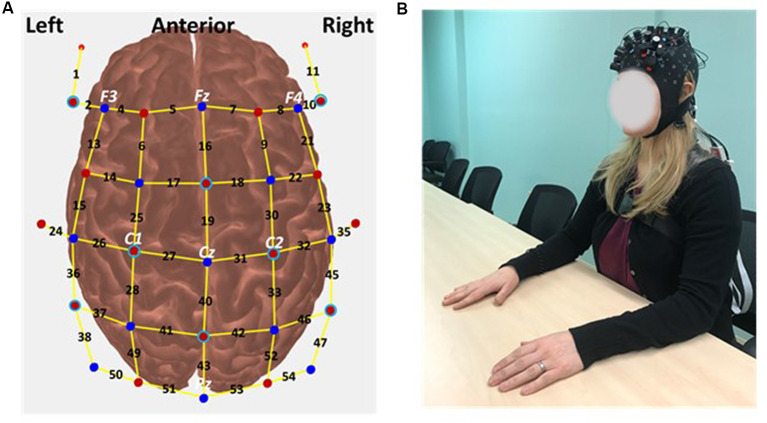
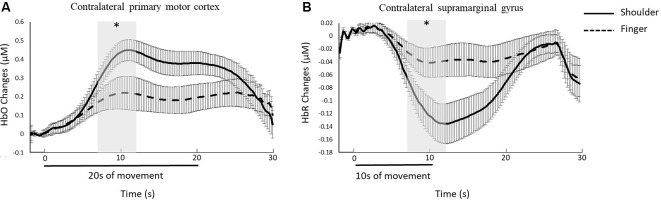
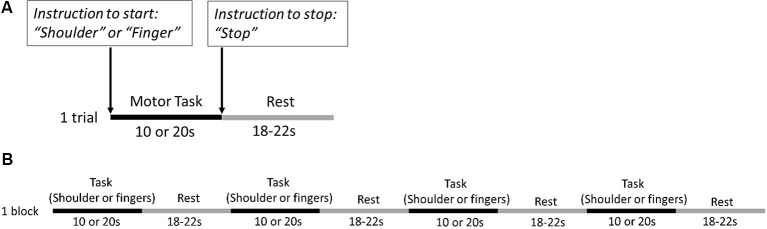
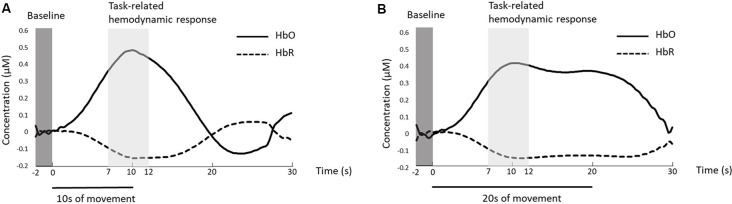
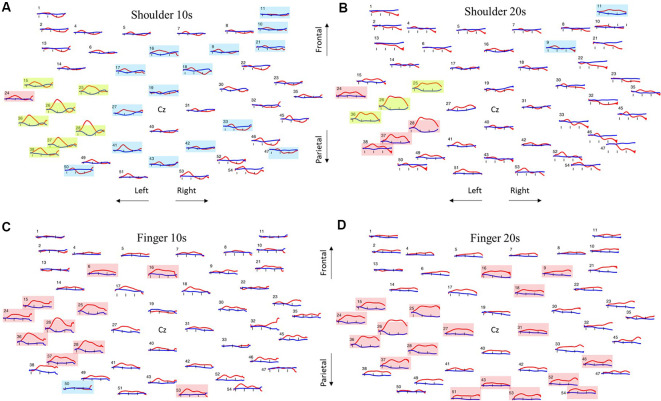
Characterization of cortical activation patterns during movement of the upper extremity in healthy adults is helpful in understanding recovery mechanisms following neurological disorders. This study explores cortical activation patterns associated with movements of the shoulder and fingers in healthy adults using functional near-infrared spectroscopy (fNIRS). Twelve healthy right-handed participants were recruited. Two motor tasks (shoulder abduction and finger extension) with two different trial lengths (10 s and 20 s) were performed in a sitting position at a rate of 0.5 Hz. The hemodynamic response, as indicated by oxy-hemoglobin (HbO) and deoxy-hemoglobin (HbR), over both hemispheres was acquired using a 54-channel fNIRS system. We found a generalized bilateral cortical activation during both motor tasks with greater activation in the contralateral compared to the ipsilateral primary motor cortex. Particularly in the more medial part of the contralateral hemisphere, significant higher activation was found during the shoulder compared to finger movements. Furthermore, cortical activation patterns are affected not only by motor tasks but also by trial lengths. HbO is more sensitive to detect cortical activation during finger movements in longer trials, while HbR is a better surrogate to capture active areas during shoulder movement in shorter trials. Based on these findings, reporting both HbO and HbR is strongly recommended for future fNIRS studies, and trial lengths should be taken into account when designing experiments and explaining results. Our findings demonstrating distinct cortical activation patterns associated with shoulder and finger movements in healthy adults provide a foundation for future research to study recovery mechanisms following neurological disorders.
了解健康成年人上肢运动过程中的皮质激活模式,有助于理解神经疾病后的恢复机制。本研究使用功能近红外光谱技术(fNIRS),探索健康成年人中与肩部和手指运动相关的皮质激活模式。招募了12名右利手健康参与者。在坐姿下以0.5Hz的频率进行两项运动任务(肩部外展和手指伸展),每项任务有两种不同的试验时长(10秒和20秒)。使用54通道fNIRS系统采集双侧半球的氧合血红蛋白(HbO)和脱氧血红蛋白(HbR)所指示的血液动力学反应。我们发现,在两项运动任务中均存在双侧皮质广泛激活,与同侧初级运动皮层相比,对侧激活更强。特别是在对侧半球更内侧部分,肩部运动时的激活显著高于手指运动。此外,皮质激活模式不仅受运动任务影响,还受试验时长影响。在较长试验中,HbO在检测手指运动时的皮质激活方面更敏感,而在较短试验中,HbR是捕捉肩部运动时活跃区域的更好替代指标。基于这些发现,强烈建议未来的fNIRS研究同时报告HbO和HbR,并且在设计实验和解释结果时应考虑试验时长。我们的研究结果表明,健康成年人中与肩部和手指运动相关的皮质激活模式不同,为未来研究神经疾病后的恢复机制奠定了基础。