Giraudier Manon, Ventura-Bort Carlos, Weymar Mathias
Department of Biological Psychology and Affective Science, University of Potsdam, Potsdam, Germany.
Front Psychol. 2020 Jul 9;11:1276. doi: 10.3389/fpsyg.2020.01276. eCollection 2020.
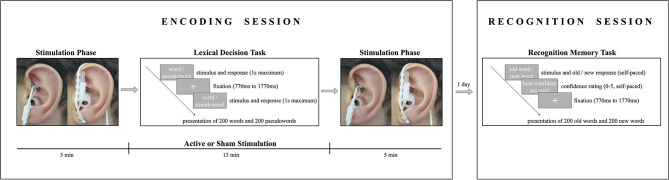
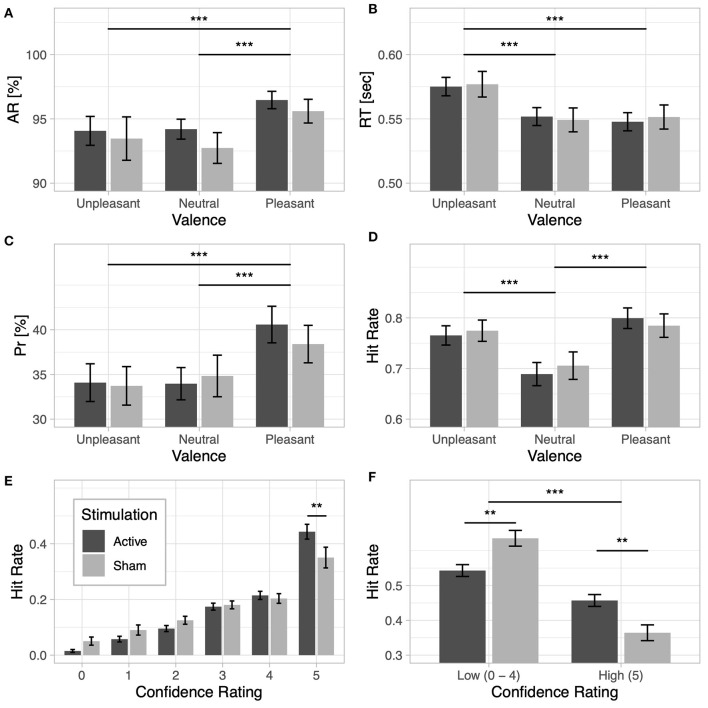
Previous clinical research found that invasive vagus nerve stimulation (VNS) enhanced word recognition memory in epileptic patients, an effect assumed to be related to the activation of brainstem arousal systems. In this study, we applied non-invasive transcutaneous auricular VNS (tVNS) to replicate and extend the previous work. Using a single-blind, randomized, between-subject design, 60 healthy volunteers received active or sham stimulation during a lexical decision task, in which emotional and neutral stimuli were classified as words or non-words. In a subsequent recognition memory task (1 day after stimulation), participants' memory performance on these words and their subjective memory confidence were tested. Salivary alpha-amylase (sAA) levels, a putative indirect measure of central noradrenergic activation, were also measured before and after stimulation. During encoding, pleasant words were more accurately detected than neutral and unpleasant words. However, no tVNS effects were observed on task performance or on overall sAA level changes. tVNS also did not modulate overall recognition memory, which was particularly enhanced for pleasant emotional words. However, when hit rates were split based on confidence ratings reflecting familiarity- and recollection-based memory, higher recollection-based memory performance (irrespective of emotional category) was observed during active stimulation than during sham stimulation. To summarize, we replicated prior findings of enhanced processing and memory for emotional (pleasant) words. Whereas tVNS showed no effects on word processing, subtle effects on recollection-based memory performance emerged, which may indicate that tVNS facilitates hippocampus-mediated consolidation processes.
先前的临床研究发现,侵入性迷走神经刺激(VNS)可增强癫痫患者的单词识别记忆,这一效应被认为与脑干唤醒系统的激活有关。在本研究中,我们应用非侵入性经皮耳迷走神经刺激(tVNS)来重复并扩展先前的研究。采用单盲、随机、组间设计,60名健康志愿者在词汇判断任务中接受了主动或假刺激,在该任务中,情绪性和中性刺激被分类为单词或非单词。在随后的识别记忆任务中(刺激后1天),测试了参与者对这些单词的记忆表现及其主观记忆信心。还在刺激前后测量了唾液α-淀粉酶(sAA)水平,这是一种假定的中枢去甲肾上腺素能激活的间接指标。在编码过程中,愉快的单词比中性和不愉快的单词被更准确地检测到。然而,未观察到tVNS对任务表现或总体sAA水平变化有影响。tVNS也未调节总体识别记忆,而总体识别记忆对愉快的情绪性单词有特别增强的作用。然而,当根据反映基于熟悉度和回忆的记忆的信心评级将命中率分开时,与假刺激相比,主动刺激期间观察到基于回忆的记忆表现更高(无论情绪类别如何)。总之,我们重复了先前关于对情绪性(愉快)单词的加工和记忆增强的发现。虽然tVNS对单词加工没有影响,但对基于回忆的记忆表现出现了微妙的影响,这可能表明tVNS促进了海马体介导的巩固过程。