Section of Microbiology and Applied Pathology, Department of Life Science and Biotechnology, University of Ferrara, Ferrara, Italy.
Department of Anesthesia, Critical Care & Pain Medicine, Beth Israel Deaconess Medical Center, Harvard Medical School, Boston, MA, United States.
Front Immunol. 2020 Jul 8;11:1339. doi: 10.3389/fimmu.2020.01339. eCollection 2020.
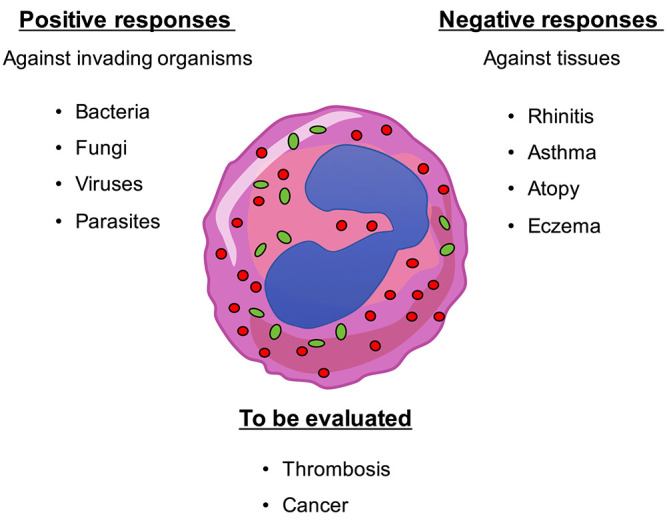
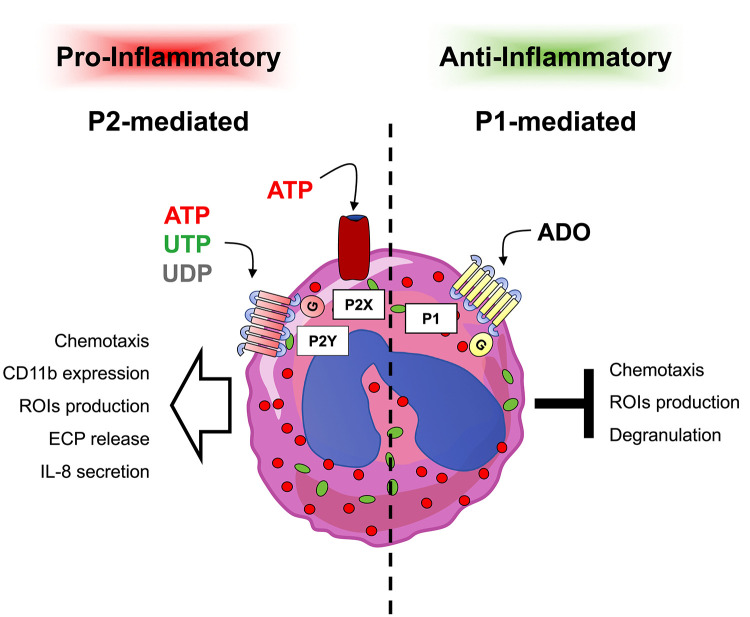
Eosinophils are major effector cells against parasites, fungi, bacteria, and viruses. However, these cells also take part in local and systemic inflammation, which are central to eczema, atopy, rhinitis, asthma, and autoimmune diseases. A role for eosinophils has been also shown in vascular thrombotic disorders and in cancer. Many, if not all, above-mentioned conditions involve the release of intracellular nucleotides (ATP, ADP, UTP, etc.) and nucleosides (adenosine) in the extracellular environment. Simultaneously, eosinophils further release ATP, which in autocrine and paracrine manners, stimulates P2 receptors. Purinergic signaling in eosinophils mediates a variety of responses including CD11b induction, ROI production, release of granule contents and enzymes, as well as cytokines. Exposure to extracellular ATP also modulates the expression of endothelial adhesion molecules, thereby favoring eosinophil extravasation and accumulation. In addition, eosinophils express the immunosuppressive adenosine P1 receptors, which regulate degranulation and migration. However, pro-inflammatory responses induced by extracellular ATP predominate. Due to their important role in innate immunity and tissue damage, pharmacological targeting of nucleotide- and nucleoside-mediated signaling in eosinophils could represent a novel approach to alleviate eosinophilic acute and chronic inflammatory diseases. These innovative approaches might also have salutary effects, particularly in host defense against parasites and in cancer.
嗜酸性粒细胞是对抗寄生虫、真菌、细菌和病毒的主要效应细胞。然而,这些细胞也参与局部和全身炎症,这是特应性皮炎、过敏、鼻炎、哮喘和自身免疫性疾病的核心。嗜酸性粒细胞在血管血栓形成障碍和癌症中也发挥作用。如果不是所有上述情况,至少涉及到细胞内核苷酸(ATP、ADP、UTP 等)和核苷(腺苷)在细胞外环境中的释放。同时,嗜酸性粒细胞进一步释放 ATP,以自分泌和旁分泌的方式刺激 P2 受体。嘌呤能信号在嗜酸性粒细胞中介导多种反应,包括 CD11b 诱导、ROI 产生、颗粒内容物和酶的释放以及细胞因子。细胞外 ATP 的暴露还调节内皮细胞粘附分子的表达,从而有利于嗜酸性粒细胞的渗出和积聚。此外,嗜酸性粒细胞表达免疫抑制性腺苷 P1 受体,调节脱颗粒和迁移。然而,细胞外 ATP 诱导的促炎反应占主导地位。由于其在先天免疫和组织损伤中的重要作用,针对嗜酸性粒细胞中核苷酸和核苷介导的信号的药理学靶向可能代表一种减轻嗜酸性粒细胞急性和慢性炎症性疾病的新方法。这些创新方法也可能具有有益的影响,特别是在宿主对寄生虫和癌症的防御方面。