Föller Michael, Lang Florian
Department of Physiology, University of Hohenheim, Stuttgart, Germany.
Department of Physiology Institute of Physiology, University of Tübingen, Tübingen, Germany.
Front Cell Dev Biol. 2020 Jul 8;8:597. doi: 10.3389/fcell.2020.00597. eCollection 2020.
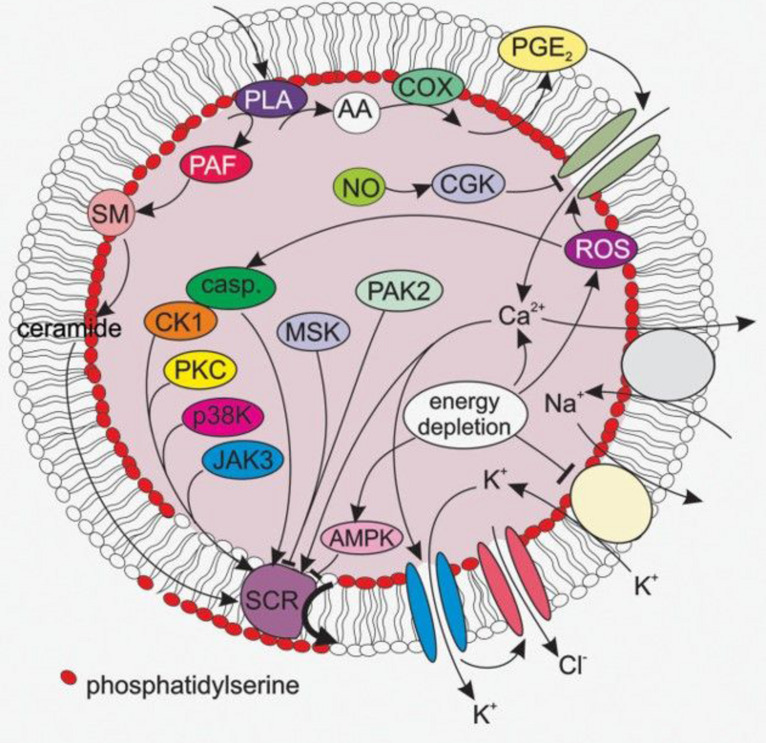
Erythrocytes are among the most abundant cells in mammals and are perfectly adapted to their main functions, i.e., the transport of O to peripheral tissues and the contribution to CO transport to the lungs. In contrast to other cells, they are fully devoid of organelles. Similar to apoptosis of nucleated cells erythrocytes may enter suicidal death, eryptosis, which is characterized by the presentation of membrane phosphatidylserine on the cell surface and cell shrinkage, hallmarks that are also typical of apoptosis. Eryptosis may be triggered by an increase in the cytosolic Ca concentration, which may be due to Ca influx via non-selective cation channels of the TRPC family. Eryptosis is further induced by ceramide, which sensitizes erythrocytes to the eryptotic effect of Ca. Signaling regulating eryptosis further involves a variety of kinases including AMPK, PAK2, cGKI, JAK3, CK1α, CDK4, MSK1/2 and casein kinase. Eryptosis-dependent shrinkage is induced by K efflux through Ca-activated K channel K3.1, the Gardos channel. Eryptotic cells are phagocytosed and may adhere to endothelial cells. Eryptosis may help prevent hemolysis since defective erythrocytes usually undergo eryptosis followed by rapid clearance from circulating blood. Excessive eryptosis stimulated by various diseases and xenobiotics may result in anemia and/or impaired microcirculation. This review focuses on the significance and mechanisms of eryptosis as well as on the ion fluxes involved. Moreover, a short summary of further ion transport mechanisms of the erythrocyte membrane is provided.
红细胞是哺乳动物中数量最多的细胞之一,并且完美地适应了其主要功能,即向周围组织运输氧气以及协助将二氧化碳运输至肺部。与其他细胞不同,它们完全没有细胞器。与有核细胞的凋亡类似,红细胞可能会进入自杀性死亡,即红细胞凋亡,其特征是细胞表面出现膜磷脂酰丝氨酸以及细胞收缩,这些特征也是凋亡的典型标志。红细胞凋亡可能由胞质钙浓度升高触发,这可能是由于通过瞬时受体电位阳离子通道家族(TRPC家族)的非选择性阳离子通道的钙内流所致。神经酰胺进一步诱导红细胞凋亡,它使红细胞对钙的凋亡效应敏感。调节红细胞凋亡的信号传导还涉及多种激酶,包括腺苷酸活化蛋白激酶(AMPK)、p21激活激酶2(PAK2)、环鸟苷酸依赖性蛋白激酶I(cGKI)、Janus激酶3(JAK3)、酪蛋白激酶1α(CK1α)、细胞周期蛋白依赖性激酶4(CDK4)、丝裂原和应激激活蛋白激酶1/2(MSK1/2)以及酪蛋白激酶。红细胞凋亡依赖性收缩是由钾离子通过钙激活钾通道K3.1(加尔多斯通道)外流诱导的。凋亡的红细胞会被吞噬,并且可能会黏附在内皮细胞上。红细胞凋亡可能有助于预防溶血,因为有缺陷的红细胞通常会经历红细胞凋亡,随后从循环血液中迅速清除。由各种疾病和异生物质刺激引起的过度红细胞凋亡可能导致贫血和/或微循环受损。本综述重点关注红细胞凋亡的意义和机制以及所涉及的离子通量。此外,还提供了红细胞膜其他离子转运机制的简要概述。