Ding Wenyan, Liu Jianzhou, Zhou Xiang, Miao Qi, Zheng Haibo, Zhou Baojin, Dou Guifang, Tong Yigang, Long Yun, Su Longxiang
Department of Critical Care Medicine, Peking Union Medical College Hospital, Peking Union Medical College, Chinese Academy of Medical Sciences, Beijing, China.
Department of Cardiac Surgery, Peking Union Medical College Hospital, Peking Union Medical College, Chinese Academy of Medical Sciences, Beijing, China.
Front Med (Lausanne). 2020 Jul 8;7:269. doi: 10.3389/fmed.2020.00269. eCollection 2020.
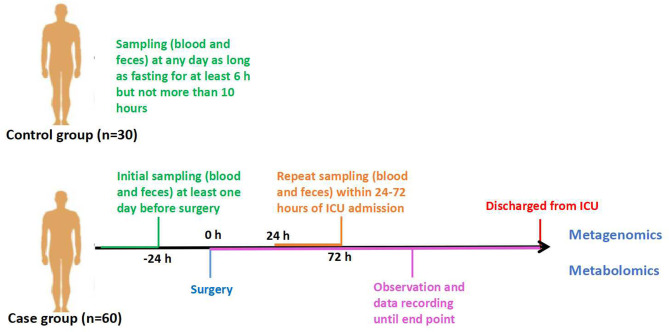
Fever of unknown origin (FUO) and hemodynamic instability are complications that develop after cardiac surgery combined with cardiopulmonary bypass (CPB) for heart disease. Patients who develop fever with hemodynamic instability after cardiac surgery may have systemic inflammatory response syndrome or sepsis. Cardiopulmonary bypass (CPB) is a technique that temporarily takes over the function of the heart and lungs during cardiac surgery. Recent reports suggest that early bloodstream infections of patients undergoing CPB are due to gram-negative bacteria that are present in the intestinal flora. The theory of intestinal flora translocation has growing evidence. Intestinal ischemia-reperfusion that occurs during cardiac surgery with CPB will induce a systemic inflammatory reaction and may cause intestinal flora translocation. Does this systemic reaction cause sepsis? We therefore propose this protocol to determine whether the changes in the intestinal flora in patients after cardiac surgery with CPB are related to sepsis. This study is a prospective observational case-control study to analyze the variation in the intestinal microflora and metabolites in patients undergoing cardiac surgery with CPB and to observe the outcomes of patients with routine clinical interventions. The control group will include healthy people without intestinal illness. Feces and blood samples will be acquired 1 day before cardiac surgery and within 24-72 h after cardiac surgery, and will be used for genomics and metabolomics analyses. Demographic data describing age, sex, main diagnosis, and past medical history and data related to the CPB time and application of antibiotics are available. Sequential (sepsis-related) organ failure assessment, infection-related laboratory items, infection site, and pathogenic microorganisms, and nutrition, and gastrointestinal function assessment are additionally recorded. Group analysis of data will be conducted according to the outcomes (sepsis vs. non-sepsis and survivors vs. non-survivors). This protocol has been ethically approved by the Ethics Committee of Peking Union Medical College (ID: ZS-1612). Informed consent will be obtained before subject enrolment, and data will be stored in a secured database. The results will be submitted to international peer-reviewed journals and presented at international conferences. NCT04032938.
不明原因发热(FUO)和血流动力学不稳定是心脏病患者在心脏手术联合体外循环(CPB)后出现的并发症。心脏手术后出现发热并伴有血流动力学不稳定的患者可能患有全身炎症反应综合征或脓毒症。体外循环(CPB)是一种在心脏手术期间暂时接管心肺功能的技术。最近的报告表明,接受CPB的患者早期血流感染是由肠道菌群中的革兰氏阴性菌引起的。肠道菌群易位理论有越来越多的证据。在CPB心脏手术期间发生的肠道缺血再灌注会诱发全身炎症反应,并可能导致肠道菌群易位。这种全身反应会导致脓毒症吗?因此,我们提出本方案以确定CPB心脏手术后患者肠道菌群的变化是否与脓毒症有关。本研究是一项前瞻性观察性病例对照研究,旨在分析接受CPB心脏手术患者的肠道微生物群和代谢物的变化,并观察常规临床干预患者的结局。对照组将包括无肠道疾病的健康人。将在心脏手术前1天以及心脏手术后24 - 72小时内采集粪便和血液样本,并用于基因组学和代谢组学分析。可获得描述年龄、性别、主要诊断和既往病史的人口统计学数据以及与CPB时间和抗生素应用相关的数据。另外记录序贯(脓毒症相关)器官衰竭评估、感染相关实验室指标、感染部位、致病微生物以及营养和胃肠功能评估。将根据结局(脓毒症与非脓毒症以及幸存者与非幸存者)进行数据分组分析。本方案已获得北京协和医学院伦理委员会的伦理批准(编号:ZS - 1612)。在受试者入组前将获得知情同意,数据将存储在安全的数据库中。研究结果将提交给国际同行评审期刊并在国际会议上发表。NCT04032938。