Wigneswaran John, St Peter Wendy L, Nissenson Allen R, Krishnan Mahesh, Faris Richard, Becker Bryan, Lorch Jonathan
Express Scripts, Inc, Franklin Lakes, NJ.
College of Pharmacy, Department of Pharmaceutical Care and Health Systems, University of Minnesota, Minneapolis, MN.
Kidney Med. 2019 Aug 20;1(5):307-314. doi: 10.1016/j.xkme.2019.06.008. eCollection 2019 Sep-Oct.
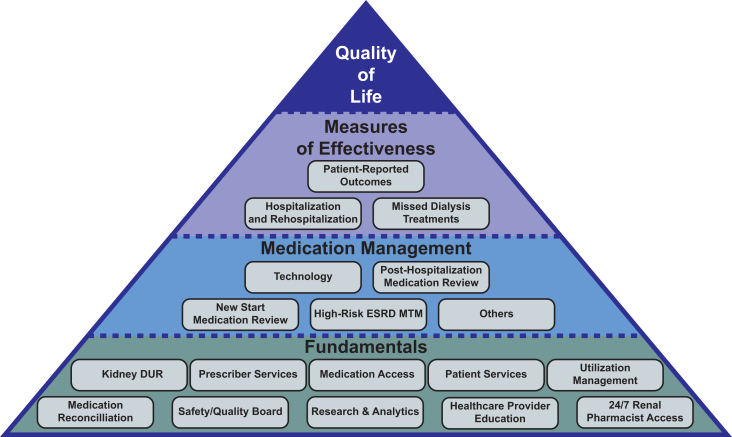
Patients with end-stage renal disease treated with dialysis are often prescribed complex medication regimens, placing them at risk for drug-drug interactions and other medication-related problems. Particularly in the context of a broader interest in more patient-centered value-based care, improving medication management is an increasingly important focus area. However, current medication management metrics, designed for the broader patient population, may not be well suited to the specific needs of patients with kidney disease, especially given the complexity of medication regimens used by dialysis patients. We propose a kidney pharmacy-focused quality pyramid that is intended to provide a framework to guide dialysis organizations, health care providers, and/or clinicians with respect to an optimal medication management approach for dialysis patients. Incorporation of core programs in medication management, including medication reconciliation, safety programs, and medication therapy management for patients at high risk for medication-related problems, may result in improved outcomes. Although a growing body of evidence supports the concept that active medication management can improve medication adherence and reduce medication-related problems, these strategies are viewed as costly and are not widely deployed. However, if done effectively, pharmacy-led medication management has the potential to be one of the more cost-effective disease management strategies and may greatly improve outcomes for these complex patients.
接受透析治疗的终末期肾病患者通常会被开出复杂的药物治疗方案,这使他们面临药物相互作用及其他与药物相关问题的风险。特别是在对以患者为中心的基于价值的医疗保健兴趣日益浓厚的背景下,改善药物管理成为一个越来越重要的重点领域。然而,目前为更广泛的患者群体设计的药物管理指标,可能不太适合肾病患者的特定需求,尤其是考虑到透析患者使用的药物治疗方案的复杂性。我们提出了一个以肾脏药房为重点的质量金字塔,旨在为透析机构、医疗保健提供者和/或临床医生提供一个框架,以指导针对透析患者的最佳药物管理方法。纳入药物管理的核心项目,包括药物重整、安全项目以及针对药物相关问题高风险患者的药物治疗管理,可能会改善治疗效果。尽管越来越多的证据支持积极的药物管理可以提高药物依从性并减少药物相关问题这一概念,但这些策略被认为成本高昂且未得到广泛应用。然而,如果有效实施,由药房主导的药物管理有可能成为更具成本效益的疾病管理策略之一,并可能极大地改善这些复杂患者的治疗效果。