Chair and Department of Cardiology, Medical University of Lublin, Lublin, Poland.
Cardiological Health Resort Hospital, Nałęczów, Poland.
PLoS One. 2020 Jul 31;15(7):e0236413. doi: 10.1371/journal.pone.0236413. eCollection 2020.
Although a number of modifiable and non-modifiable causes were implicated in arterial stiffness, its pathogenesis remains elusive, and very little is known about aortic elasticity in supraventricular arrhythmias. The potential role of disturbed kynurenine metabolism in the pathogenesis of cardiovascular disease has been recently suggested. Thus, we studied the correlations of aortic stiffness and echocardiographic parameters with biochemical markers and serum level of kynurenic acid (KYNA), an endothelial derivative of tryptophan, formed along the kynurenine pathway, among patients with atrial fibrillation (AF).
Study cohort comprised 100 patients with persistent AF (43 females/57 males). Arterial stiffness index (ASI), structural and functional indices of left atrium (LA) and left ventricle (LV) were evaluated electrocardiographically. Biochemical analyses included the measurements of serum KYNA (HPLC) and of the selected markers of lipids and glucose metabolism, thyroid status, kidney function, inflammation and coagulation.
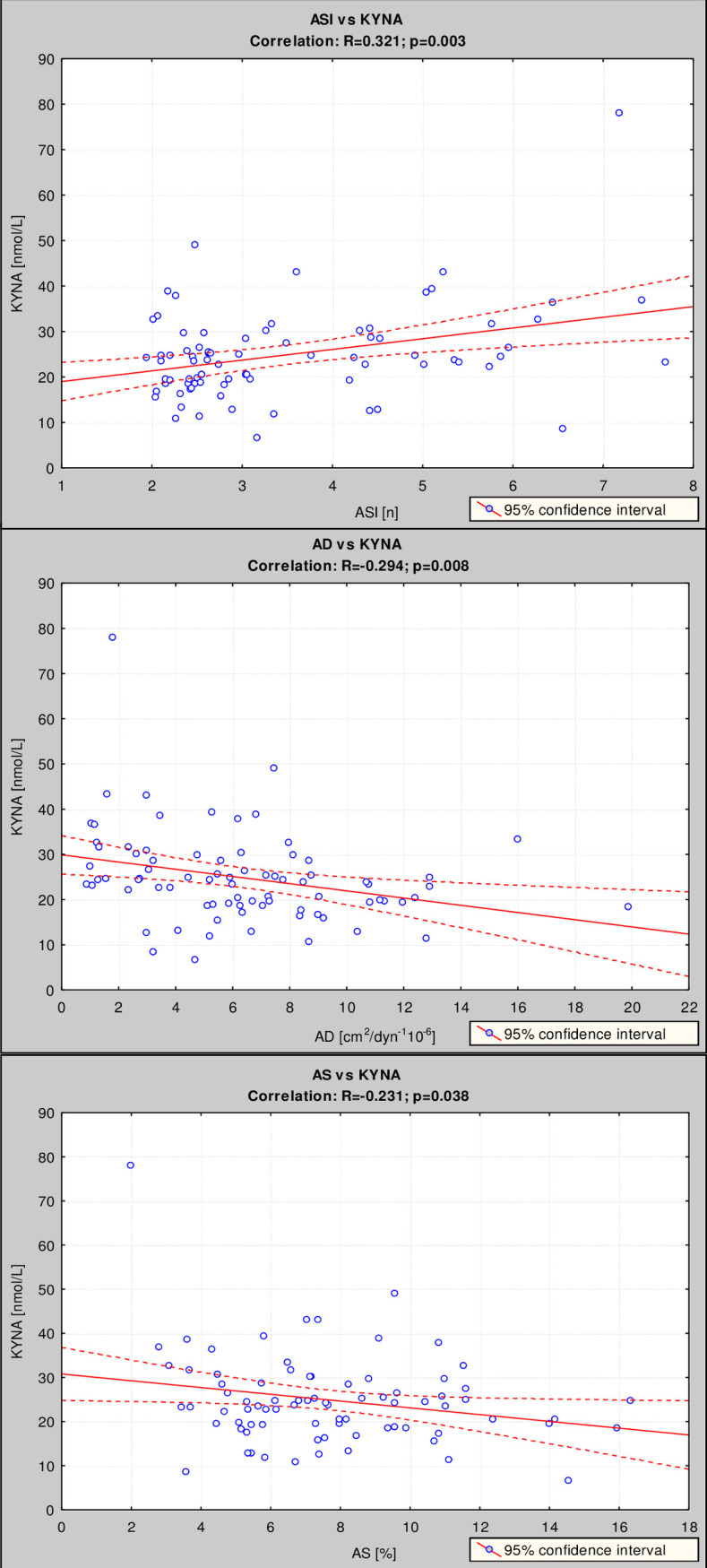
KYNA (β = 0.389, P = 0.029), homocysteine (β = 0.256, P = 0.40), total cholesterol (β = 0.814; P = 0.044), LDL (β = 0.663; P = 0.44), TSH (β = 0.262, P = 0.02), fT3 (β = -0.333, P = 0.009), fT4 (β = -0.275, P = 0.043) and creatinine (β = 0.374, P = 0.043) were independently correlated with ASI. ASI was also independently associated with LV end-systolic diameter (LVEDd; β = 1.751, P = 0.045), midwall fractional shortening (mFS; β = -1.266, P = 0.007), ratio mFS/end-systolic stress (mFS/ESS; β = -0.235, P = 0.026), LV shortening fraction (FS; β = -0.254, P = 0.017), and LA volume index (LAVI; β = 0.944, P = 0.022).
In patients with AF, aortic stiffness correlated positively with KYNA, biochemical risk factors of atherosclerosis and with the indices of diastolic dysfunction of LV and LA. Revealed relationship between ASI and KYNA is an original observation, suggesting a potential role of disturbed kynurenine metabolism in the pathogenesis of arterial stiffening. KYNA, synthesis of which is influenced by homocysteine, emerges as a novel, non-classical factor associated with ASI in patients with AF.
尽管有许多可改变和不可改变的因素与动脉僵硬有关,但动脉僵硬的发病机制仍难以捉摸,关于室上性心律失常的主动脉弹性知之甚少。最近有人提出,色氨酸代谢紊乱在心血管疾病发病机制中的潜在作用。因此,我们研究了持续性心房颤动(AF)患者中主动脉僵硬和超声心动图参数与生化标志物和血清犬尿氨酸(KYNA)水平之间的相关性,KYNA 是色氨酸沿犬尿氨酸途径形成的一种内皮衍生的物质。
研究队列包括 100 名持续性房颤(AF)患者(43 名女性/57 名男性)。通过心电图评估动脉僵硬指数(ASI)、左心房(LA)和左心室(LV)的结构和功能指标。生化分析包括血清 KYNA(HPLC)和选定的血脂和葡萄糖代谢标志物、甲状腺功能、肾功能、炎症和凝血标志物的测量。
KYNA(β=0.389,P=0.029)、同型半胱氨酸(β=0.256,P=0.40)、总胆固醇(β=0.814;P=0.044)、LDL(β=0.663;P=0.44)、TSH(β=0.262,P=0.02)、fT3(β=-0.333,P=0.009)、fT4(β=-0.275,P=0.043)和肌酐(β=0.374,P=0.043)与 ASI 独立相关。ASI 还与 LV 收缩末期直径(LVEDd;β=1.751,P=0.045)、中壁节段缩短率(mFS;β=-1.266,P=0.007)、mFS/收缩末期压力比(mFS/ESS;β=-0.235,P=0.026)、LV 缩短分数(FS;β=-0.254,P=0.017)和左房容积指数(LAVI;β=0.944,P=0.022)独立相关。
在 AF 患者中,主动脉僵硬与 KYNA、动脉粥样硬化的生化危险因素以及 LV 和 LA 的舒张功能障碍指数呈正相关。ASI 与 KYNA 之间显示的关系是一个原始观察结果,表明犬尿氨酸代谢紊乱在动脉僵硬发病机制中可能发挥作用。KYNA 的合成受同型半胱氨酸影响,它是 AF 患者与 ASI 相关的一种新的非经典因素。