Institute of Science and Technology (ICT), Federal University of São Paulo (UNIFESP), São José dos Campos, SP, Brazil.
Institute of Flight System Dynamics, Department of Aerospace and Geodesy, Technical University of Munich (TUM), Garching bei München, Bavaria, Germany.
PLoS One. 2020 Jul 31;15(7):e0236386. doi: 10.1371/journal.pone.0236386. eCollection 2020.
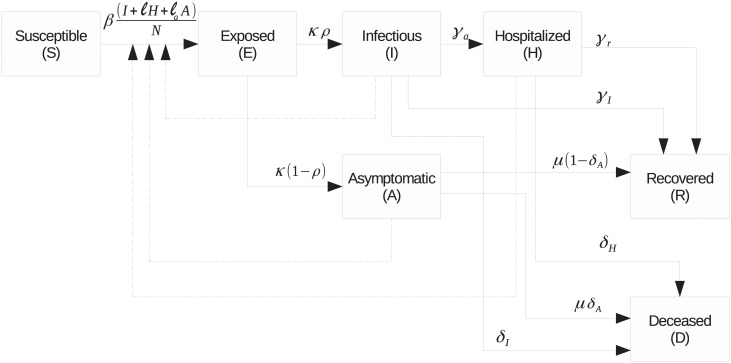
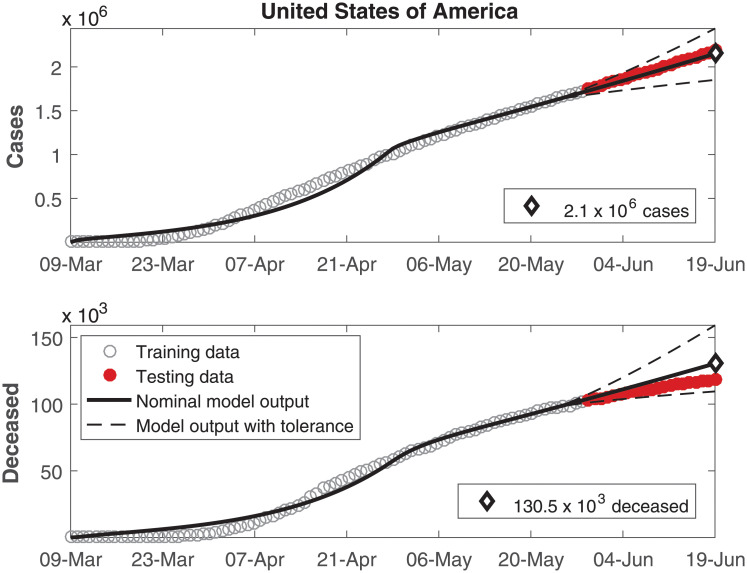
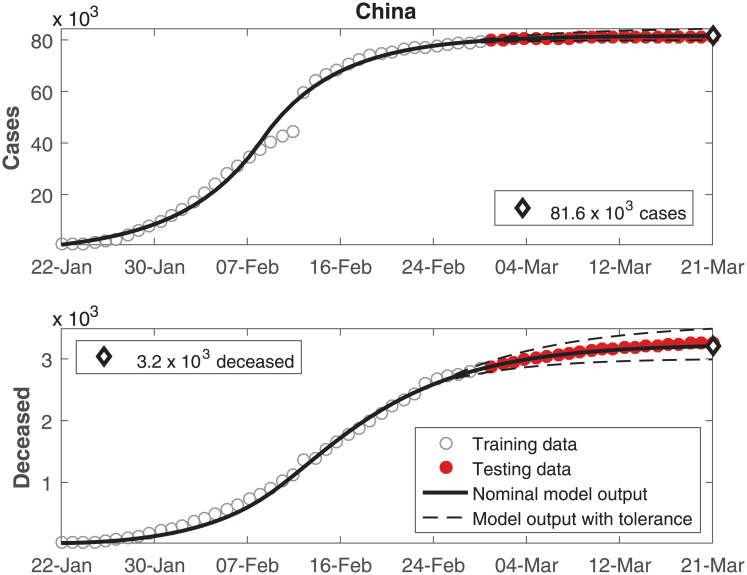
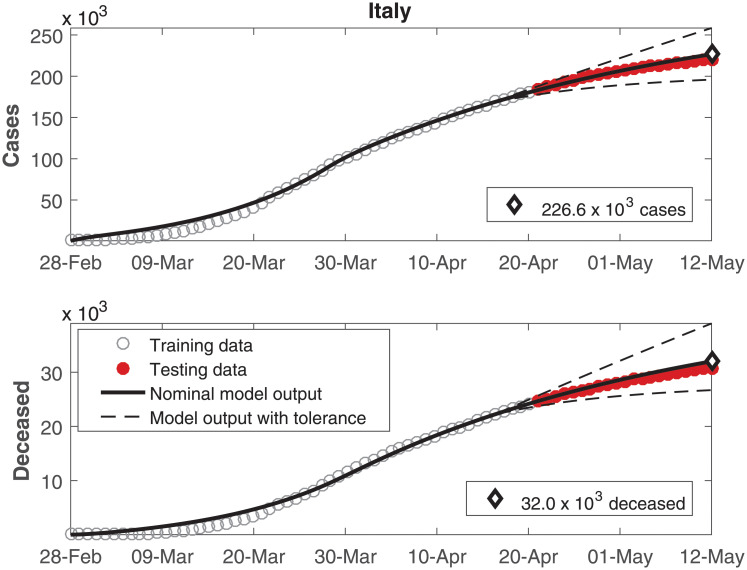
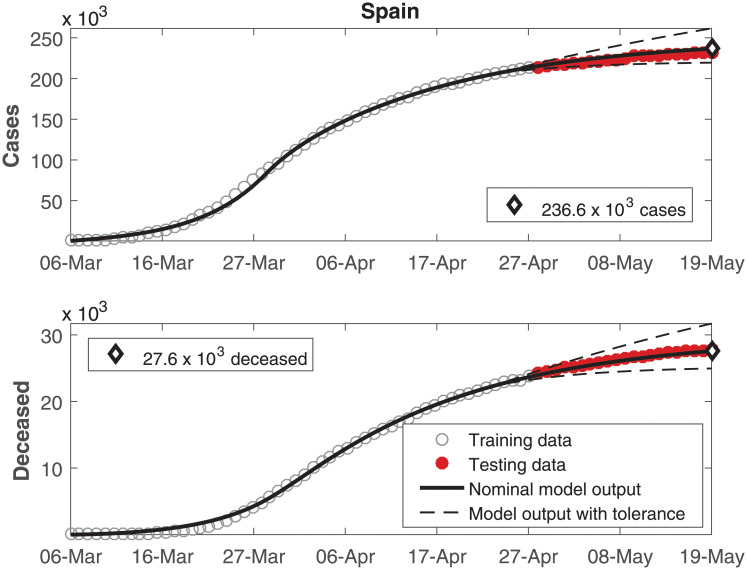
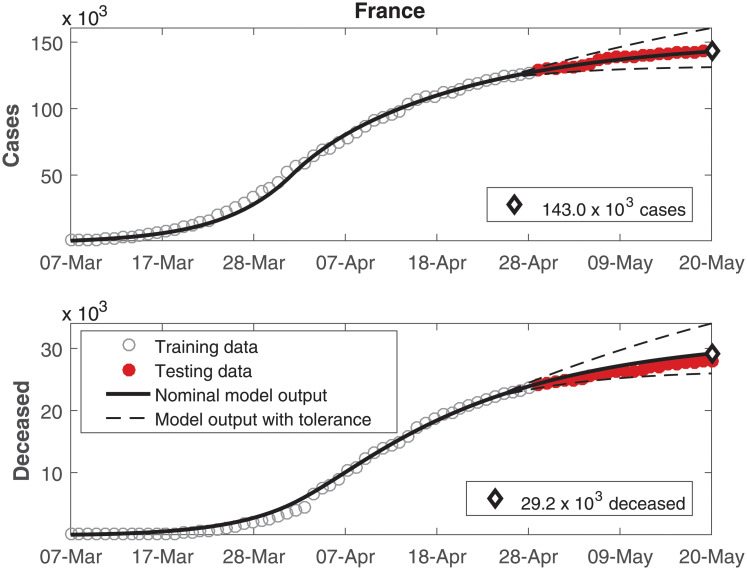
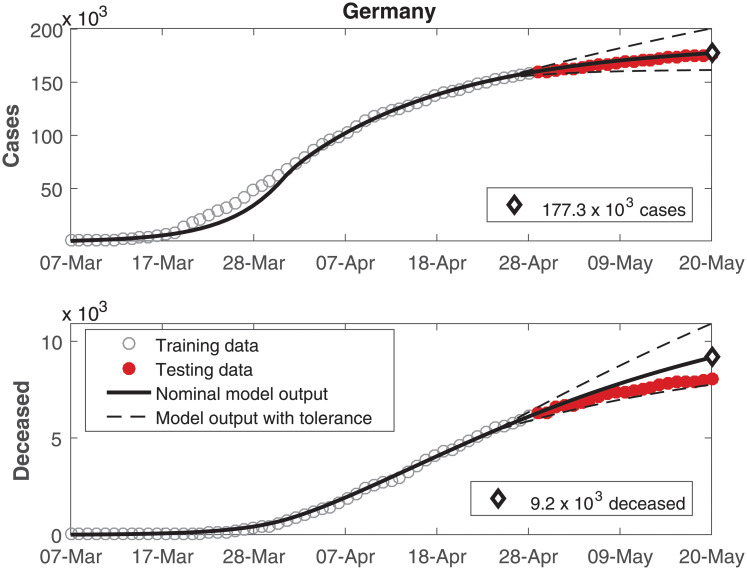
This paper proposes a dynamic model to describe and forecast the dynamics of the coronavirus disease COVID-19 transmission. The model is based on an approach previously used to describe the Middle East Respiratory Syndrome (MERS) epidemic. This methodology is used to describe the COVID-19 dynamics in six countries where the pandemic is widely spread, namely China, Italy, Spain, France, Germany, and the USA. For this purpose, data from the European Centre for Disease Prevention and Control (ECDC) are adopted. It is shown how the model can be used to forecast new infection cases and new deceased and how the uncertainties associated to this prediction can be quantified. This approach has the advantage of being relatively simple, grouping in few mathematical parameters the many conditions which affect the spreading of the disease. On the other hand, it requires previous data from the disease transmission in the country, being better suited for regions where the epidemic is not at a very early stage. With the estimated parameters at hand, one can use the model to predict the evolution of the disease, which in turn enables authorities to plan their actions. Moreover, one key advantage is the straightforward interpretation of these parameters and their influence over the evolution of the disease, which enables altering some of them, so that one can evaluate the effect of public policy, such as social distancing. The results presented for the selected countries confirm the accuracy to perform predictions.
本文提出了一个动态模型来描述和预测冠状病毒疾病 COVID-19 的传播动态。该模型基于以前用于描述中东呼吸综合征 (MERS) 流行的方法。这种方法用于描述在 COVID-19 广泛传播的六个国家(中国、意大利、西班牙、法国、德国和美国)的 COVID-19 动态。为此,采用了欧洲疾病预防和控制中心 (ECDC) 的数据。结果表明,该模型如何用于预测新的感染病例和新的死亡病例,以及如何量化与该预测相关的不确定性。这种方法的优点是相对简单,将影响疾病传播的许多条件分组为少数几个数学参数。另一方面,它需要来自疾病在该国传播的先前数据,因此更适合疫情尚未处于早期阶段的地区。有了手头的估计参数,就可以使用该模型来预测疾病的演变,这反过来又使当局能够规划他们的行动。此外,一个关键优势是这些参数及其对疾病演变的影响的直接解释,这使得可以改变其中一些参数,以便评估公共政策(如社会隔离)的效果。为选定国家提供的结果证实了进行预测的准确性。