Sciannameo Veronica, Azzolina Danila, Lanera Corrado, Acar Aslihan Şentürk, Corciulo Maria Assunta, Comoretto Rosanna Irene, Berchialla Paola, Gregori Dario
Unit of Biostatistics, Epidemiology and Public Health, Department of Cardiac, Thoracic, Vascular Sciences, and Public Health, University of Padova, 35131 Padova, Italy.
Center of Biostatistics, Epidemiology and Public Health, Department of Clinical and Biological Sciences, University of Torino, 10124 Turin, Italy.
Healthcare (Basel). 2023 Aug 21;11(16):2363. doi: 10.3390/healthcare11162363.
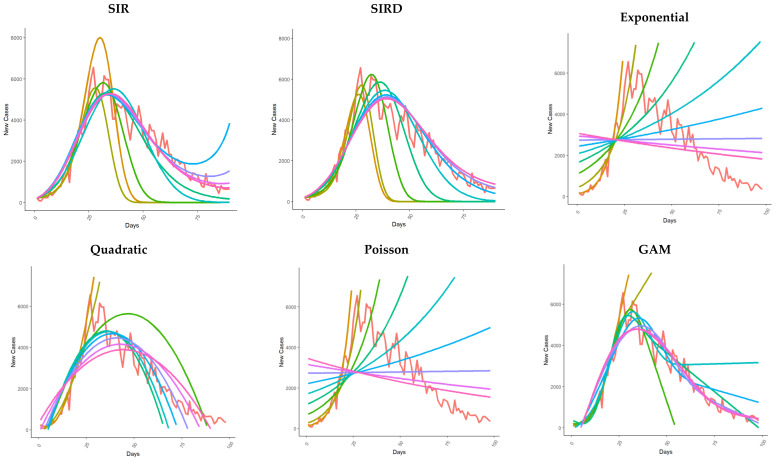
The COVID-19 outbreak involved a spread of prediction efforts, especially in the early pandemic phase. A better understanding of the epidemiological implications of the different models seems crucial for tailoring prevention policies. This study aims to explore the concordance and discrepancies in outbreak prediction produced by models implemented and used in the first wave of the epidemic. To evaluate the performance of the model, an analysis was carried out on Italian pandemic data from February 24, 2020. The epidemic models were fitted to data collected at 20, 30, 40, 50, 60, 70, 80, 90, and 98 days (the entire time series). At each time step, we made predictions until May 31, 2020. The Mean Absolute Error () and the Mean Absolute Percentage Error () were calculated. The GAM model is the most suitable parameterization for predicting the number of new cases; exponential or Poisson models help predict the cumulative number of cases. When the goal is to predict the epidemic peak, GAM, ARIMA, or Bayesian models are preferable. However, the prediction of the pandemic peak could be made carefully during the early stages of the epidemic because the forecast is affected by high uncertainty and may very likely produce the wrong results.
新冠疫情引发了一系列预测工作,尤其是在疫情初期。更好地理解不同模型的流行病学意义对于制定预防政策似乎至关重要。本研究旨在探讨在疫情第一波中实施和使用的模型所产生的疫情预测的一致性和差异。为评估模型的性能,对2020年2月24日以来的意大利疫情数据进行了分析。将疫情模型拟合到在第20、30、40、50、60、70、80、90和98天(整个时间序列)收集的数据。在每个时间步,我们进行预测直至2020年5月31日。计算了平均绝对误差()和平均绝对百分比误差()。广义相加模型(GAM)是预测新增病例数最合适的参数化方法;指数模型或泊松模型有助于预测累计病例数。当目标是预测疫情高峰时,GAM、自回归积分移动平均模型(ARIMA)或贝叶斯模型更为可取。然而,在疫情早期对疫情高峰进行预测时应谨慎,因为预测受到高度不确定性的影响,很可能产生错误结果。