Michigan Institute for Data Science, University of Michigan, Ann Arbor, MI, USA.
JC School of Public Health and Primary Care, Chinese University of Hong Kong, Hong Kong, China; Shenzhen Research Institute of Chinese University of Hong Kong, Shenzhen, China.
Int J Infect Dis. 2020 Apr;93:211-216. doi: 10.1016/j.ijid.2020.02.058. Epub 2020 Mar 4.
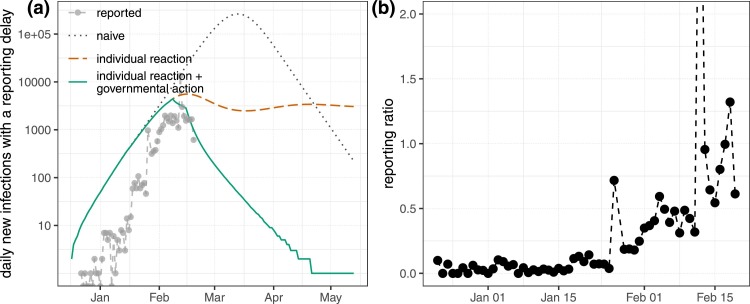
The ongoing coronavirus disease 2019 (COVID-19) outbreak, emerged in Wuhan, China in the end of 2019, has claimed more than 2600 lives as of 24 February 2020 and posed a huge threat to global public health. The Chinese government has implemented control measures including setting up special hospitals and travel restriction to mitigate the spread. We propose conceptual models for the COVID-19 outbreak in Wuhan with the consideration of individual behavioural reaction and governmental actions, e.g., holiday extension, travel restriction, hospitalisation and quarantine. We employe the estimates of these two key components from the 1918 influenza pandemic in London, United Kingdom, incorporated zoonotic introductions and the emigration, and then compute future trends and the reporting ratio. The model is concise in structure, and it successfully captures the course of the COVID-19 outbreak, and thus sheds light on understanding the trends of the outbreak.
截至 2020 年 2 月 24 日,在中国武汉爆发的 2019 年冠状病毒病(COVID-19)疫情已造成超过 2600 人死亡,对全球公共卫生构成巨大威胁。中国政府已实施控制措施,包括建立专门医院和旅行限制,以减轻疫情传播。我们考虑个人行为反应和政府行动,例如延长假期、旅行限制、住院和隔离,提出了武汉 COVID-19 疫情的概念模型。我们从英国伦敦 1918 年流感大流行中估计了这两个关键因素,并考虑了人畜共患病的引入和移民,然后计算了未来的趋势和报告率。该模型结构简洁,成功地捕捉到了 COVID-19 疫情的发展过程,从而为了解疫情趋势提供了线索。