Department of Behavioural Sciences and Learning, Linköping University, Linköping, Sweden.
Department of Psychology, Lund University, Lund, Sweden.
PLoS One. 2020 Jul 31;15(7):e0236627. doi: 10.1371/journal.pone.0236627. eCollection 2020.
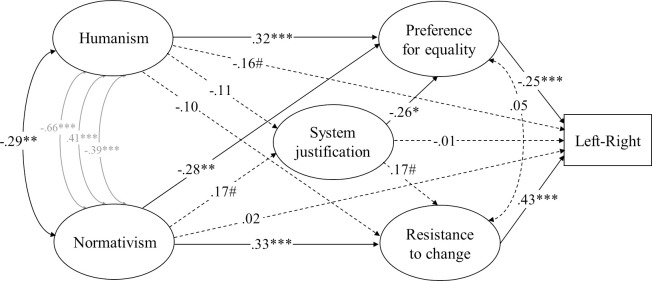
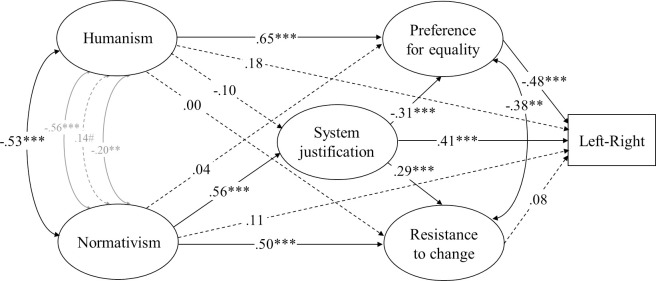
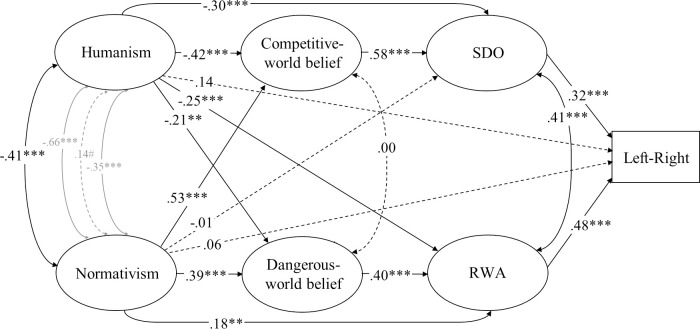
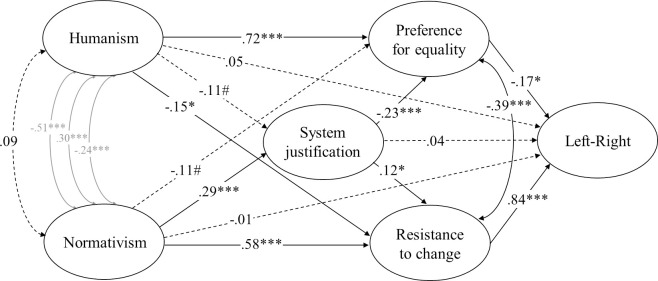
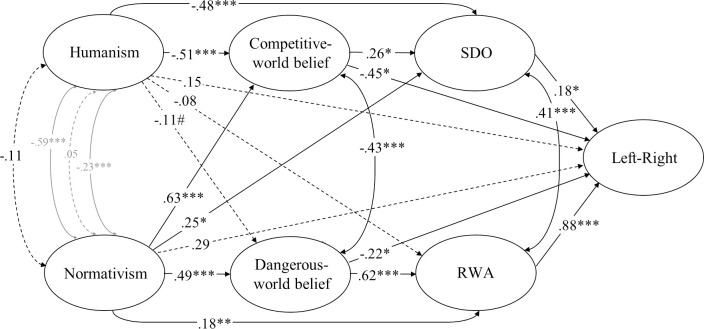
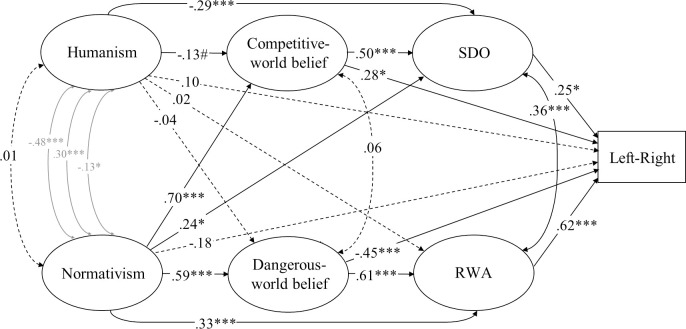
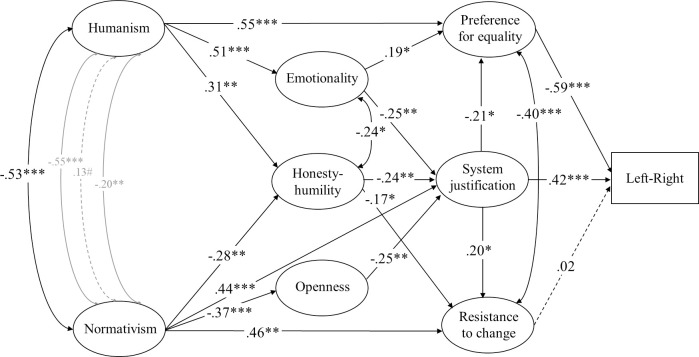
According to Silvan Tomkins' polarity theory, ideological thought is universally structured by a clash between two opposing worldviews. On the left, a humanistic worldview seeks to uphold the intrinsic value of the person; on the right, a normative worldview holds that human worth is contingent upon conformity to rules. In this article, we situate humanism and normativism within the context of contemporary models of political ideology as a function of motivated social cognition, beliefs about the social world, and personality traits. In four studies conducted in the U.S. and Sweden, normativism was robustly associated with rightist (or conservative) self-placement; conservative issue preferences; resistance to change and acceptance of inequality; right-wing authoritarianism and social dominance orientation; system justification and its underlying epistemic and existential motives to reduce uncertainty and threat; and a lack of openness, emotionality, and honesty-humility. Humanism exhibited the opposite relations to most of these constructs, but it was largely unrelated to epistemic and existential needs. Humanism was strongly associated with preferences for equality, openness to change, and low levels of authoritarianism, social dominance, and general and economic system justification. We conclude that polarity theory possesses considerable potential to explain how conflicts between worldviews shape contemporary politics.
根据西尔万·汤姆金斯的极性理论,意识形态思想普遍是由两种对立世界观之间的冲突构建的。在左边,一种人文主义世界观试图维护人的内在价值;在右边,一种规范世界观认为人的价值取决于对规则的遵守。在本文中,我们将人文主义和规范主义置于当代政治意识形态模型的背景下,作为动机社会认知、对社会世界的信念和人格特质的函数。在美国和瑞典进行的四项研究中,规范主义与右派(或保守派)的自我定位、保守的问题偏好、对变革的抵制和对不平等的接受、右翼独裁主义和社会支配倾向、制度辩护及其减少不确定性和威胁的潜在认知和存在动机、以及缺乏开放性、情感性和诚实-谦逊都有很强的关联。人文主义与这些结构中的大多数都呈现出相反的关系,但与认知和存在需求基本无关。人文主义与平等偏好、对变革的开放态度以及较低的独裁主义、社会支配和一般及经济制度辩护水平密切相关。我们得出结论,极性理论具有很大的潜力,可以解释世界观之间的冲突如何塑造当代政治。