Brigham and Women's Hospital, Boston, Massachusetts, United States of America.
Massachusetts General Hospital, Boston, Massachusetts, United States of America.
PLoS One. 2020 Jul 31;15(7):e0235190. doi: 10.1371/journal.pone.0235190. eCollection 2020.
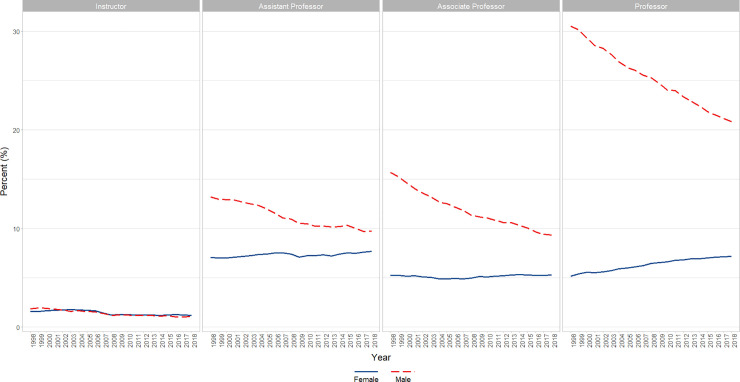
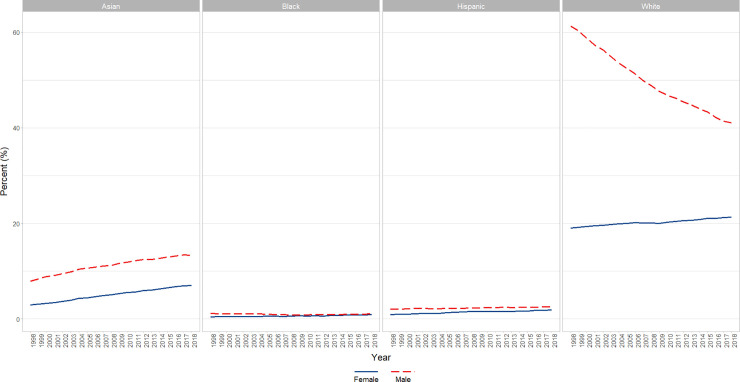
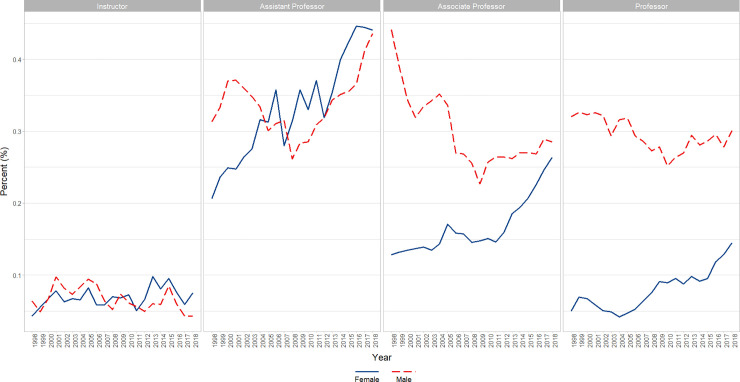
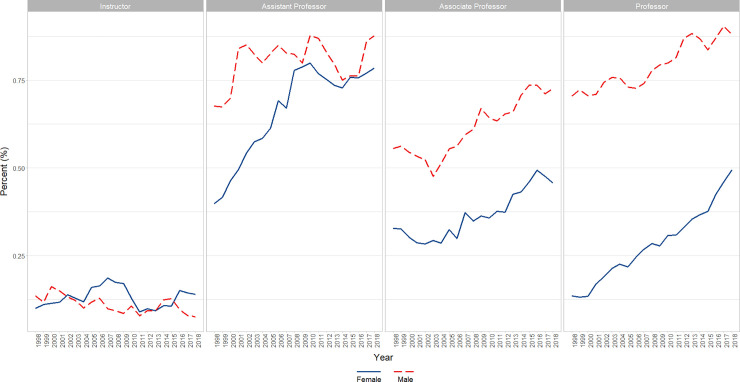
To examine changes in U.S. medical school basic science faculty over the last 20 years (1998-2018), we undertook an observational study utilizing data from the American Association of Medical Colleges Faculty Roster. Rank (Instructor, Assistant Professor, Associate Professor, and Professor), sex (Female), and race/ethnicity (Asian, Black or African American, Hispanic, Latino, Spanish Origin, or Multiple Race-Hispanic, and White) were analyzed; this reflected a population of 14,047 (1998) to 18,601 (2018) faculty. Summary percent of faculty in various gender, race/ethnicity origin categories were analyzed across years of the study using regression models. We found that females (24.47% to 35.32%) were underrepresented at all timepoints and a minority of faculty identified as Black or African American (1.57% to 1.99%), Hispanic, Latino, Spanish Origin, or Multiple Race-Hispanic (3.03% to 4.44%), or Asian (10.90% to 20.41%). The largest population at all time points was White Male Professors (30.53% to 20.85%), followed by White Male Associate Professors (15.67% to 9.34%), and White Male Assistant Professors (13.22% to 9.75%). Small statistically significant increases were observed among female faculty and faculty at multiple ranks who identified as Black or African American or Hispanic, Latino, Spanish Origin, or Multiple Race-Hispanic. We then completed secondary analyses looking at the interaction of race/ethnicity and Gender. We found: (1) a significant increase (p<0.0001) in both genders who identify as Asian although males had a higher rate of increase (6 point difference, p<0.0001); (2) a significant increase for Black or African American females (P<0.01) not found among males; (3) significant increases (p<0.0001) among both genders of faculty who identify as Hispanic, Latino, Spanish Origin, or Multiple Race-Hispanic although females had an approximately 1% higher rate of increase; and (4) among faculty who identify as White, males had a significant decrease (p<0.0001) while females demonstrated an increase (p<0.0001).
为了研究过去 20 年(1998 年至 2018 年)美国医学院基础科学教师队伍的变化,我们利用美国医学协会教师名册中的数据进行了一项观察性研究。分析了职称(讲师、助理教授、副教授和教授)、性别(女性)和种族/民族(亚裔、非裔美国人、西班牙裔、拉丁裔、西班牙裔或多种族裔-西班牙裔和白人);这反映了 1998 年的 14047 名教师到 2018 年的 18601 名教师。使用回归模型分析了研究期间各年不同性别和种族/民族出身的教师的总体百分比。我们发现,女性(24.47% 至 35.32%)在所有时间点都代表性不足,少数教师自认为是非裔美国人(1.57% 至 1.99%)、西班牙裔、拉丁裔、西班牙裔或多种族裔-西班牙裔(3.03% 至 4.44%)或亚裔(10.90% 至 20.41%)。在所有时间点,人数最多的是白人男性教授(30.53% 至 20.85%),其次是白人男性副教授(15.67% 至 9.34%)和白人男性助理教授(13.22% 至 9.75%)。黑人或非洲裔美国女性和多个职称的教职员工中,女性教职员工和教职员工的比例都有小的统计学显著增加。然后,我们进行了二次分析,观察种族/民族和性别之间的相互作用。我们发现:(1)虽然男性的增长率更高(相差 6 个百分点,p<0.0001),但自认为是亚裔的男女比例均显著增加(p<0.0001);(2)黑人或非洲裔美国女性的比例显著增加(p<0.01),但男性没有这种情况;(3)自认为是西班牙裔、拉丁裔、西班牙裔或多种族裔-西班牙裔的男女教师比例均显著增加(p<0.0001),尽管女性的增长率略高(约 1%);(4)自认为是白人的教师中,男性比例显著下降(p<0.0001),而女性比例则有所上升(p<0.0001)。