Brain Stimulation Division, Department of Psychiatry, Medical University of South Carolina, SC, USA.
Department of Psychiatry and Health Behavior, GA, USA; Medical College of Georgia, GA, USA; Augusta University, GA, USA.
Brain Stimul. 2020 Sep-Oct;13(5):1416-1425. doi: 10.1016/j.brs.2020.07.015. Epub 2020 Jul 29.
Focal Electrically-Administered Seizure Therapy (FEAST) is a form of electroconvulsive therapy (ECT) that spatially focuses the electrical stimulus to initiate seizure activity in right prefrontal cortex. Two open-label non-comparative studies suggested that FEAST has reduced cognitive side effects when compared to historical data from other forms of ECT. In two different ECT clinics, we compared the efficacy and cognitive side effects of FEAST and Right Unilateral Ultrabrief Pulse (RUL-UBP) ECT.
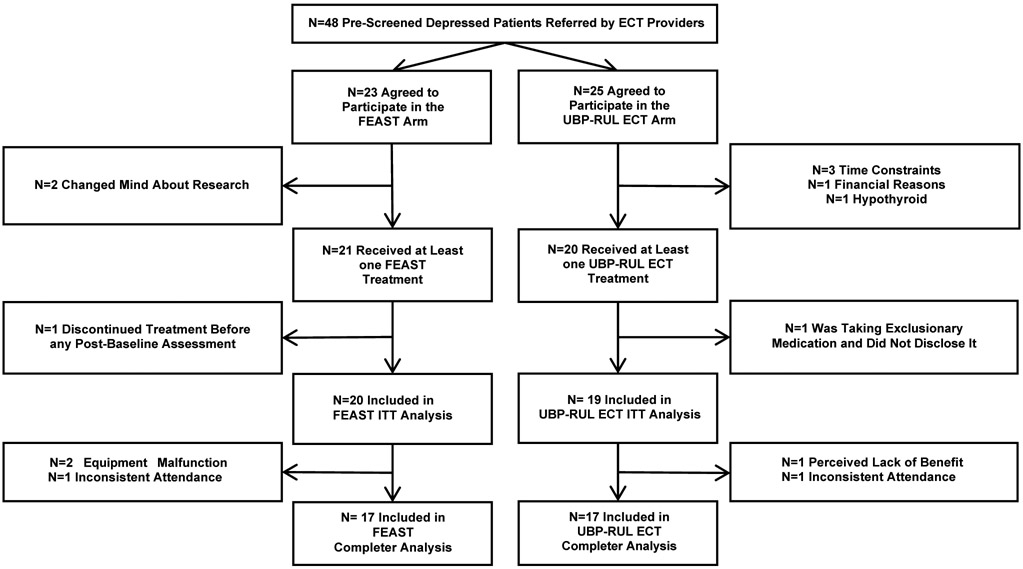
Using a non-randomized, open-label design, 39 depressed adults were recruited after referral for ECT. Twenty patients received FEAST (14 women; age 45.2 ± 12.7), and 19 received RUL-UBP ECT (16 women; age 43.2 ± 16.4). Key cognitive outcome measures were the postictal time to reorientation and the Columbia University Autobiographical Memory Interview: Short-Form (CUAMI-SF). Antidepressant effects were assessed using the Hamilton Rating Scale for Depression (HRSD).
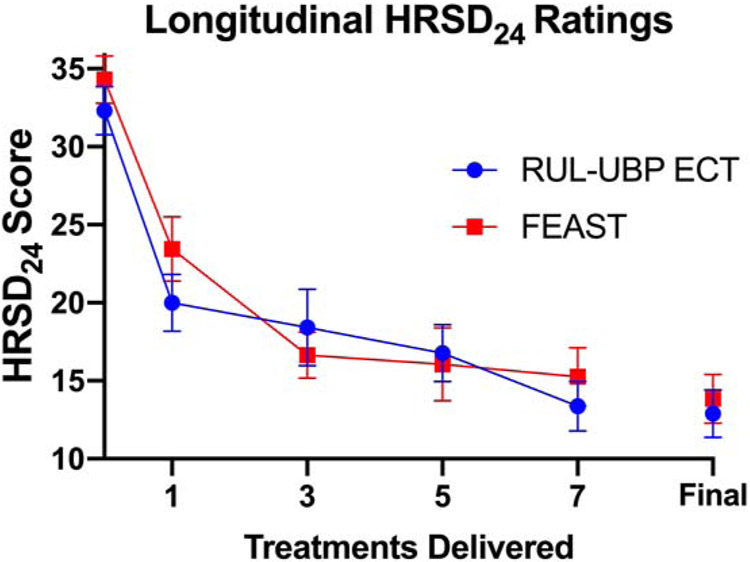
In the Intent-to-treat sample, a repeated measures mixed model suggested no between group difference in HRSD score over time (F = 0.82, p = 0.37), while the response rate favored FEAST (FEAST: 65%; RUL-UBP ECT: 57.9%), and the remission rate favored RUL-UBP ECT (FEAST: 35%; RUL-UBP ECT: 47.4%). The FEAST group had numeric superiority in average time to reorientation (FEAST: 6.6 ± 5.0 min; RUL-UBP ECT: 8.8 ± 5.8 min; Cohens d = 0.41), and CUAMI-SF consistency score (FEAST: 69.2 ± 14.2%; RUL-UBP ECT: 63.9 ± 9.9%; Cohens d = 0.43); findings that failed to meet statistical significance.
FEAST exerts similar efficacy relative to an optimal form of conventional ECT and may have milder cognitive side effects. A blinded, randomized, non-inferiority trial is needed.
焦点电诱发癫痫治疗(FEAST)是一种电抽搐治疗(ECT)形式,它将电刺激集中在右前额皮质以引发癫痫活动。两项开放性非对照研究表明,与其他形式的 ECT 的历史数据相比,FEAST 的认知副作用更小。在两个不同的 ECT 诊所,我们比较了 FEAST 和右侧单侧超短脉冲(RUL-UBP)ECT 的疗效和认知副作用。
使用非随机、开放性设计,在转诊进行 ECT 后招募了 39 名抑郁成年患者。20 名患者接受 FEAST(14 名女性;年龄 45.2 ± 12.7),19 名患者接受 RUL-UBP ECT(16 名女性;年龄 43.2 ± 16.4)。关键认知结局测量包括癫痫后定向时间和哥伦比亚大学自传记忆访谈:短式(CUAMI-SF)。使用汉密尔顿抑郁量表(HRSD)评估抗抑郁效果。
在意向治疗样本中,重复测量混合模型表明,HRSD 评分随时间无组间差异(F=0.82,p=0.37),而 FEAST 的反应率更高(FEAST:65%;RUL-UBP ECT:57.9%),缓解率则更倾向于 RUL-UBP ECT(FEAST:35%;RUL-UBP ECT:47.4%)。FEAST 组在平均定向时间(FEAST:6.6 ± 5.0 分钟;RUL-UBP ECT:8.8 ± 5.8 分钟;Cohen d=0.41)和 CUAMI-SF 一致性评分(FEAST:69.2 ± 14.2%;RUL-UBP ECT:63.9 ± 9.9%;Cohen d=0.43)方面具有数值优势,但未达到统计学意义。
FEAST 相对于一种优化形式的传统 ECT 具有相似的疗效,且认知副作用可能更轻。需要进行一项盲法、随机、非劣效性试验。