Division of Antiviral Chemotherapy, Joint Research Center for Human Retrovirus Infection, Kagoshima University, Kagoshima, 890-8544, Japan.
Division of Antiviral Chemotherapy, Joint Research Center for Human Retrovirus Infection, Kagoshima University, Kagoshima, 890-8544, Japan.
Antiviral Res. 2020 Oct;182:104902. doi: 10.1016/j.antiviral.2020.104902. Epub 2020 Jul 30.
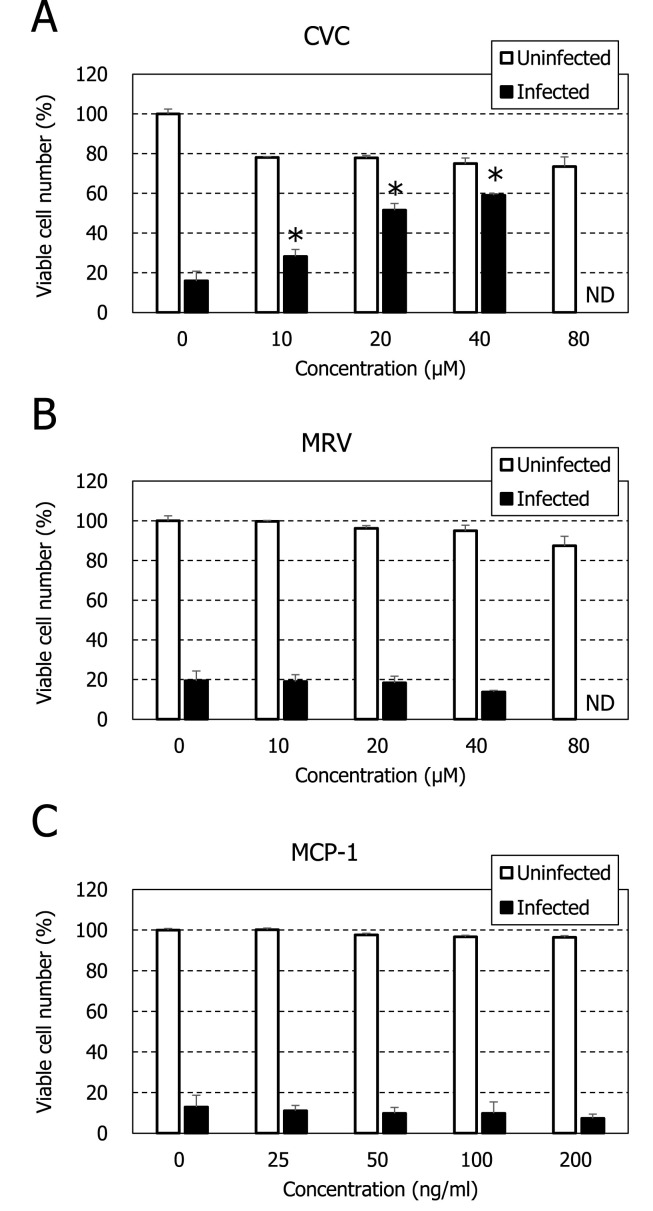
Cenicriviroc (CVC) is a small-molecule chemokine receptor antagonist with highly potent and selective anti-human immunodeficiency virus type 1 (HIV-1) activity through antagonizing C-C chemokine receptor type 5 (CCR5) as a coreceptor of HIV-1. CVC also strongly antagonizes C-C chemokine receptor type 2b (CCR2b), thereby it has potent anti-inflammatory and immunomodulatory effects. CVC is currently under clinical trials in the patients for treatment of nonalcoholic steatohepatitis, in which immune cell activation and dysregulation of proinflammatory cytokines play an important role in its pathogenesis. In this study, CVC was examined for its inhibitory effect on the replication of SARS-CoV-2, the causative agent of COVID-19, in cell cultures and found to be a selective inhibitor of the virus. The 50% effective concentrations of CVC were 19.0 and 2.9 μM in the assays based on the inhibition of virus-induced cell destruction and viral RNA levels in culture supernatants of the infected cells, respectively. Interestingly, the CCR5-specific antagonist maraviroc did not show any anti-SARS-CoV-2 activity. Although the mechanism of SARS-CoV-2 inhibition by CVC remains to be elucidated, CCR2b does not seem to be its target molecule. Considering the fact that the regulation of excessive immune activation is required to treat COVID-19 patients at the late stage of the disease, CVC should be further pursued for its potential in the treatment of SARS-CoV-2 infection.
西尼可韦(CVC)是一种小分子趋化因子受体拮抗剂,通过拮抗 HIV-1 的辅助受体 C-C 趋化因子受体 5(CCR5),对人类免疫缺陷病毒 1(HIV-1)具有高效和选择性的抑制作用。CVC 还强烈拮抗 C-C 趋化因子受体 2b(CCR2b),因此具有强大的抗炎和免疫调节作用。CVC 目前正在临床试验中,用于治疗非酒精性脂肪性肝炎,其中免疫细胞激活和促炎细胞因子的失调在其发病机制中起着重要作用。在这项研究中,研究人员研究了 CVC 对细胞培养物中导致 COVID-19 的 SARS-CoV-2 复制的抑制作用,发现它是该病毒的选择性抑制剂。基于抑制病毒诱导的细胞破坏和感染细胞培养上清液中病毒 RNA 水平的测定,CVC 的 50%有效浓度分别为 19.0 和 2.9 μM。有趣的是,CCR5 特异性拮抗剂马拉维若(maraviroc)对 SARS-CoV-2 没有任何抑制活性。尽管 CVC 抑制 SARS-CoV-2 的机制仍有待阐明,但 CCR2b 似乎不是其靶分子。考虑到需要调节过度的免疫激活来治疗 COVID-19 患者疾病后期,应该进一步探索 CVC 在治疗 SARS-CoV-2 感染方面的潜力。