Guo Xiangyang, Wang Jieying, Wang Nana, Mishra Anurag, Li Hongyan, Liu Hong, Fan Yingli, Liu Na, Wu Zhongliang
Department of Pediatrics, Shaanxi Provincial People's Hospital, The Affiliated Hospital of Xi'an Medical University, The Third Affiliated Hospital of Xi'an Jiaotong University, The Affiliated Hospital of Northwestern Polytechnical University, No. 256 Youyi West Road, Beilin District, Xi'an, Shaanxi 710068, China.
Department of Neurology, The First Affiliated Hospital of Air Force Military Medical University, No.127 Changle West Road, Xincheng District, Xi'an, Shaanxi 710032, China.
Saudi J Biol Sci. 2020 Aug;27(8):2149-2156. doi: 10.1016/j.sjbs.2020.05.030. Epub 2020 May 22.
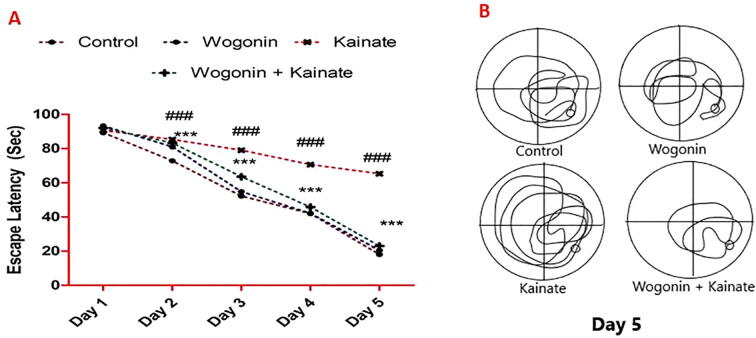
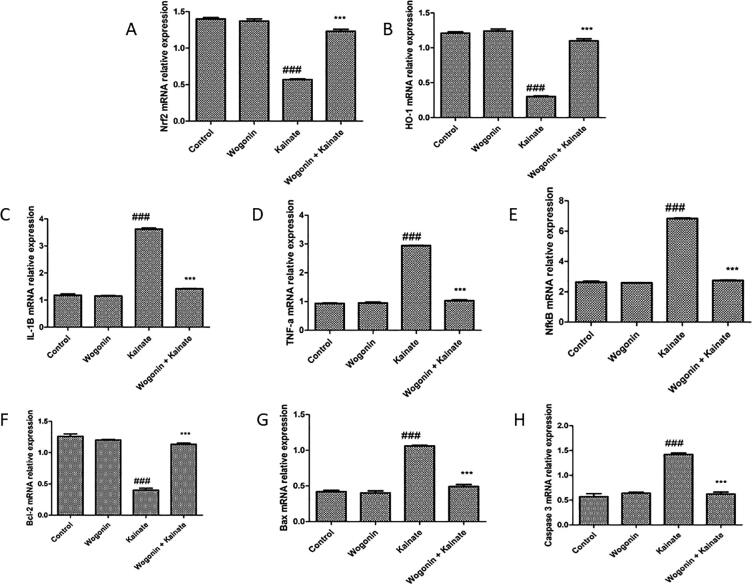
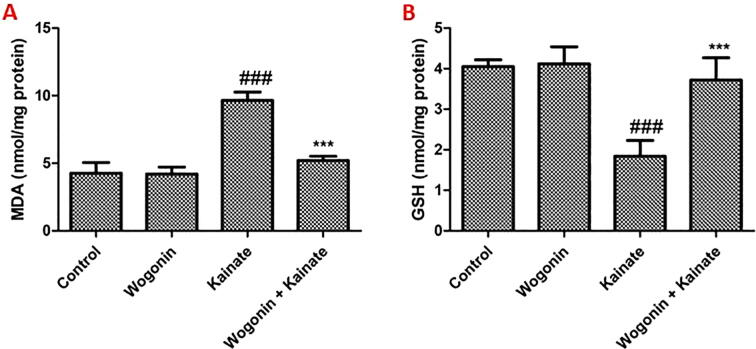
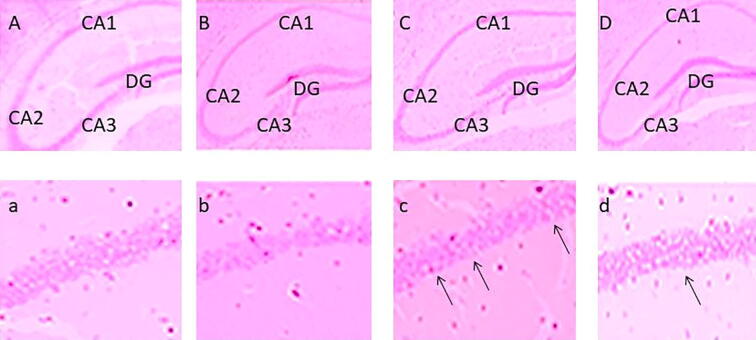
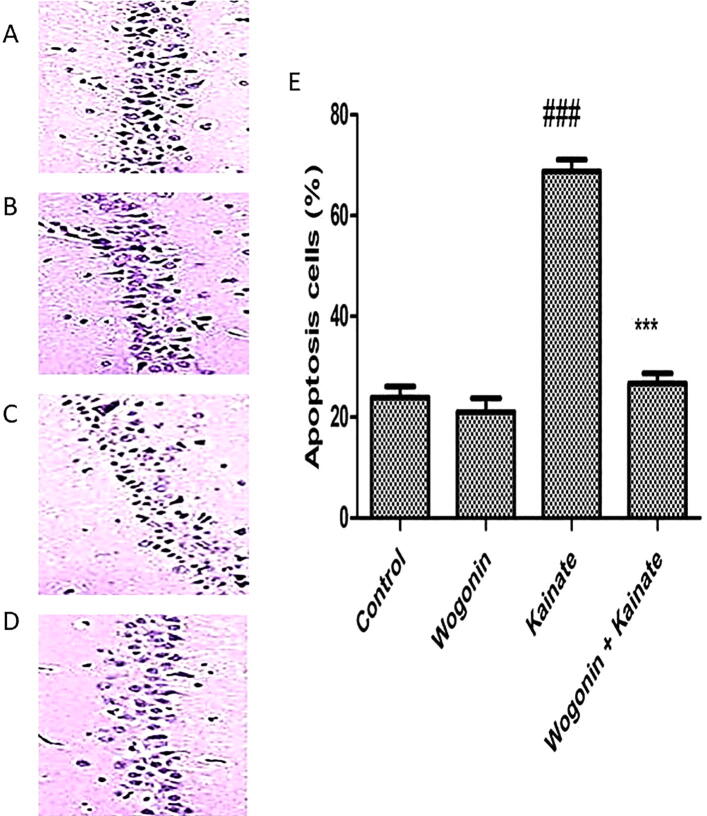
Previous studies demonstrated that the pathophysiological changes after temporal lobe epilepsy (TLE) such as oxidative stress, inflammatory reaction contribute to cognitive defect and neuronal damage. The present study was conducted to evaluate the anticonvulsant effect of wogonin ameliorates kainate-induced TLE, and to investigate the mechanism underlying these effects. Rats were divided into control, wogonin, kainate, and wogonin-pretreated kainate groups. The rat model of TLE was induced by unilateral intrahippocampal injection of 0.4 ug/ul of kainate. The results showed that the cognitive function in TLE rats was significantly impaired, and wogonin treatment improved cognitive function in the Morris water maze (MWM). H & E staining and TUNEL staining showed obvious damage in the hippocampus of TLE rats, and wogonin alleviated the damage. To evaluate the oxidative stress, the expression of MDA and GSH in plasma were detected. Nrf-2 and HO-1 mRNA expression in the hippocampus were detected. The levels of MDA in plasma increased in TLE rats, and the levels of GSH in plasma and Nrf-2, HO-1 in the brain decreased. Treatment with wogonin alleviated these changes. We also detected the mRNA expression of inflammatory mediators like IL-1β, TNF-α, and NF kB in the brain. The inflammatory reaction was significantly activated in the brain of TLE rats, and wogonin alleviated neuroinflammation. We detected the mRNA expression of Bcl-2, Bax, caspase-3, in the hippocampus. The levels of Bcl-2 decreased in TLE rats, Bax and caspase-3 increased, while wogonin alleviated these changes. The present study indicated that wogonin exerted a noticeable neuroprotective effect in kainate-induced TLE rats.
先前的研究表明,颞叶癫痫(TLE)后的病理生理变化,如氧化应激、炎症反应,会导致认知缺陷和神经元损伤。本研究旨在评估汉黄芩素改善海藻酸诱导的TLE的抗惊厥作用,并探讨其作用机制。将大鼠分为对照组、汉黄芩素组、海藻酸组和汉黄芩素预处理海藻酸组。通过单侧海马内注射0.4μg/μl海藻酸诱导TLE大鼠模型。结果显示,TLE大鼠的认知功能明显受损,而汉黄芩素治疗改善了Morris水迷宫(MWM)中的认知功能。苏木精-伊红(H&E)染色和TUNEL染色显示TLE大鼠海马有明显损伤,而汉黄芩素减轻了损伤。为评估氧化应激,检测了血浆中丙二醛(MDA)和谷胱甘肽(GSH)的表达。检测了海马中核因子E2相关因子2(Nrf-2)和血红素加氧酶-1(HO-1)mRNA的表达。TLE大鼠血浆中MDA水平升高,血浆中GSH水平以及脑中Nrf-2、HO-1水平降低。汉黄芩素治疗减轻了这些变化。我们还检测了脑中白细胞介素-1β(IL-1β)、肿瘤坏死因子-α(TNF-α)和核因子κB(NF-κB)等炎症介质的mRNA表达。TLE大鼠脑中炎症反应明显激活,而汉黄芩素减轻了神经炎症。我们检测了海马中B细胞淋巴瘤-2(Bcl-2)、Bax、半胱天冬酶-3(caspase-3)的mRNA表达。TLE大鼠中Bcl-2水平降低,Bax和caspase-3水平升高,而汉黄芩素减轻了这些变化。本研究表明,汉黄芩素对海藻酸诱导的TLE大鼠具有显著的神经保护作用。