Jo Seung-Woo, Do Jeong-Mi, Na Ho, Hong Ji Won, Kim Il-Sup, Yoon Ho-Sung
Department of Energy Science, Kyungpook National University, Daegu, South Korea.
Department of Biology, Kyungpook National University, Daegu, South Korea.
PeerJ. 2020 Jul 16;8:e9418. doi: 10.7717/peerj.9418. eCollection 2020.
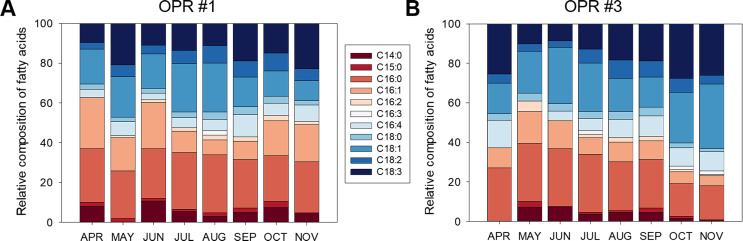
Metagenome studies have provided us with insights into the complex interactions of microorganisms with their environments and hosts. Few studies have focused on microalgae-associated metagenomes, and no study has addressed aquatic microalgae and their bacterial communities in open pond raceways (OPRs). This study explored the possibility of using microalgal biomasses from OPRs for biodiesel and biofertilizer production. The fatty acid profiles of the biomasses and the physical and chemical properties of derived fuels were evaluated. In addition, the phenotype-based environmental adaptation ability of soybean plants was assessed. The growth rate, biomass, and lipid productivity of microalgae were also examined during mass cultivation from April to November 2017. Metagenomics analysis using MiSeq identified ∼127 eukaryotic phylotypes following mass cultivation with (OPR 1) or without (OPR 3) a semitransparent film. Of these, ∼80 phylotypes were found in both OPRs, while 23 and 24 phylotypes were identified in OPRs 1 and 3, respectively. The phylotypes belonged to various genera, such as , , , and , of which, the dominant microalgal species was sp. On average, OPRs 1 and 3 produced ∼8.6 and 9.9 g m d (0.307 and 0.309 DW L) of total biomass, respectively, of which 14.0 and 13.3 wt% respectively, was lipid content. Fatty acid profiling revealed that total saturated fatty acids (mainly C16:0) of biodiesel obtained from the microalgal biomasses in OPRs 1 and 3 were 34.93% and 32.85%, respectively; total monounsaturated fatty acids (C16:1 and C18:1) were 32.40% and 31.64%, respectively; and polyunsaturated fatty acids (including C18:3) were 32.68% and 35.50%, respectively. Fuel properties determined by empirical equations were within the limits of biodiesel standards ASTM D6751 and EN 14214. Culture solutions with or without microalgal biomasses enhanced the environmental adaptation ability of soybean plants, increasing their seed production. Therefore, microalgal biomass produced through mass cultivation is excellent feedstock for producing high-quality biodiesel and biofertilizer.
宏基因组研究让我们深入了解了微生物与其环境和宿主之间的复杂相互作用。很少有研究聚焦于与微藻相关的宏基因组,且尚无研究涉及开放式池塘跑道(OPR)中的水生微藻及其细菌群落。本研究探索了利用OPR中的微藻生物质生产生物柴油和生物肥料的可能性。评估了生物质的脂肪酸谱以及衍生燃料的物理和化学性质。此外,还评估了大豆植株基于表型的环境适应能力。在2017年4月至11月的大规模培养期间,还检测了微藻的生长速率、生物量和脂质生产率。使用MiSeq进行的宏基因组学分析确定,在使用(OPR 1)或不使用(OPR 3)半透明薄膜进行大规模培养后,分别鉴定出约127种真核生物系统型。其中,在两个OPR中均发现约80种系统型,而在OPR 1和OPR 3中分别鉴定出23种和24种系统型。这些系统型属于不同的属,如 、 、 和 等,其中,优势微藻物种为 属。平均而言,OPR 1和OPR 3分别产生约8.6和9.9 g m d(0.307和0.309 DW L)的总生物量,其中脂质含量分别为14.0 wt%和13.3 wt%。脂肪酸分析表明,从OPR 1和OPR 3中的微藻生物质获得的生物柴油的总饱和脂肪酸(主要为C16:0)分别为34.93%和32.85%;总单不饱和脂肪酸(C16:1和C18:1)分别为32.40%和31.64%;多不饱和脂肪酸(包括C18:3)分别为32.68%和35.50%。通过经验公式确定的燃料性质在生物柴油标准ASTM D6751和EN 14214的范围内。含有或不含微藻生物质的培养液提高了大豆植株的环境适应能力,增加了它们的种子产量。因此,通过大规模培养产生的微藻生物质是生产高质量生物柴油和生物肥料的优质原料。