Mohd Jaya Fatin N, Garcia Sergio G, Borràs Francesc E, Chan Godfrey C F, Franquesa Marcella
Department of Pediatrics and Adolescent Medicine, Faculty of Medicine, The University of Hong Kong, 21 Sassoon Road, Hong Kong.
REMAR-IVECAT Group, Health Science Research Institute Germans Trias I Pujol, Can Ruti Campus, 08916, Badalona, Spain.
J Transl Autoimmun. 2019 Aug 17;2:100011. doi: 10.1016/j.jtauto.2019.100011. eCollection 2019 Dec.
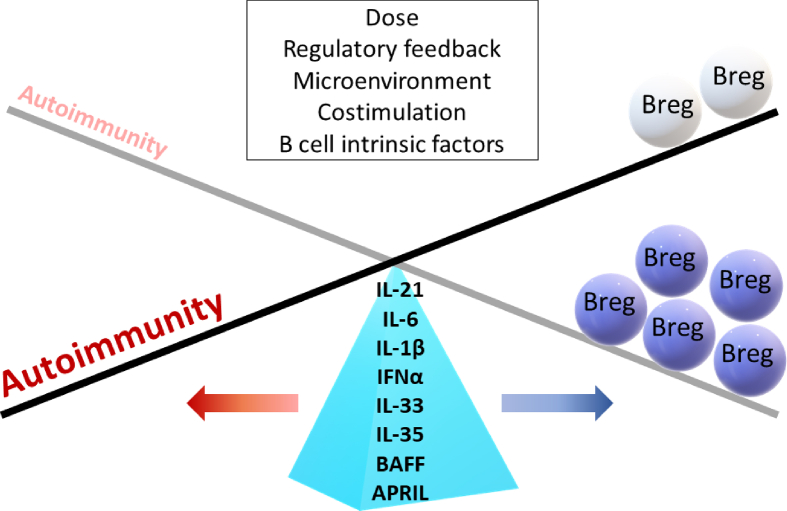
Regulatory B cells (Breg) are crucial immunoregulators that maintain peripheral tolerance and suppress inflammatory autoimmune responses. In recent years, our understanding on the nature and mechanism of action of Bregs has revealed the important role of cytokines in promoting the regulatory properties of this unique B cell subset, both in animal and human models. In this review, we compiled the cytokines that have been reported by multiple studies to induce the expansion of Breg. The Breg-inducing cytokines which are currently known include IL-21, IL-6, IL1β, IFNα, IL-33, IL-35, BAFF and APRIL. As cytokines are also known to play a pivotal role in the pathogenesis of autoimmune diseases, in parallel we reviewed the pattern of expression of the Breg-inducing cytokines in Systemic Lupus Erythematosus (SLE), Rheumatoid Arthritis (RA), Inflammatory Bowel Diseases (IBD) and Multiple Sclerosis (MS). We show here that Breg-inducing cytokines are commonly implicated in these inflammatory diseases where they typically have a higher expression than in healthy individuals, suggesting their paradoxical nature. Interestingly, despite the general overexpression of Breg-inducing cytokines, it is known that Breg cells are often numerically or functionally impaired in various autoimmune conditions. Considering these alterations, we explored the possible parameters that may influence the function of Breg-inducing cytokines in exhibiting either their regulatory or pro-inflammatory properties in the context of autoimmune conditions.
调节性B细胞(Breg)是维持外周免疫耐受和抑制炎症性自身免疫反应的关键免疫调节细胞。近年来,我们对Breg细胞的性质和作用机制的认识揭示了细胞因子在促进这一独特B细胞亚群的调节特性方面的重要作用,这在动物和人类模型中均有体现。在本综述中,我们汇总了多项研究报道的可诱导Breg细胞扩增的细胞因子。目前已知的可诱导Breg细胞的细胞因子包括白细胞介素-21(IL-21)、白细胞介素-6(IL-6)、白细胞介素-1β(IL1β)、干扰素α(IFNα)、白细胞介素-33(IL-33)、白细胞介素-35(IL-35)、B细胞活化因子(BAFF)和增殖诱导配体(APRIL)。由于细胞因子在自身免疫性疾病的发病机制中也起着关键作用,因此我们同时综述了可诱导Breg细胞的细胞因子在系统性红斑狼疮(SLE)、类风湿关节炎(RA)、炎症性肠病(IBD)和多发性硬化症(MS)中的表达模式。我们在此表明,可诱导Breg细胞的细胞因子通常与这些炎症性疾病有关,在这些疾病中它们的表达通常高于健康个体,这表明了它们矛盾的性质。有趣的是,尽管可诱导Breg细胞的细胞因子普遍过度表达,但已知Breg细胞在各种自身免疫性疾病中往往在数量上或功能上受损。考虑到这些改变,我们探讨了在自身免疫性疾病背景下可能影响可诱导Breg细胞的细胞因子发挥其调节或促炎特性的功能的参数。