Bo Marco, Niegowska Magdalena, Eames Hayley L, Almuttaqi Hannah, Arru Giannina, Erre Gian Luca, Passiu Giuseppe, Khoyratty Tariq E, van Grinsven Erinke, Udalova Irina A, Sechi Leonardo A
Department of Biomedical Sciences, Section of Microbiology and Virology, University of Sassari, Viale San Pietro 43b, 07100, Sassari, Italy.
Kennedy Institute of Rheumatology, Oxford University, Oxford, Roosevelt Drive, Headington, OX3 7FY, United Kingdom.
J Transl Autoimmun. 2020 Mar 17;3:100048. doi: 10.1016/j.jtauto.2020.100048. eCollection 2020.
Improved knowledge of different biomarkers is crucial for early diagnosis of rheumatic diseases and to provide important insights for clinical management. In this study, we evaluated the seroreactivity of patients with different connective tissue diseases (CTDs) (rheumatoid arthritis, RA; systemic lupus erythematosus, SLE; systemic sclerosis, SSc; and Sjogren's syndrome, SSj) to interferon regulatory factor 5 (IRF5) peptide and homologs derived from Epstein-Barr virus (EBV) and subsp. (MAP). Antigen-induced arthritis (AIA) experiments have been performed in control and IRF5 conditional knockout mice to reinforce the hypothesis that antibodies generated against the three homologous peptides are cross-reactive.
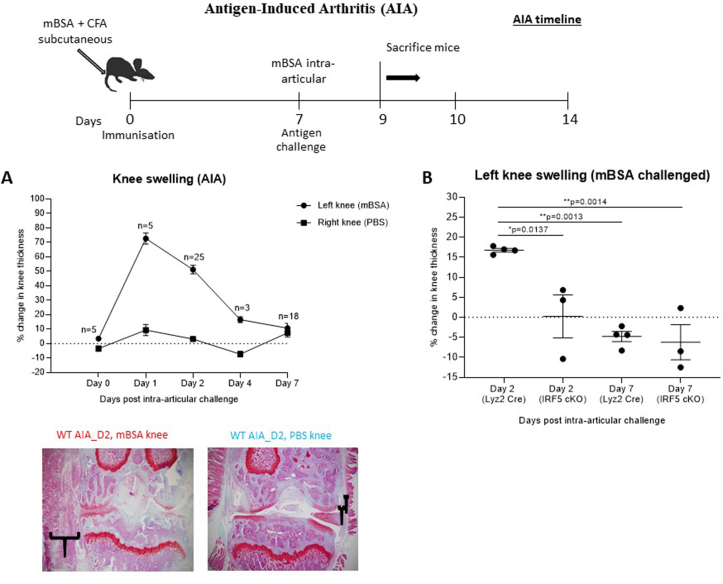
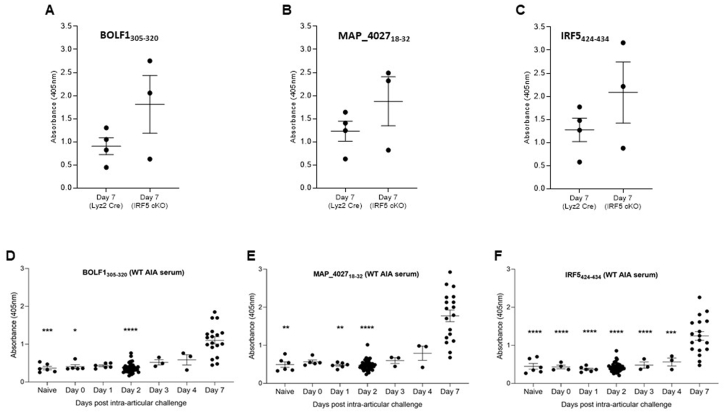
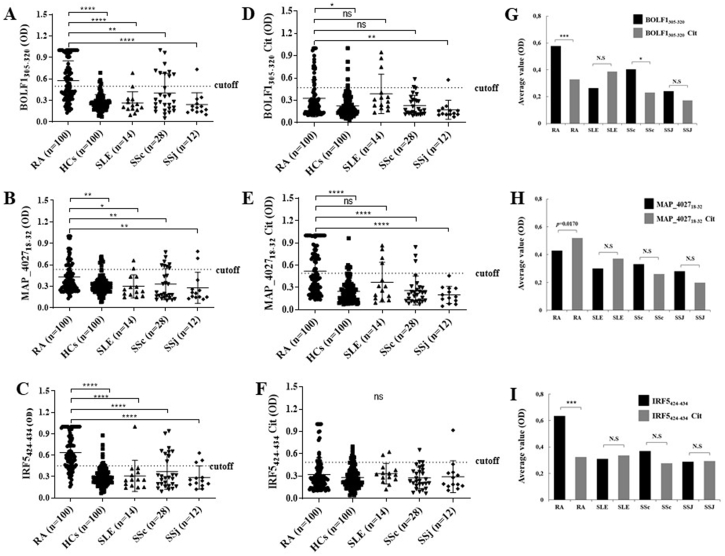
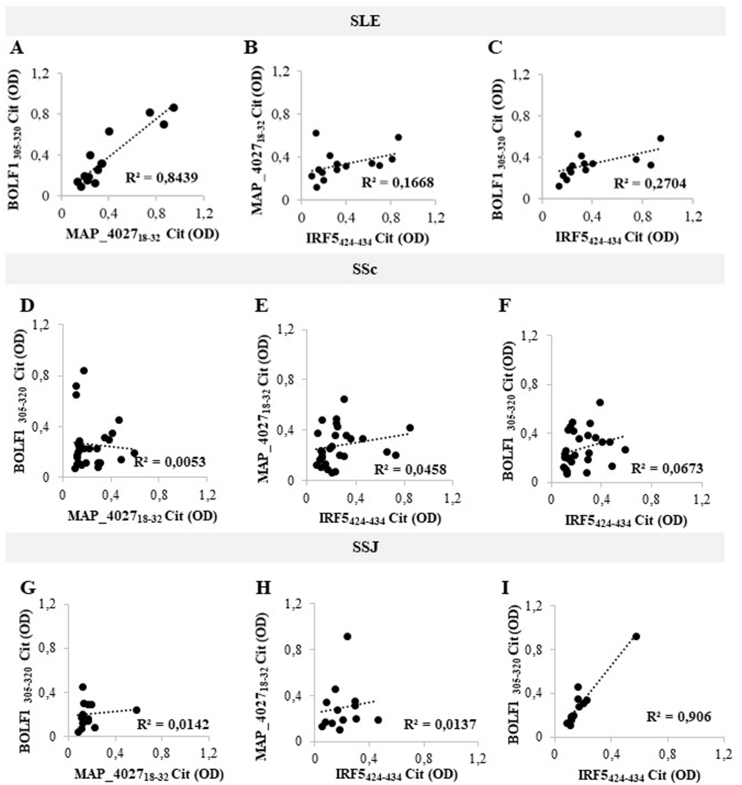
Reactivity against wild-type (wt) and citrullinated (cit) IRF5 (IRF5), MAP (MAP_4027) and EBV (BOLF1) peptides were tested by indirect ELISA in sera from 100 RA patients, 54 patients with other CTDs (14 SLE, 28 SSc and 12 SSj) and 100 healthy subjects (HCs). Antibody responses to the same wt peptides have been tested in AIA mouse sera after immunization with complete Freud's adjuvant (CFA) and methylated bovine serum albumin (mBSA) to induce arthritis in the knee joint.
BOLF1, MAP_4027 and IRF5 peptides triggered different antibody responses in CTD diseases with a stronger reactivity in RA (=0.0001). Similar trends were observed in AIA mice with significantly higher reactivity after 7 days from induction of arthritis. We also found statistically significant differences in antibody responses between SSc and HCs for BOLF1 (=0.003), MAP_4027 (=0.0076) and IRF5 (=0.0042). Peripheral reactivity to cit peptides was lower compared to their wt counterparts, except for cit-MAP_4027, which induced stronger responses in RA than wt-MAP_4027 (46% 26%, =0.0170). Our results show differential antibody responses to BOLF1, MAP_4027 and IRF5 peptides among CTDs, highlighting their potential as diagnostic biomarkers in these diseases. Experiments performed in IRF5 conditional knockout mice support the hypothesis of cross-reactivity between the investigated homologous antigens.
深入了解不同的生物标志物对于风湿性疾病的早期诊断以及为临床管理提供重要见解至关重要。在本研究中,我们评估了不同结缔组织病(CTD)患者(类风湿关节炎,RA;系统性红斑狼疮,SLE;系统性硬化症,SSc;以及干燥综合征,SSj)对干扰素调节因子5(IRF5)肽以及源自爱泼斯坦 - 巴尔病毒(EBV)和亚种(MAP)的同源物的血清反应性。已在对照小鼠和IRF5条件性敲除小鼠中进行了抗原诱导性关节炎(AIA)实验,以强化针对这三种同源肽产生的抗体具有交叉反应性的假设。
通过间接ELISA检测了100例RA患者、54例其他CTD患者(14例SLE、28例SSc和12例SSj)以及100名健康对照者(HC)血清中对野生型(wt)和瓜氨酸化(cit)的IRF5(IRF5)、MAP(MAP_4027)和EBV(BOLF1)肽的反应性。在用完全弗氏佐剂(CFA)和甲基化牛血清白蛋白(mBSA)免疫以诱导膝关节关节炎后,检测了AIA小鼠血清中对相同wt肽的抗体反应。
BOLF1、MAP_4027和IRF5肽在CTD疾病中引发了不同的抗体反应,在RA中反应性更强(P = 0.0001)。在AIA小鼠中观察到类似趋势,在关节炎诱导7天后反应性显著更高。我们还发现,在SSc患者和HC之间,BOLF1(P = 0.003)、MAP_4027(P = 0.0076)和IRF5(P = 0.0042)的抗体反应存在统计学显著差异。与野生型对应物相比,外周对瓜氨酸化肽的反应性较低,除了瓜氨酸化的MAP_4027,其在RA中诱导的反应比野生型MAP_4027更强(46% ± 26%,P = 0.0170)。我们的结果显示了CTD之间对BOLF1、MAP_4027和IRF5肽的不同抗体反应,突出了它们作为这些疾病诊断生物标志物的潜力。在IRF5条件性敲除小鼠中进行的实验支持了所研究的同源抗原之间存在交叉反应性的假设。