School of Environment, Faculty of Science, University of Auckland, Private Bag 92019, Auckland, New Zealand.
School of Environment, Faculty of Science, University of Auckland, Private Bag 92019, Auckland, New Zealand.
Sci Total Environ. 2020 Dec 1;746:141129. doi: 10.1016/j.scitotenv.2020.141129. Epub 2020 Jul 27.
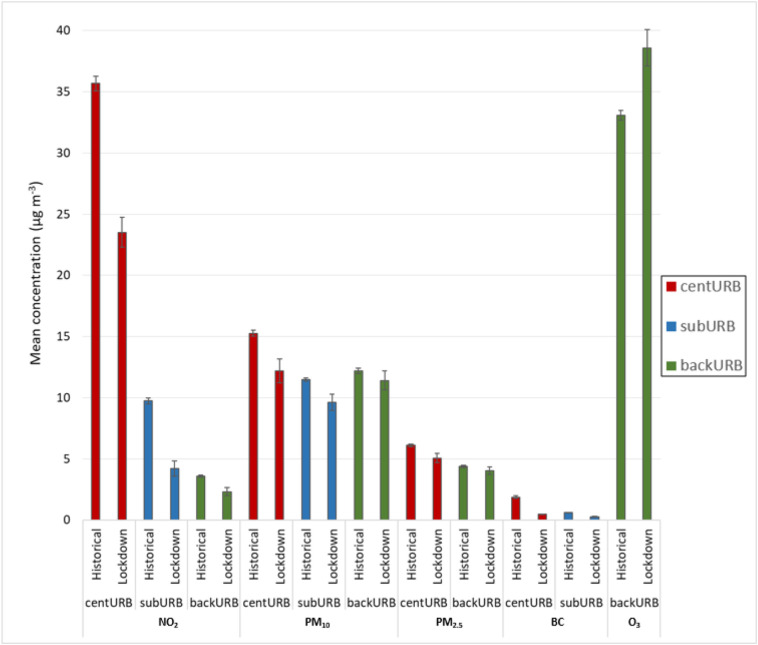
The current changes in vehicle movement due to 'lockdown' conditions (imposed in cities worldwide in response to the COVID-19 epidemic) provide opportunities to quantify the local impact of 'controlled interventions' on air quality and establish baseline pollution concentrations in cities. Here, we present a case study from Auckland, New Zealand, an isolated Southern Hemisphere city, which is largely unaffected by long-range pollution transport or industrial sources of air pollution. In this city, traffic flows reduced by 60-80% as a result of a government-led initiative to contain the virus by limiting all transport to only essential services. In this paper, ambient pollutant concentrations of NO, O, BC, PM, and PM are compared between the lockdown period and comparable periods in the historical air pollution record, while taking into account changes in the local meteorology. We show that this 'natural experiment' in source emission reductions had significant but non-linear impacts on air quality. While emission inventories and receptor modelling approaches confirm the dominance of traffic sources for NO (86%), and BC (72%) across the city, observations suggest a consequent reduction in NO of only 34-57% and a reduction in BC of 55-75%. The observed reductions in PM (still likely to be dominated by traffic emissions), and PM (dominated by sea salt, traffic emissions to a lesser extent, and affected by seasonality) were found to be significantly less (8-17% for PM and 7-20% for PM). The impact of this unplanned controlled intervention shows the importance of establishing accurate, local-scale emission inventories, and the potential of the local atmospheric chemistry and meteorology in limiting their accuracy.
由于新冠疫情而在全球城市实施的“封锁”措施导致当前车辆行驶的变化为量化“人为干预”对空气质量的局部影响以及在城市中建立污染基准浓度提供了机会。在这里,我们呈现了一个来自新西兰奥克兰的案例研究,这是一个地处南半球的孤立城市,基本不受长距离污染传输或工业空气污染源的影响。由于政府采取限制所有交通为必要服务的措施来控制病毒,该城市的交通流量减少了 60-80%。在本文中,我们将比较封锁期间和历史空气污染记录中可比时期的环境污染物浓度,同时考虑到当地气象条件的变化。我们表明,这种减少污染源排放的“自然实验”对空气质量产生了显著但非线性的影响。尽管排放清单和受体模型方法证实了交通源对整个城市的 NO(86%)和 BC(72%)的主导地位,但观测结果表明,NO 的减少仅为 34-57%,BC 的减少为 55-75%。观测到的 PM(仍可能主要来自交通排放)和 PM(主要来自海盐,其次是交通排放,并且受季节性影响)的减少明显较小(PM 为 8-17%,PM 为 7-20%)。这种未计划的人为干预的影响表明了建立准确的、局部尺度的排放清单的重要性,以及当地大气化学和气象条件在限制其准确性方面的潜力。