Kelly Frank J, Fussell Julia C
NIHR Health Protection Research Unit in Health Impact of Environmental Hazards, MRC-PHE Centre for Environment and Health, Facility of Life Sciences and Medicine, King's College London, 150 Stamford Street, London, SE1 9NH, UK,
Environ Geochem Health. 2015 Aug;37(4):631-49. doi: 10.1007/s10653-015-9720-1. Epub 2015 Jun 4.
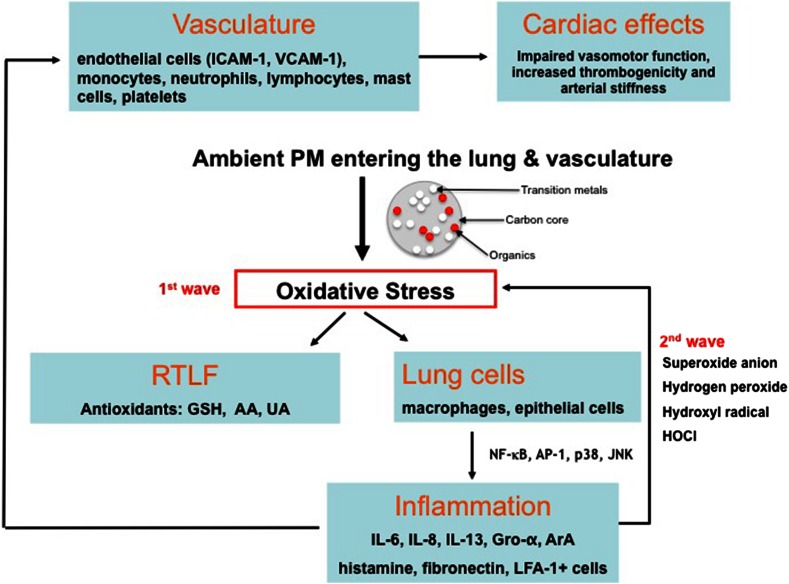
Despite past improvements in air quality, very large parts of the population in urban areas breathe air that does not meet European standards let alone the health-based World Health Organisation Air Quality Guidelines. Over the last 10 years, there has been a substantial increase in findings that particulate matter (PM) air pollution is not only exerting a greater impact on established health endpoints, but is also associated with a broader number of disease outcomes. Data strongly suggest that effects have no threshold within the studied range of ambient concentrations, can occur at levels close to PM2.5 background concentrations and that they follow a mostly linear concentration-response function. Having firmly established this significant public health problem, there has been an enormous effort to identify what it is in ambient PM that affects health and to understand the underlying biological basis of toxicity by identifying mechanistic pathways-information that in turn will inform policy makers how best to legislate for cleaner air. Another intervention in moving towards a healthier environment depends upon the achieving the right public attitude and behaviour by the use of optimal air pollution monitoring, forecasting and reporting that exploits increasingly sophisticated information systems. Improving air quality is a considerable but not an intractable challenge. Translating the correct scientific evidence into bold, realistic and effective policies undisputedly has the potential to reduce air pollution so that it no longer poses a damaging and costly toll on public health.
尽管过去空气质量有所改善,但城市地区很大一部分人口呼吸的空气仍不符合欧洲标准,更不用说基于健康的世界卫生组织空气质量指南了。在过去十年中,有大量研究发现,颗粒物(PM)空气污染不仅对既定的健康指标产生更大影响,还与更多疾病结果相关。数据有力地表明,在所研究的环境浓度范围内,影响没有阈值,在接近PM2.5背景浓度的水平上就可能发生,而且它们大多遵循线性浓度-反应函数。在确定了这一重大公共卫生问题后,人们付出了巨大努力来确定环境中的PM中影响健康的成分,并通过识别作用机制途径来了解毒性的潜在生物学基础,这些信息反过来将告知政策制定者如何以最佳方式制定更清洁空气的立法。朝着更健康环境迈进的另一项干预措施取决于通过利用日益复杂的信息系统进行最佳空气污染监测、预测和报告,来培养正确的公众态度和行为。改善空气质量是一项艰巨但并非无法解决的挑战。将正确的科学证据转化为大胆、现实和有效的政策无疑有可能减少空气污染,使其不再对公众健康造成损害和高昂代价。