IEEE Trans Med Imaging. 2020 Dec;39(12):3868-3878. doi: 10.1109/TMI.2020.3006437. Epub 2020 Nov 30.
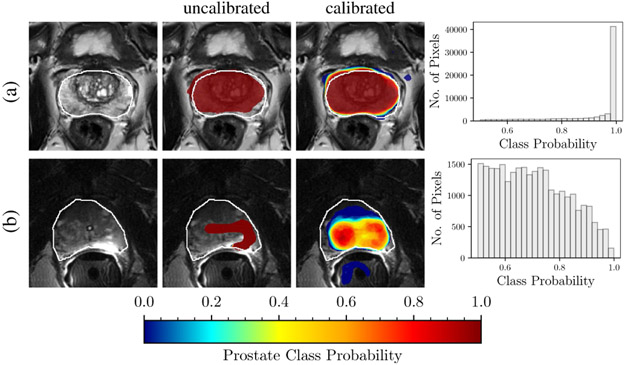
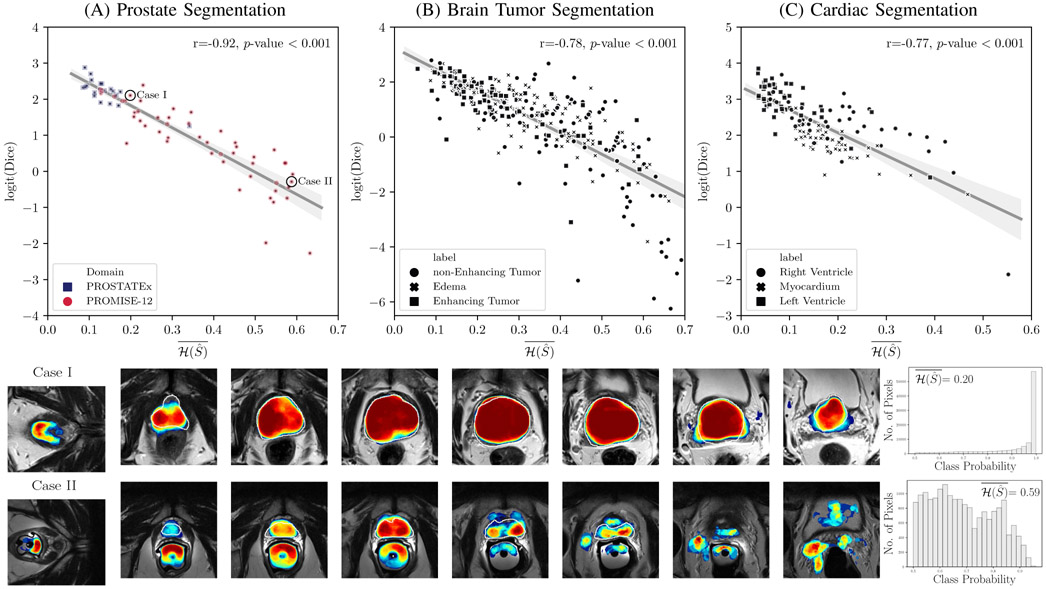
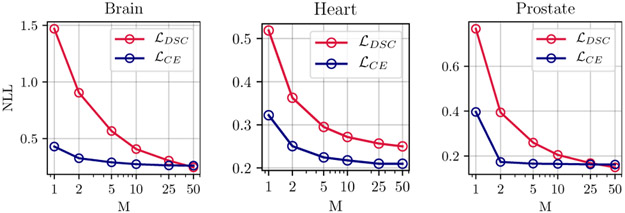
Fully convolutional neural networks (FCNs), and in particular U-Nets, have achieved state-of-the-art results in semantic segmentation for numerous medical imaging applications. Moreover, batch normalization and Dice loss have been used successfully to stabilize and accelerate training. However, these networks are poorly calibrated i.e. they tend to produce overconfident predictions for both correct and erroneous classifications, making them unreliable and hard to interpret. In this paper, we study predictive uncertainty estimation in FCNs for medical image segmentation. We make the following contributions: 1) We systematically compare cross-entropy loss with Dice loss in terms of segmentation quality and uncertainty estimation of FCNs; 2) We propose model ensembling for confidence calibration of the FCNs trained with batch normalization and Dice loss; 3) We assess the ability of calibrated FCNs to predict segmentation quality of structures and detect out-of-distribution test examples. We conduct extensive experiments across three medical image segmentation applications of the brain, the heart, and the prostate to evaluate our contributions. The results of this study offer considerable insight into the predictive uncertainty estimation and out-of-distribution detection in medical image segmentation and provide practical recipes for confidence calibration. Moreover, we consistently demonstrate that model ensembling improves confidence calibration.
全卷积神经网络(FCNs),特别是 U-Nets,在许多医学图像应用的语义分割中取得了最先进的结果。此外,批量归一化和 Dice 损失已成功用于稳定和加速训练。然而,这些网络的校准效果很差,即它们往往对正确和错误分类都会产生过度自信的预测,从而导致它们不可靠且难以解释。在本文中,我们研究了用于医学图像分割的 FCN 中的预测不确定性估计。我们做出了以下贡献:1)我们系统地比较了交叉熵损失和 Dice 损失在 FCN 的分割质量和不确定性估计方面的表现;2)我们提出了模型集成,用于对使用批量归一化和 Dice 损失训练的 FCN 进行置信度校准;3)我们评估了校准后的 FCN 预测结构分割质量和检测离群测试示例的能力。我们在脑、心和前列腺三个医学图像分割应用中进行了广泛的实验,以评估我们的贡献。这项研究的结果为医学图像分割中的预测不确定性估计和离群检测提供了重要的见解,并为置信度校准提供了实用的方法。此外,我们始终证明模型集成可以提高置信度校准的效果。