School of Health and Welfare, Halmstad University, Box 823, SE-301 18, Halmstad, Sweden.
Spenshult Research and Development Centre, Bäckagårdsvägen 47, SE-302 74, Halmstad, Sweden.
BMC Pediatr. 2023 Jun 29;23(1):328. doi: 10.1186/s12887-023-04139-2.
Pain is common in children and its associations with various biopsychosocial factors is complex. Comprehensive pain assessments could contribute to a better understanding of pediatric pain, but these assessments are scarce in literature. The aim of this study was to examine differences in pain prevalence and pain patterns in 10-year-old boys and girls from a Swedish birth cohort and to study associations between pain, health-related quality of life and various lifestyle factors stratified by sex.
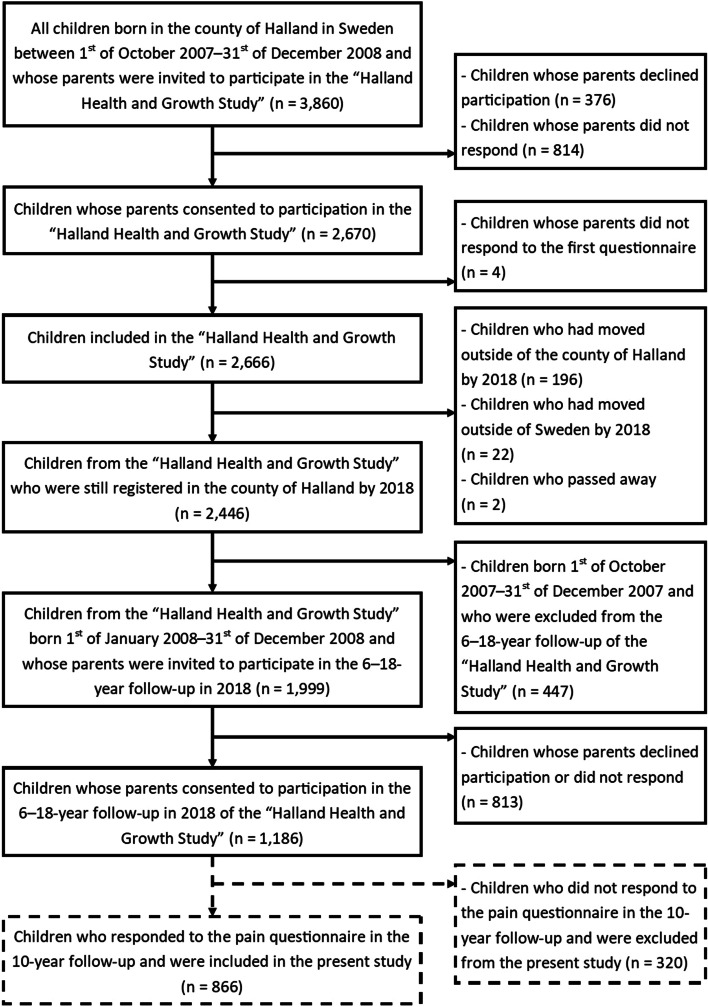
866 children (426 boys and 440 girls) and their parents from the "Halland Health and Growth Study" participated in this cross-sectional study. Children were categorized into two pain groups, "infrequent pain" (never-monthly pain) or "frequent pain" (weekly-almost daily pain), based on a pain mannequin. Univariate logistic regression analyses, stratified by sex, were performed to study associations between frequent pain and children's self-reports of disease and disability and health-related quality of life (Kidscreen-27, five domains), and parents' reports of their child's sleep (quality and duration), physical activity time, sedentary time, and participation in organized physical activities.
The prevalence of frequent pain was 36.5% with no difference between boys and girls (p = 0.442). Boys with a longstanding disease or disability had higher odds of being in the frequent pain group (OR 2.167, 95% CI 1.168-4.020). Higher scores on health-related quality of life in all five domains for girls, and in two domains for boys, was associated with lower odds of being categorized into the frequent pain group. Frequent pain was associated with poor sleep quality (boys OR 2.533, 95% CI 1.243-5.162; girls OR 2.803, 95% CI 1.276-6.158) and more sedentary time (boys weekends OR 1.131, 95% CI 1.022-1.253; girls weekdays OR 1.137, 95% CI 1.032-1.253), but not with physical activity.
The high prevalence of frequent pain needs to be acknowledged and treated by school health-care services and the healthcare sector in order to prevent pain from influencing health and lifestyle factors negatively in children.
疼痛在儿童中很常见,其与各种身心社会因素的关系较为复杂。全面的疼痛评估有助于更好地了解儿童疼痛,但此类评估在文献中较为少见。本研究旨在比较瑞典出生队列中 10 岁男孩和女孩的疼痛发生率和疼痛模式,并按性别分层,研究疼痛与健康相关生活质量以及各种生活方式因素之间的关联。
共有 866 名儿童(426 名男孩和 440 名女孩)及其父母参加了这项横断面研究。基于疼痛模型,儿童被分为“偶发性疼痛”(从不/每月疼痛)或“频发疼痛”(每周/几乎每天疼痛)两组。采用单变量逻辑回归分析,按性别分层,研究频发疼痛与儿童自报疾病和残疾以及健康相关生活质量(儿童生活质量问卷 27 项,五个领域)之间的关联,并分析父母报告的儿童睡眠(质量和时长)、身体活动时间、久坐时间和参加有组织的体育活动时间与儿童疼痛之间的关联。
频发疼痛的发生率为 36.5%,男孩和女孩之间无差异(p = 0.442)。患有慢性疾病或残疾的男孩发生频发疼痛的可能性更高(比值比 2.167,95%可信区间 1.168-4.020)。女孩在所有五个健康相关生活质量领域和男孩在两个领域的评分较高,其归类为频发疼痛组的可能性较低。频发疼痛与较差的睡眠质量相关(男孩比值比 2.533,95%可信区间 1.243-5.162;女孩比值比 2.803,95%可信区间 1.276-6.158),且与更多的久坐时间相关(男孩周末比值比 1.131,95%可信区间 1.022-1.253;女孩工作日比值比 1.137,95%可信区间 1.032-1.253),但与身体活动无关。
频发疼痛的高发生率需要得到学校保健服务和医疗保健部门的重视和治疗,以防止疼痛对儿童的健康和生活方式因素产生负面影响。