State Key Laboratory of Medical Molecular Biology, Department of Biochemistry and Molecular Biology, Institute of Basic Medical Sciences, Chinese Academy of Medical Sciences and Peking Union Medical College, Beijing, 100005, China.
State Key Laboratory of Membrane Biology, Tsinghua University-Peking University Joint Center for Life Sciences, School of Life Sciences, TsinghuaUniversity, Beijing, 100084, China.
J Exp Clin Cancer Res. 2020 Aug 3;39(1):147. doi: 10.1186/s13046-020-01632-9.
Colorectal cancer (CRC) is one of the most common malignancies, and it's expected that the CRC burden will substantially increase in the next two decades. New biomarkers for targeted treatment and associated molecular mechanism of tumorigenesis remain to be explored. In this study, we investigated whether PDCD6 plays an oncogenic role in colorectal cancer and its underlying mechanism.
Programmed cell death protein 6 (PDCD6) expression in CRC samples were analyzed by immunohistochemistry and immunofluorescence. The prognosis between PDCD6 and clinical features were analyzed. The roles of PDCD6 in cellular proliferation and tumor growth were measured by using CCK8, colony formation, and tumor xenograft in nude mice. RNA-sequence (RNA-seq), Mass Spectrum (MS), Co-Immunoprecipitation (Co-IP) and Western blot were utilized to investigate the mechanism of tumor progression. Immunohistochemistry (IHC) and quantitative real-time PCR (qRT-PCR) were performed to determine the correlation of PDCD6 and MAPK pathway.
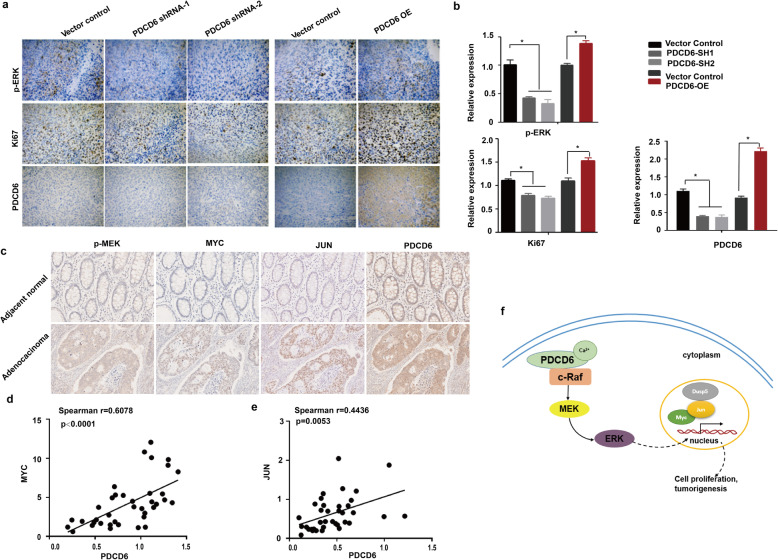
Higher expression levels of PDCD6 in tumor tissues were associated with a poorer prognosis in patients with CRC. Furthermore, PDCD6 increased cell proliferation in vitro and tumor growth in vivo. Mechanistically, RNA-seq showed that PDCD6 could affect the activation of the MAPK signaling pathway. PDCD6 interacted with c-Raf, resulting in the activation of downstream c-Raf/MEK/ERK pathway and the upregulation of core cell proliferation genes such as MYC and JUN.
These findings reveal the oncogenic effect of PDCD6 in CRC by activating c-Raf/MEK/ERK pathway and indicate that PDCD6 might be a potential prognostic indicator and therapeutic target for patients with colorectal cancer.
结直肠癌(CRC)是最常见的恶性肿瘤之一,预计在未来二十年 CRC 的负担将大幅增加。仍需要探索新的靶向治疗生物标志物和相关的肿瘤发生分子机制。在这项研究中,我们研究了 PDCD6 是否在结直肠癌中发挥致癌作用及其潜在机制。
通过免疫组化和免疫荧光分析 CRC 样本中的程序性细胞死亡蛋白 6(PDCD6)表达。分析 PDCD6 与临床特征之间的预后关系。通过 CCK8、集落形成和裸鼠肿瘤异种移植实验来测量 PDCD6 在细胞增殖和肿瘤生长中的作用。利用 RNA 测序(RNA-seq)、质谱(MS)、共免疫沉淀(Co-IP)和 Western blot 来研究肿瘤进展的机制。免疫组化(IHC)和实时定量 PCR(qRT-PCR)用于确定 PDCD6 与 MAPK 通路的相关性。
肿瘤组织中 PDCD6 表达水平较高与 CRC 患者的预后较差相关。此外,PDCD6 增加了体外细胞增殖和体内肿瘤生长。在机制上,RNA-seq 显示 PDCD6 可以影响 MAPK 信号通路的激活。PDCD6 与 c-Raf 相互作用,导致下游 c-Raf/MEK/ERK 通路的激活和核心细胞增殖基因如 MYC 和 JUN 的上调。
这些发现揭示了 PDCD6 通过激活 c-Raf/MEK/ERK 通路在 CRC 中的致癌作用,并表明 PDCD6 可能是结直肠癌患者的潜在预后指标和治疗靶点。