Section of Clinical Nutrition and Nutrigenomics, Department of Biomedicine and Prevention, University of Rome Tor Vergata, 00133, Rome, Italy.
Department of Experimental Medicine, University of Rome Sapienza, 00161, Rome, Italy.
J Transl Med. 2020 Aug 3;18(1):299. doi: 10.1186/s12967-020-02464-z.
Obesity and steatosis are associated with COVID-19 severe pneumonia. Elevated levels of pro-inflammatory cytokines and reduced immune response are typical of these patients. In particular, adipose tissue is the organ playing the crucial role. So, it is necessary to evaluate fat mass and not simpler body mass index (BMI), because BMI leaves a portion of the obese population unrecognized. The aim is to evaluate the relationship between Percentage of Fat Mass (FM%) and immune-inflammatory response, after 10 days in Intensive Care Unit (ICU).
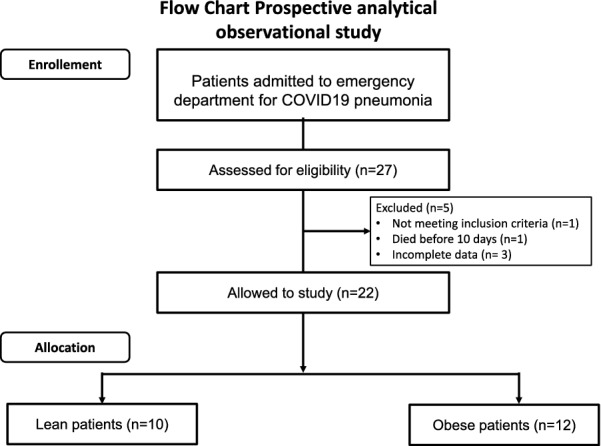
Prospective observational study of 22 adult patients, affected by COVID-19 pneumonia and admitted to the ICU and classified in two sets: (10) lean and (12) obese, according to FM% and age (De Lorenzo classification). Patients were analyzed at admission in ICU and at 10th day.
Obese have steatosis, impaired hepatic function, compromise immune response and higher inflammation. In addition, they have a reduced prognostic nutritional index (PNI), nutritional survival index for ICU patients.
This is the first study evaluating FM% in COVID-19 patient. We underlined obese characteristic with likely poorly prognosis and an important misclassification of obesity. A not negligible number of patients with normal BMI could actually have an excess of adipose tissue and therefore have an unfavorable outcome such as an obese. Is fundamental personalized patients nutrition basing on disease phases.
肥胖和脂肪变性与 COVID-19 重症肺炎有关。这些患者通常存在促炎细胞因子水平升高和免疫反应降低的情况。特别是,脂肪组织是发挥关键作用的器官。因此,有必要评估脂肪量,而不是简单的体重指数(BMI),因为 BMI 会遗漏一部分肥胖人群。本研究旨在评估重症监护病房(ICU)入住 10 天后,脂肪百分比(FM%)与免疫炎症反应之间的关系。
这是一项前瞻性观察研究,共纳入 22 例成人 COVID-19 肺炎患者,根据 FM%和年龄(De Lorenzo 分类)分为两组:(10)瘦组和(12)肥胖组。患者在入住 ICU 时和第 10 天进行分析。
肥胖组存在脂肪变性、肝功能受损、免疫反应受损和更高的炎症反应。此外,肥胖组的预后营养指数(PNI)和 ICU 患者的营养生存指数较低。
这是第一项评估 COVID-19 患者 FM%的研究。我们强调了肥胖患者的特征,可能预后较差,而且肥胖的分类存在重要错误。实际上,许多 BMI 正常的患者可能存在过多的脂肪组织,因此可能会出现不良结局,如肥胖患者。基于疾病阶段,为患者提供个性化的营养支持至关重要。