Department of Kidney Development, Institute of Molecular Embryology and Genetics, Kumamoto University, Kumamoto, Japan.
Department of Pediatrics, Faculty of Life Sciences, Kumamoto University, Kumamoto, Japan.
J Am Soc Nephrol. 2020 Oct;31(10):2355-2371. doi: 10.1681/ASN.2020030378. Epub 2020 Aug 3.
Autosomal dominant polycystic kidney disease (ADPKD) is the most common hereditary kidney disease leading to renal failure, wherein multiple cysts form in renal tubules and collecting ducts derived from distinct precursors: the nephron progenitor and ureteric bud (UB), respectively. Recent progress in induced pluripotent stem cell (iPSC) biology has enabled cyst formation in nephron progenitor-derived human kidney organoids in which or , the major causative genes for ADPKD, are deleted. However, cysts have not been generated in UB organoids, despite the prevalence of collecting duct cysts in patients with ADPKD.
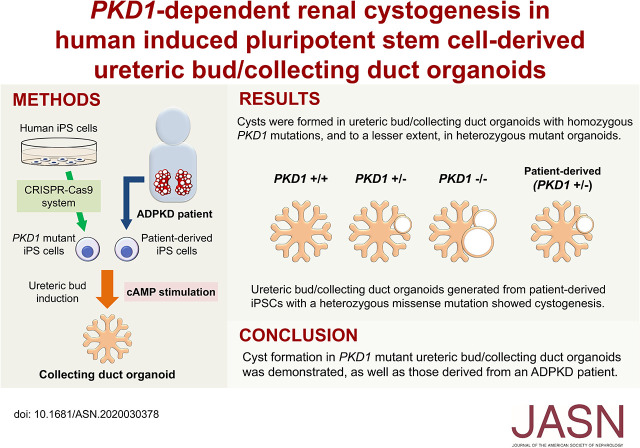
CRISPR-Cas9 technology deleted in human iPSCs and the cells induced to differentiate along pathways leading to formation of either nephron progenitor or UB organoids. Cyst formation was investigated in both types of kidney organoid derived from -deleted iPSCs and in UB organoids generated from iPSCs from a patient with ADPKD who had a missense mutation.
Cysts formed in UB organoids with homozygous mutations upon cAMP stimulation and, to a lesser extent, in heterozygous mutant organoids. Furthermore, UB organoids generated from iPSCs from a patient with ADPKD who had a heterozygous missense mutation developed cysts upon cAMP stimulation.
Cysts form in mutant UB organoids as well as in iPSCs derived from a patient with ADPKD. The organoids provide a robust model of the genesis of ADPKD.
常染色体显性多囊肾病(ADPKD)是最常见的遗传性肾病,可导致肾衰竭,其中多个囊肿形成于肾小管和集合管,分别来自不同的前体:肾祖细胞和输尿管芽(UB)。诱导多能干细胞(iPSC)生物学的最新进展使得在肾祖细胞衍生的人类肾类器官中可以形成囊肿,其中或,ADPKD 的主要致病基因缺失。然而,尽管 ADPKD 患者的集合管囊肿很常见,但在 UB 类器官中并未产生囊肿。
CRISPR-Cas9 技术在人类 iPSC 中缺失,并诱导其沿着导致肾祖细胞或 UB 类器官形成的途径分化。在从 -缺失的 iPSC 衍生的两种类型的肾类器官中以及从具有错义突变的 ADPKD 患者的 iPSC 衍生的 UB 类器官中研究了囊肿形成。
在 cAMP 刺激下,具有纯合突变的 UB 类器官中形成了囊肿,杂合突变的类器官中则形成程度较轻。此外,在 cAMP 刺激下,从具有杂合错义突变的 ADPKD 患者的 iPSC 衍生的 UB 类器官中也形成了囊肿。
在突变的 UB 类器官以及从 ADPKD 患者的 iPSC 中均形成了囊肿。类器官为 ADPKD 的发生提供了一个强大的模型。