CeMM Research Center for Molecular Medicine of the Austrian Academy of Sciences, Vienna, Austria.
FMI Friedrich Miescher Institute for Biomedical Research, Basel, Switzerland.
Nat Chem Biol. 2020 Nov;16(11):1199-1207. doi: 10.1038/s41589-020-0594-x. Epub 2020 Aug 3.
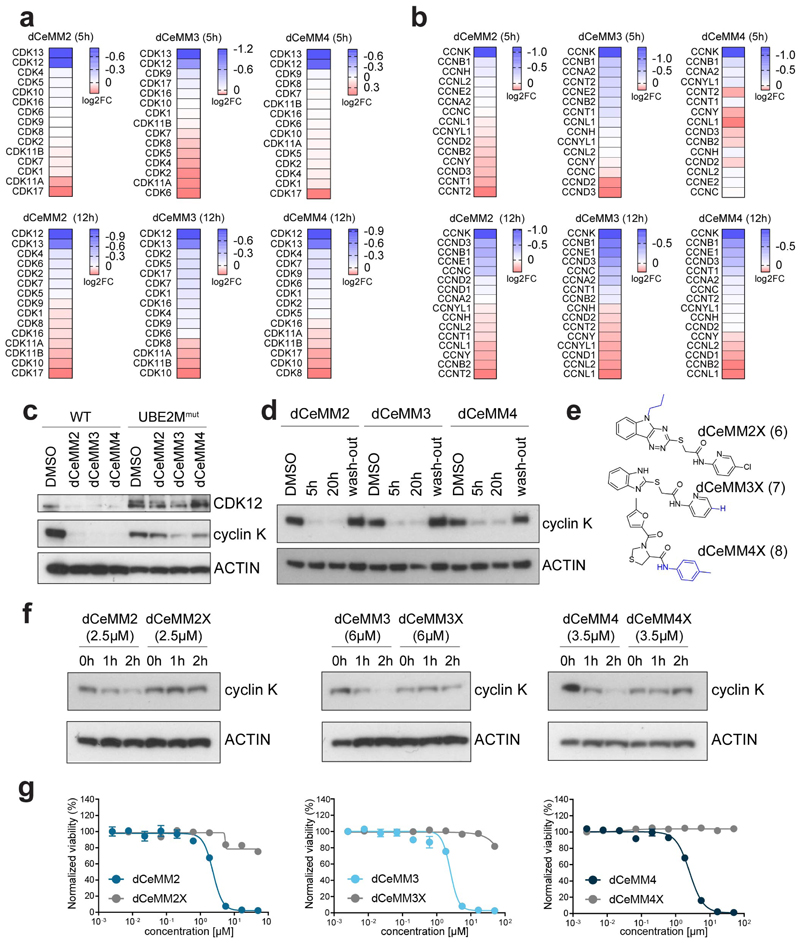
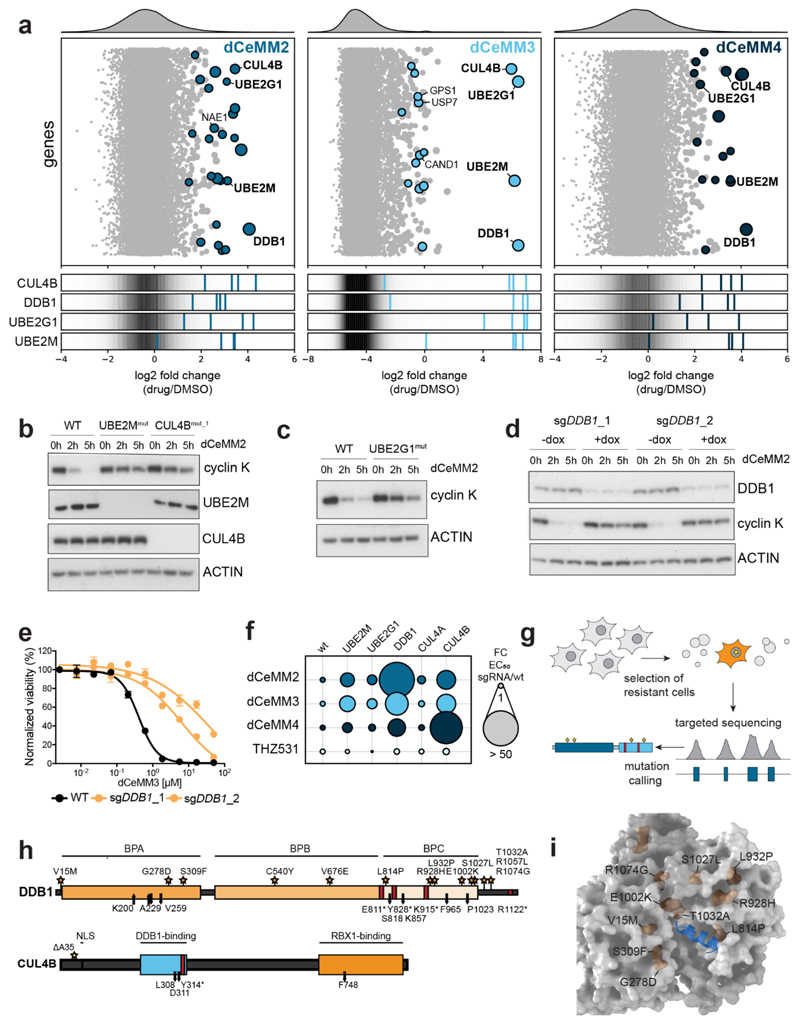
Targeted protein degradation is a new therapeutic modality based on drugs that destabilize proteins by inducing their proximity to E3 ubiquitin ligases. Of particular interest are molecular glues that can degrade otherwise unligandable proteins by orchestrating direct interactions between target and ligase. However, their discovery has so far been serendipitous, thus hampering broad translational efforts. Here, we describe a scalable strategy toward glue degrader discovery that is based on chemical screening in hyponeddylated cells coupled to a multi-omics target deconvolution campaign. This approach led us to identify compounds that induce ubiquitination and degradation of cyclin K by prompting an interaction of CDK12-cyclin K with a CRL4B ligase complex. Notably, this interaction is independent of a dedicated substrate receptor, thus functionally segregating this mechanism from all described degraders. Collectively, our data outline a versatile and broadly applicable strategy to identify degraders with nonobvious mechanisms and thus empower future drug discovery efforts.
靶向蛋白降解是一种新的治疗模式,基于通过诱导蛋白质接近 E3 泛素连接酶来使蛋白质不稳定的药物。特别有趣的是分子胶,它可以通过协调靶蛋白和连接酶之间的直接相互作用,来降解原本不可配体的蛋白质。然而,到目前为止,它们的发现都是偶然的,因此阻碍了广泛的转化努力。在这里,我们描述了一种基于在低泛素化细胞中进行化学筛选,结合多组学目标解析的大规模胶降解剂发现策略。这种方法使我们发现了能够通过促使 CDK12- cyclin K 与 CRL4B 连接酶复合物相互作用来诱导 cyclin K 泛素化和降解的化合物。值得注意的是,这种相互作用不依赖于专门的底物受体,因此将这种机制与所有描述的降解剂功能上区分开来。总的来说,我们的数据概述了一种通用且广泛适用的策略,用于鉴定具有不明显机制的降解剂,从而为未来的药物发现提供支持。