Neural Regeneration, Institute of Reconstructive Neurobiology, Medical Faculty and University Hospital of Bonn, University of Bonn, Venusberg-Campus 1, D-53127 Bonn, Germany.
Int J Mol Sci. 2020 Jul 31;21(15):5494. doi: 10.3390/ijms21155494.
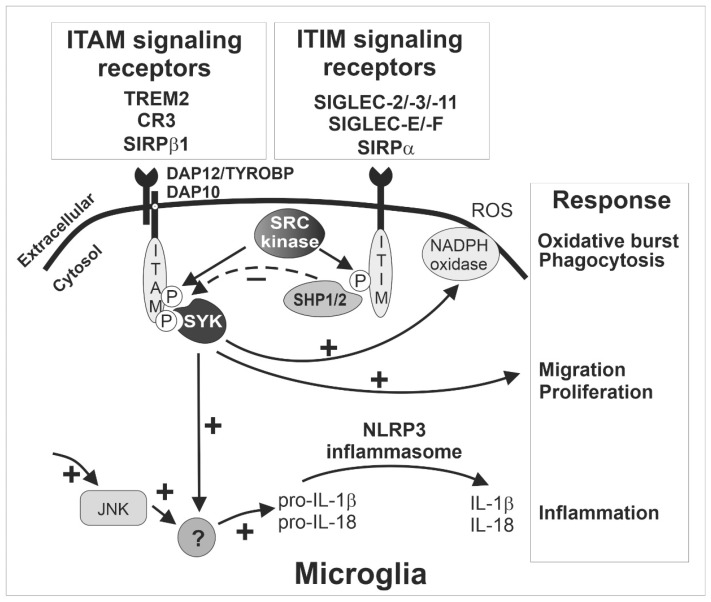
Sialic acids (Sias) are the most abundant terminal sugar residues of glycoproteins and glycolipids on the surface of mammalian cells. The nervous tissue is the organ with the highest expression level of Sias. The 'sialylation' of glycoconjugates is performed via sialyltransferases, whereas 'desialylation' is done by sialidases or is a possible consequence of oxidative damage. Sialic acid residues on the neural cell surfaces inhibit complement and microglial activation, as well as phagocytosis of the underlying structures, via binding to (i) complement factor H (CFH) or (ii) sialic acid-binding immunoglobulin-like lectin (SIGLEC) receptors. In contrast, activated microglial cells show sialidase activity that desialylates both microglia and neurons, and further stimulates innate immunity via microglia and complement activation. The desialylation conveys neurons to become susceptible to phagocytosis, as well as triggers a microglial phagocytosis-associated oxidative burst and inflammation. Dysfunctions of the 'Sia-SIGLEC' and/or 'Sia-complement' axes often lead to neurological diseases. Thus, Sias on glycoconjugates of the intact glycocalyx and its desialylation are major regulators of neuroinflammation.
唾液酸(Sias)是哺乳动物细胞表面糖蛋白和糖脂的最丰富的末端糖残基。神经组织是 Sias 表达水平最高的器官。糖缀合物的“唾液酸化”是通过唾液酸转移酶完成的,而“去唾液酸化”是通过唾液酸酶完成的,或者是氧化损伤的可能结果。神经细胞表面的唾液酸残基通过与(i)补体因子 H(CFH)或(ii)唾液酸结合免疫球蛋白样凝集素(SIGLEC)受体结合,抑制补体和小胶质细胞的激活以及对下伏结构的吞噬作用。相比之下,活化的小胶质细胞表现出唾液酸酶活性,使小胶质细胞和神经元去唾液酸化,并通过小胶质细胞和补体激活进一步刺激先天免疫。去唾液酸化使神经元易被吞噬,并且触发小胶质细胞吞噬相关的氧化爆发和炎症。“Sia-SIGLEC”和/或“Sia-补体”轴的功能障碍常常导致神经疾病。因此,完整糖萼上糖缀合物上的 Sias 及其去唾液酸化是神经炎症的主要调节剂。