Department of Psychology, Bournemouth University, Poole, UK.
Mol Autism. 2020 Aug 5;11(1):63. doi: 10.1186/s13229-020-00364-z.
Autistic people are disproportionately vulnerable to anorexia nervosa and other eating disorders (ED), and within the general population, autistic traits correlate with ED psychopathology. A putative mechanism which may underpin this heightened risk is alexithymia, a difficulty identifying and describing emotional states which is observed in both autism and ED. In two experiments with independent non-clinical samples, we explored whether alexithymia might mediate the heightened risk of eating psychopathology in individuals high in autistic traits.
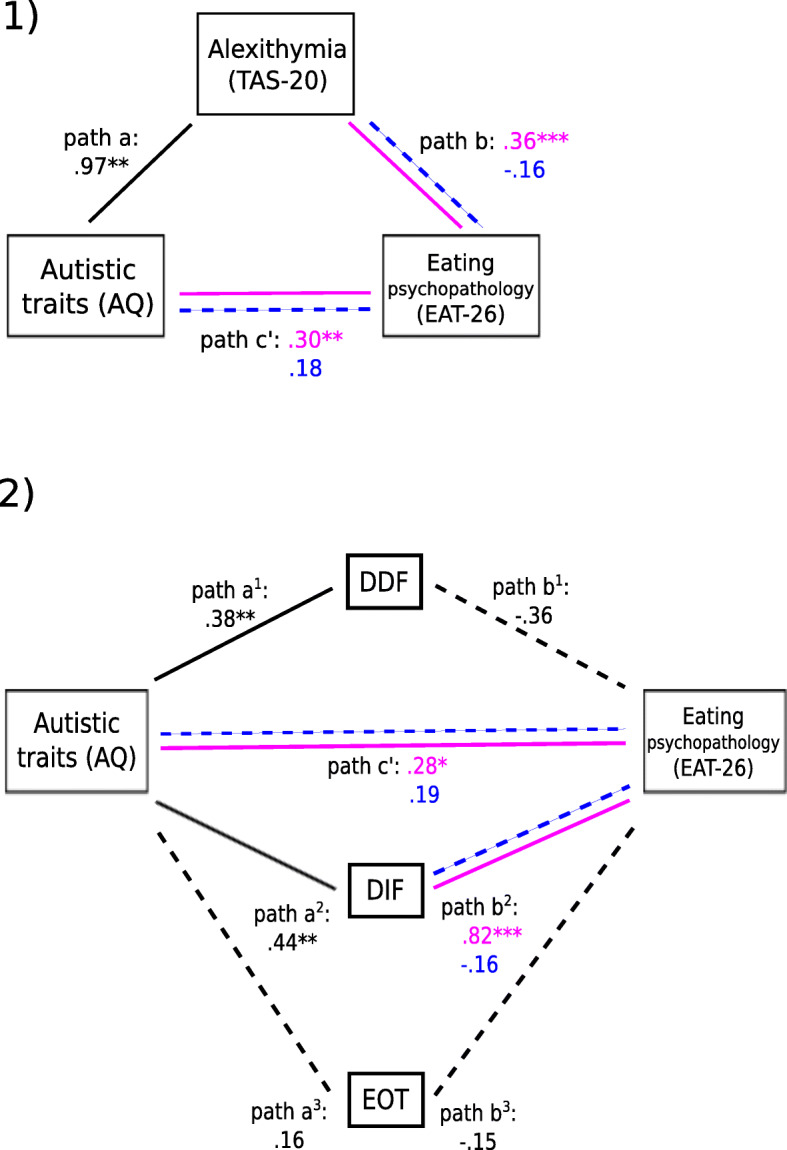
Our first experiment used the PROCESS macro for SPSS to examine relationships between alexithymia (measured by the Toronto Alexithymia Scale (TAS-20)), autistic traits (autism quotient (AQ)), and eating psychopathology (Eating Attitudes Test (EAT-26)) in 121 participants. Our second experiment (n = 300) replicated and furthered this analysis by examining moderating effects of sex and controlling for anxiety and depression as covariates. We also included an additional performance-based measure of alexithymia, the Levels of Emotional Awareness Scale (LEAS).
Study 1 suggested that TAS-20 scores mediated the relationship between heightened autistic traits and eating psychopathology. Replication and further scrutiny of this finding, in study 2, revealed that this mediation effect was partial and specific to the female participants in this sample. The mediation effect appeared to be carried by the difficulty identifying feelings subscale of the TAS-20, even when depression and anxiety were controlled for. LEAS scores, however, were not significantly related to autistic traits or eating psychopathology.
Cross-sectional data prevents any conclusions around the direction and causality of relationships between alexithymia, autistic traits, and eating psychopathology (alongside depression and anxiety), necessitating longitudinal research. Our non-clinical sample was predominantly Caucasian undergraduate students, so it remains to be seen if these results would extrapolate to clinical and/or autistic samples. Divergence between the TAS-20 and LEAS raises crucial questions regarding the construct validity of these measures.
Our findings with respect to autistic traits suggest that alexithymia could partially explain the prevalence of ED in autistic people and may as such be an important consideration in the pathogenesis and treatment of ED in autistic and non-autistic people alike. Further research with clinical samples is critical to explore these ideas. Differences between men and women, furthermore, emphasize the importance of looking for sex-specific as well as generic risk factors in autistic and non-autistic men and women.
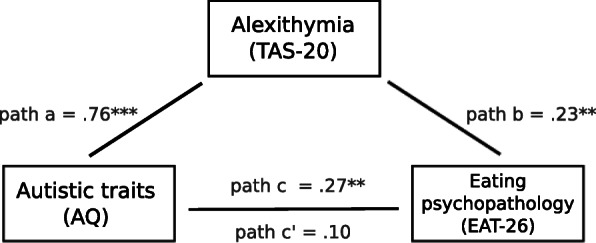
自闭症患者极易患上神经性厌食症和其他饮食失调症(ED),而在普通人群中,自闭症特征与 ED 心理病理学相关。一个可能的潜在机制是述情障碍,它存在于自闭症和 ED 中,表现为难以识别和描述情绪状态。在两个具有独立非临床样本的实验中,我们探索了在高自闭症特征个体中,述情障碍是否可能成为饮食心理病理学风险增加的中介因素。
我们的第一个实验使用了 SPSS 的 PROCESS 宏来检验述情障碍(多伦多述情障碍量表(TAS-20))、自闭症特征(自闭症商数(AQ))和饮食心理病理学(饮食态度测试(EAT-26))在 121 名参与者中的关系。我们的第二个实验(n=300)通过检验性别调节作用并将焦虑和抑郁作为协变量进行控制,对这一分析进行了复制和进一步检验。我们还包括了一项额外的基于表现的述情障碍测量,即情绪意识水平量表(LEAS)。
研究 1 表明,TAS-20 分数在高自闭症特征与饮食心理病理学之间的关系中起中介作用。在研究 2 中对这一发现的复制和进一步研究表明,这种中介效应是部分的,并且仅适用于该样本中的女性参与者。即使在控制了抑郁和焦虑的情况下,这种中介效应似乎是由 TAS-20 的难以识别情绪子量表承载的。然而,LEAS 分数与自闭症特征或饮食心理病理学均无显著相关性。
横断面数据使得无法对述情障碍、自闭症特征和饮食心理病理学(以及抑郁和焦虑)之间的关系方向和因果关系得出任何结论,这需要进行纵向研究。我们的非临床样本主要是白种人本科生,因此这些结果是否适用于临床或自闭症样本还有待观察。TAS-20 和 LEAS 之间的差异提出了关于这些测量方法结构效度的关键问题。
我们对自闭症特征的研究结果表明,述情障碍可能部分解释了自闭症人群中 ED 的流行程度,因此,它可能是自闭症和非自闭症人群中 ED 发病机制和治疗的一个重要考虑因素。对临床样本的进一步研究至关重要,以探索这些想法。男性和女性之间的差异强调了在自闭症和非自闭症男性和女性中寻找特定性别和通用风险因素的重要性。