"Sandro Pitigliani" Department of Medical Oncology, Hospital of Prato, ASL Toscana Centro, Prato, Italy.
Department of Medical Oncology, Perrino Hospital, ASL Brindisi, Brindisi, Italy.
Breast Cancer Res. 2020 Aug 5;22(1):83. doi: 10.1186/s13058-020-01319-1.
Limited data are available regarding the use of nab-paclitaxel in older patients with breast cancer. A weekly schedule is recommended, but there is a paucity of evidence regarding the optimal dose. We evaluated the efficacy of two different doses of weekly nab-paclitaxel, with a specific focus on their corresponding impact on patient function, in order to address the lack of data specifically relating to the older population.
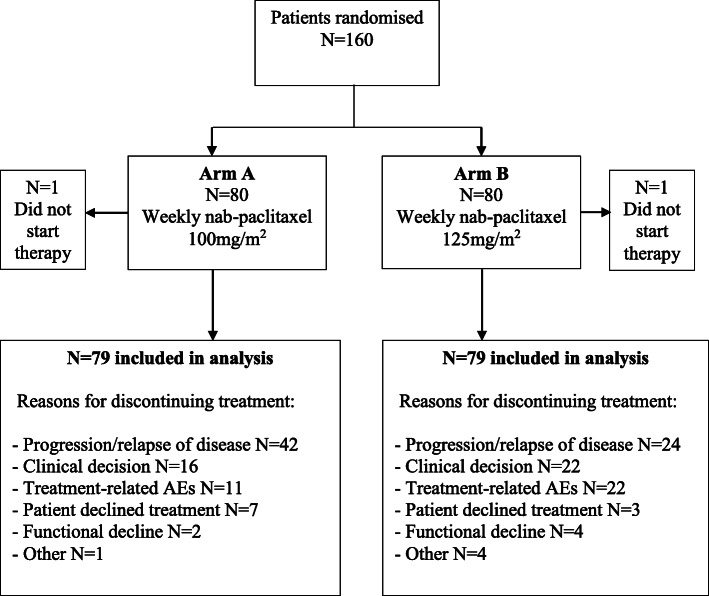
EFFECT is an open-label, phase II trial wherein 160 women with advanced breast cancer aged ≥ 65 years were enrolled from 15 institutions within Italy. Patients were randomly assigned 1:1 to receive nab-paclitaxel 100 mg/m (arm A) or 125 mg/m (arm B) on days 1, 8, and 15 on a 28-day cycle, as first-line treatment for advanced disease. The primary endpoint was event-free survival (EFS), wherein an event was defined as disease progression (PD), functional decline (FD), or death. In each arm, the null hypothesis that the median EFS would be ≤ 7 months was tested against a one-sided alternative according to the Brookmeyer Crowley test. Secondary endpoints included objective response rate (ORR), clinical benefit rate (CBR), progression-free survival (PFS), overall survival (OS), and safety.
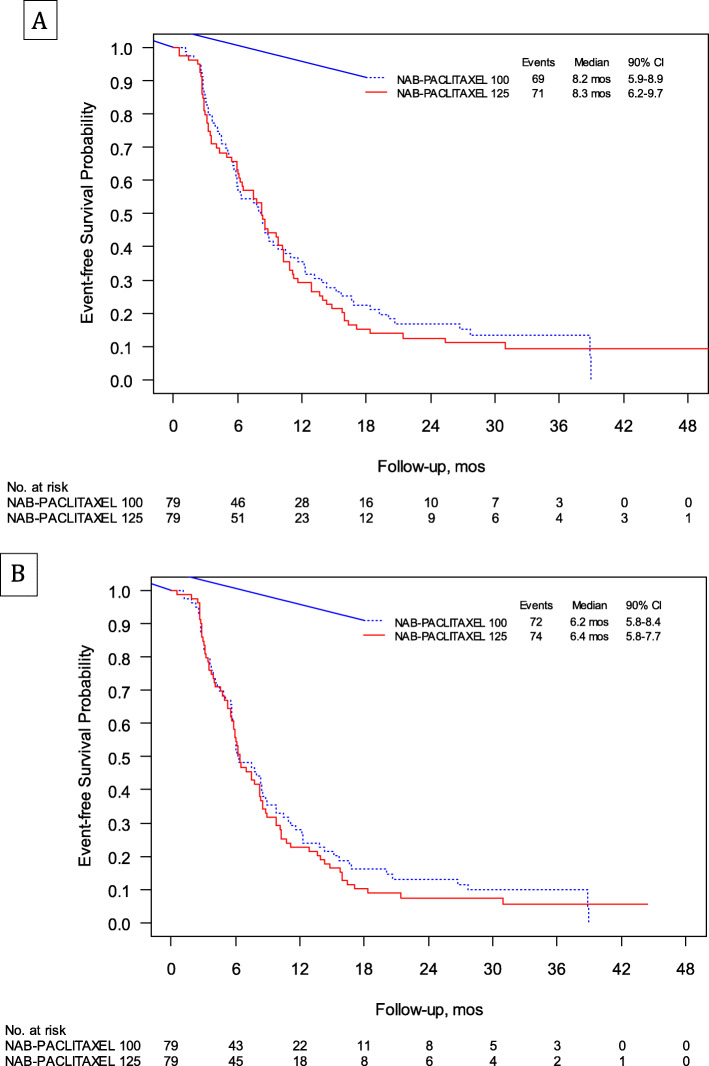
After a median follow-up of 32.6 months, 140 events were observed in 158 evaluable patients. Median EFS was 8.2 months (90% CI, 5.9-8.9; p = 0.188) in arm A vs 8.3 months (90% CI, 6.2-9.7, p = 0.078) in arm B. Progression-free survival, overall survival, and response rates were similar in both groups. A higher percentage of dose reductions and discontinuations due to adverse events (AEs) was noted in arm B. The most frequently reported non-haematological AEs were fatigue (grade [G] 2-3 toxicity occurrence in arm A vs B, 43% and 51%, respectively) and peripheral neuropathy (G2-3 arm A vs B, 19% and 38%, respectively).
Pre-specified outcomes were similar in both treatment arms. However, 100 mg/m was significantly better tolerated with fewer neurotoxicity-related events, representing a more feasible dose to be recommended for older patients with advanced disease.
EudraCT, 2012-002707-18 . Registered on June 4, 2012. NIH ClinicalTrials.gov, NCT02783222 . Retrospectively registered on May 26, 2016.
有关老年乳腺癌患者使用nab-紫杉醇的数据有限。推荐每周使用,但关于最佳剂量的证据很少。我们评估了每周使用两种不同剂量的 nab-紫杉醇的疗效,并特别关注它们对患者功能的影响,以解决特定于老年人群的数据不足的问题。
EFFECT 是一项开放标签、二期临床试验,共纳入了来自意大利 15 家机构的 160 名年龄≥65 岁的晚期乳腺癌患者。患者按 1:1 随机分配接受 nab-紫杉醇 100mg/m(A 组)或 125mg/m(B 组),在第 1、8 和 15 天接受治疗,每 28 天为一个周期,作为晚期疾病的一线治疗。主要终点是无事件生存(EFS),其中事件定义为疾病进展(PD)、功能下降(FD)或死亡。在每个臂中,根据布鲁克迈耶·克劳利检验,对中位 EFS≤7 个月的无效假设进行单侧替代检验。次要终点包括客观缓解率(ORR)、临床获益率(CBR)、无进展生存期(PFS)、总生存期(OS)和安全性。
在中位随访 32.6 个月后,在 158 名可评估患者中观察到 140 例事件。A 组的中位 EFS 为 8.2 个月(90%CI,5.9-8.9;p=0.188),B 组为 8.3 个月(90%CI,6.2-9.7,p=0.078)。两组的无进展生存期、总生存期和缓解率相似。B 组因不良事件(AE)导致剂量减少和停药的比例更高。最常报告的非血液学 AE 是疲劳(A 组和 B 组分别为 G2-3 毒性发生率为 43%和 51%)和周围神经病变(A 组和 B 组分别为 G2-3 发生率为 19%和 38%)。
两个治疗组的预设结局相似。然而,100mg/m 组的耐受性更好,神经毒性相关事件更少,因此更适合推荐用于晚期疾病的老年患者。
EudraCT,2012-002707-18。于 2012 年 6 月 4 日注册。NIH 临床试验.gov,NCT02783222。于 2016 年 5 月 26 日回溯性注册。