Institute of Sport Sciences, The Jerzy Kukuczka Academy of Physical Education, 40-065 Katowice, Poland.
Department of Tourism and Health in Biała Podlaska, The Józef Piłsudski University of Physical Education, 00-968 Warsaw, Poland.
Int J Mol Sci. 2020 Aug 4;21(15):5569. doi: 10.3390/ijms21155569.
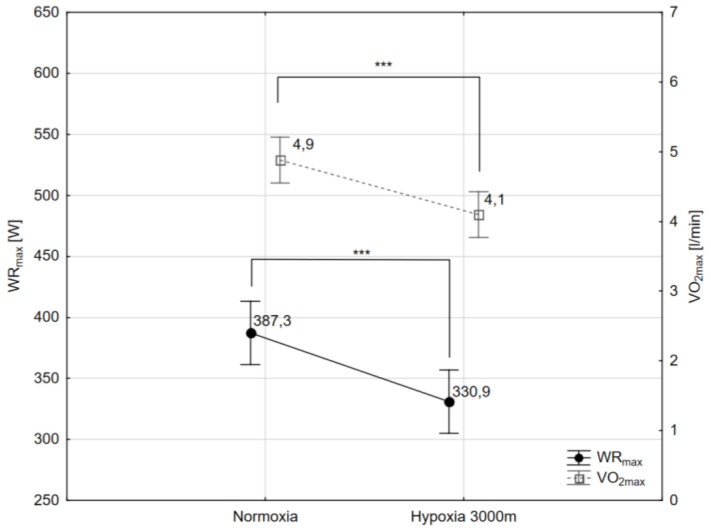
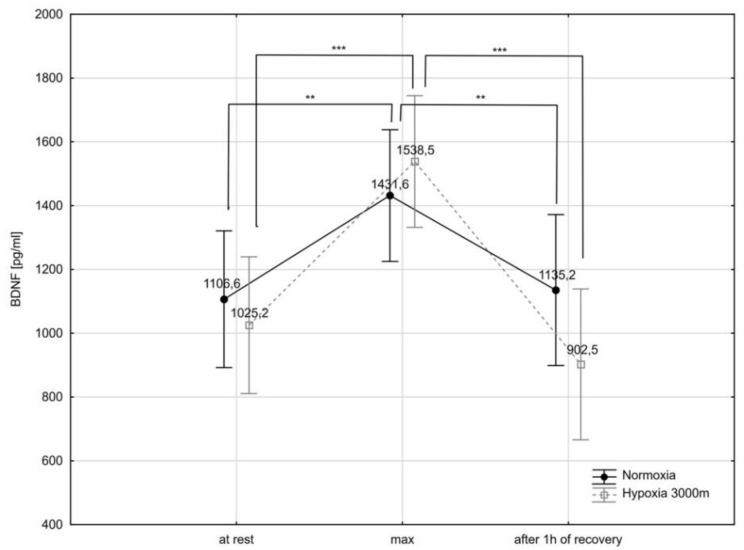
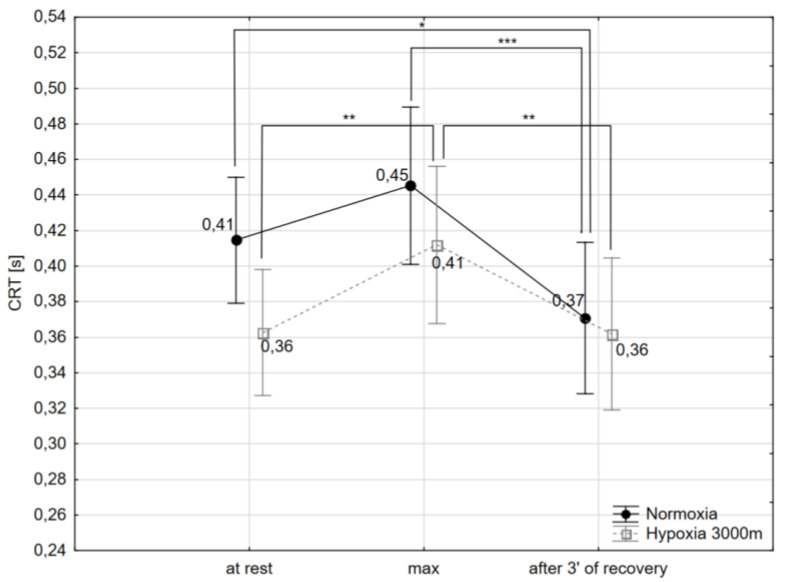
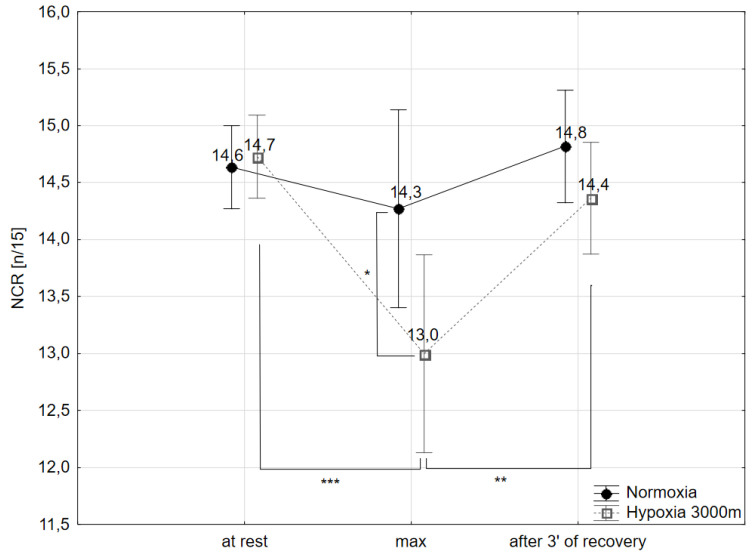
Exposure to acute hypoxia causes a detrimental effect on the brain which is also manifested by a decrease in the ability to perform psychomotor tasks. Conversely, brain-derived neurotrophic factor (BDNF), whose levels are elevated in response to exercise, is a well-known factor in improving cognitive function. Therefore, the aim of our study was to investigate whether the exercise under hypoxic conditions affects psychomotor performance. For this purpose, 11 healthy young athletes performed a graded cycloergometer exercise test to volitional exhaustion under normoxia and acute mild hypoxia (FiO = 14.7%). Before, immediately after exercise and after a period of recovery, choice reaction time (CRT) and number of correct reactions (NCR) in relation to changes in serum BDNF were examined. Additionally, other selected factors which may modify BDNF production, i.e., cortisol (C), nitrite, catecholamines (adrenalin-A, noradrenaline-NA, dopamine-DA, serotonin-5-HT) and endothelin-1 (ET-1), were also measured. Exercise in hypoxic conditions extended CRT by 13.8% ( < 0.01) and decreased NCR (by 11.5%) compared to rest ( < 0.05). During maximal workload, NCR was lower by 9% in hypoxia compared to normoxia ( < 0.05). BDNF increased immediately after exercise in normoxia (by 29.3%; < 0.01), as well as in hypoxia (by 50.0%; < 0.001). There were no differences in BDNF between normoxia and hypoxia. Considering the fact that similar levels of BDNF were seen in both conditions but cognitive performance was suppressed in hypoxia, acute elevation of BDNF did not compensate for hypoxia-induced cognition impairment. Moreover, neither potentially negative effects of C nor positive effects of A, DA and NO on the brain were observed in our study.
急性缺氧暴露会对大脑造成有害影响,这也表现为执行心理运动任务的能力下降。相反,脑源性神经营养因子(BDNF)是一种众所周知的改善认知功能的因子,其水平会因运动而升高。因此,我们的研究目的是探讨在缺氧条件下运动是否会影响心理运动表现。为此,11 名健康的年轻运动员在常氧和急性轻度缺氧(FiO = 14.7%)下进行了分级踏车运动试验直至力竭。在运动前、运动后即刻和恢复期后,检查了选择反应时间(CRT)和与血清 BDNF 变化相关的正确反应次数(NCR)。此外,还测量了其他可能改变 BDNF 产生的选定因素,即皮质醇(C)、亚硝酸盐、儿茶酚胺(肾上腺素-A、去甲肾上腺素-NA、多巴胺-DA、5-羟色胺-5-HT)和内皮素-1(ET-1)。与休息相比,缺氧条件下的运动将 CRT 延长了 13.8%(<0.01),并降低了 NCR(降低了 11.5%)(<0.05)。在最大工作负荷下,与常氧相比,缺氧时 NCR 降低了 9%(<0.05)。常氧和缺氧条件下,运动后即刻 BDNF 均增加(分别增加 29.3%和 50.0%;<0.01 和<0.001)。常氧和缺氧条件下的 BDNF 无差异。考虑到两种条件下 BDNF 水平相似,但缺氧时认知表现受到抑制,急性 BDNF 升高并未补偿缺氧引起的认知损伤。此外,在我们的研究中,没有观察到 C 的潜在负面影响,也没有观察到 A、DA 和 NO 的积极影响。