Department of Computer Science, Pontificia Universidad Católica de Chile, Santiago 7820436, Chile.
Department of Computer Science, Universidad Católica de la Santísima Concepción, Concepción 4090541, Chile.
Sensors (Basel). 2020 Aug 4;20(15):4348. doi: 10.3390/s20154348.
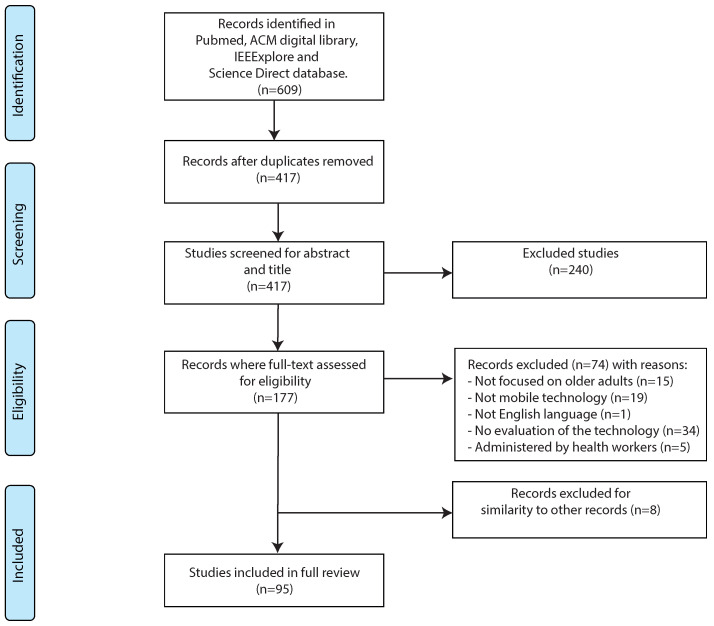
Aging is associated with a progressive decline in health, resulting in increased medical care and costs. Mobile technology may facilitate health self-management, thus increasing the quality of care and reducing costs. Although the development of technology offers opportunities in monitoring the health of older adults, it is not clear whether these technologies allow older adults to manage their health data themselves. This paper presents a review of the literature on mobile health technologies for older adults, focusing on whether these technologies enable the visualization of monitored data and the self-reporting of additional information by the older adults. The systematic search considered studies published between 2009 and 2019 in five online databases. We screened 609 articles and identified 95 that met our inclusion and exclusion criteria. Smartphones and tablets are the most frequently reported technology for older adults to enter additional data to the one that is monitored automatically. The recorded information is displayed on the monitoring device and screens of external devices such as computers. Future designs of mobile health technology should allow older users to enter additional information and visualize data; this could enable them to understand their own data as well as improve their experience with technology.
衰老是与健康状况逐渐下降相关的,这导致了医疗保健需求和费用的增加。移动技术可以促进健康的自我管理,从而提高护理质量并降低成本。尽管技术的发展为监测老年人的健康状况提供了机会,但尚不清楚这些技术是否允许老年人自行管理其健康数据。本文对老年人的移动健康技术文献进行了综述,重点研究了这些技术是否使老年人能够可视化监测数据并自行报告其他信息。系统搜索考虑了 2009 年至 2019 年在五个在线数据库中发表的研究。我们筛选了 609 篇文章,确定了 95 篇符合纳入和排除标准的文章。智能手机和平板电脑是最常用于让老年人输入额外数据的技术,这些数据会自动进行监测。记录的信息显示在监测设备和外部设备(如计算机)的屏幕上。移动健康技术的未来设计应允许老年用户输入额外信息并可视化数据;这可以使他们能够了解自己的数据,并改善他们对技术的体验。