Bartels Sara Laureen, van Knippenberg Rosalia J M, Dassen Fania C M, Asaba Eric, Patomella Ann-Helen, Malinowsky Camilla, Verhey Frans R J, de Vugt Marjolein E
Department of Psychiatry and Neuropsychology and Alzheimer Centre Limburg, School for Mental Health and Neurosciences, Maastricht University, Postbus 616, 6200 MD, Maastricht, the Netherlands.
Division of Occupational Therapy, Department of Neurobiology, Care Science and Society (NVS), Karolinska Institutet, Fack 23 200, SE-141 83 Huddinge, Sweden.
Internet Interv. 2019 Oct 19;18:100283. doi: 10.1016/j.invent.2019.100283. eCollection 2019 Dec.
Self-monitoring is crucial to raise awareness for own behaviors and emotions, and thus facilitate self-management. The composition of self-monitoring within interventions, however, varies and guidelines are currently unavailable. This review aimed to provide a comprehensive overview of technology-based self-monitoring interventions that intend to improve health in middle-aged and older adults (>45 years).
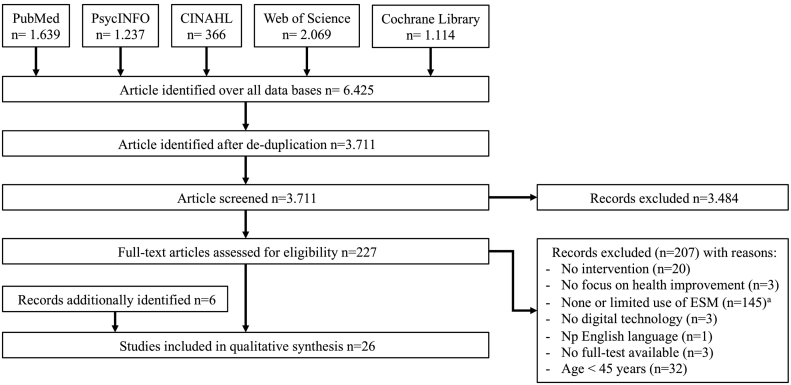
Five online databases were systematically searched and articles were independently screened. A narrative synthesis of 26 studies with 21 unique interventions was conducted. Primary focus lay on the composition of self-monitoring within interventions, including technology used, health-aspects monitored, and type of feedback provided. Secondly, the usability of/adherence to the self-monitoring treatment, intervention effects, and their sustainability were examined.
Studies concentrated on middle-aged adults (mean of 51 years). Mobile technologies seem necessary to ensure flexible self-monitoring in everyday life. Social health aspects were rarely monitored. Mechanisms and the sustainability of intervention effect are understudied.
Digital self-monitoring technologies hold promise for future trials as they seem suitable to understand and support health-related self-management. Key elements including automatic and personal feedback following the blended care principle were highlighted and may guide study designs. Prospectively, research is especially needed to study sustained self-monitoring to support disease prevention and lasting lifestyle changes.
自我监测对于提高对自身行为和情绪的认识至关重要,从而有助于自我管理。然而,干预措施中自我监测的构成各不相同,目前尚无相关指南。本综述旨在全面概述旨在改善中年及老年人(>45岁)健康状况的基于技术的自我监测干预措施。
系统检索了五个在线数据库,并对文章进行独立筛选。对26项研究和21种独特干预措施进行了叙述性综合分析。主要重点在于干预措施中自我监测的构成,包括所使用的技术、监测的健康方面以及提供的反馈类型。其次,考察了自我监测治疗的可用性/依从性、干预效果及其可持续性。
研究集中在中年成年人(平均51岁)。移动技术似乎对于确保日常生活中的灵活自我监测是必要的。社会健康方面很少被监测。干预效果的机制和可持续性研究不足。
数字自我监测技术在未来试验中有前景,因为它们似乎适合理解和支持与健康相关的自我管理。强调了遵循混合护理原则的自动和个人反馈等关键要素,可能会指导研究设计。未来,尤其需要开展研究以探讨持续的自我监测,以支持疾病预防和持久的生活方式改变。