Shimada Hiroyuki, Lee Sangyoon, Doi Takehiko, Bae Seongryu, Makino Keitaro, Chiba Ippei, Arai Hidenori
Department of Preventive Gerontology, Center for Gerontology and Social Science, National Center for Geriatrics and Gerontology, Obu, Aichi, Japan.
Center for Gerontology and Social Science, National Center for Geriatrics and Gerontology, Obu, Aichi, Japan.
Alzheimers Dement (N Y). 2019 Jul 18;5:303-307. doi: 10.1016/j.trci.2019.05.009. eCollection 2019.
Numerous studies have focused on nonpharmacological interventions on cognitive function and the effects of cognitive function on daily living. However, effects of behavior change techniques that promote physical, cognitive, and social activities on cognitive function and incident dementia in the elderly are yet to be elucidated. In this study, we aimed to design a single-blind, randomized controlled trial to study dementia prevention effects of behavior change techniques, using an accelerometer and a newly developed daily activity booklet in community-living older adults.
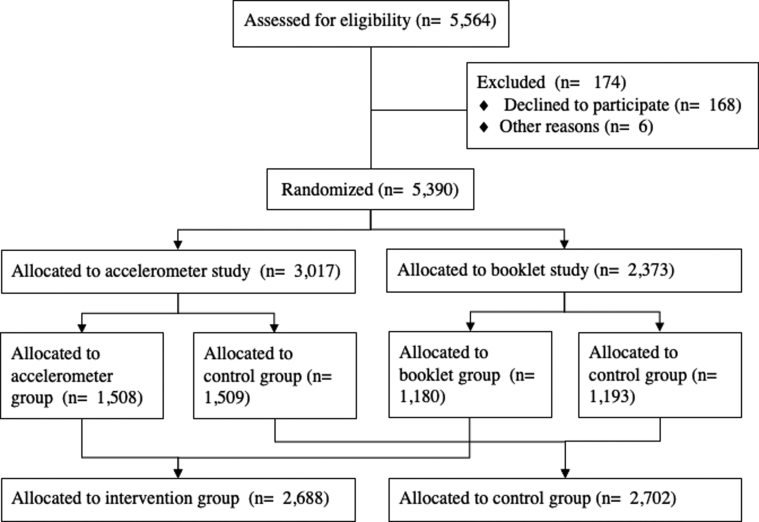
The study cohort comprised 5390 individuals aged 65 years and older who were randomized into one of the following three groups: accelerometer group (n = 1508), accelerometer and daily activity booklet group (n = 1180), or a control group (n = 2702; vs. accelerometer group [n = 1509] vs. accelerometer and daily activity booklet group [n = 1193]). Incident dementia was diagnosed based on the Japanese Health Insurance System data. The participants without dementia at baseline, who are diagnosed with dementia over a 36-month follow-up period, are considered to have incident dementia. The participants of the accelerometer group were asked to wear the accelerometer everyday and visit a site having data readers to download the accelerometer data every month. The subjects of the booklet group were requested to not only wear the accelerometer but also record the physical, cognitive, and social activities. The participants receive a feedback report from the data of the accelerometer and booklet.
The study has the potential to provide the first evidence of effectiveness of the self-monitoring tools in incident dementia. In case our trial results suggest a delayed dementia onset upon self-monitoring interventions, the study protocol will provide a cost-effective and safe method for maintaining a healthy cognitive aging.
众多研究聚焦于对认知功能的非药物干预以及认知功能对日常生活的影响。然而,促进身体、认知和社交活动的行为改变技术对老年人认知功能和新发痴呆症的影响尚未阐明。在本研究中,我们旨在设计一项单盲随机对照试验,使用加速度计和新开发的日常活动手册,研究行为改变技术对社区居住的老年人认知功能和新发痴呆症的预防效果。
研究队列包括5390名65岁及以上的个体,他们被随机分为以下三组之一:加速度计组(n = 1508)、加速度计和日常活动手册组(n = 1180)或对照组(n = 2702;与加速度计组[n = 1509]和加速度计和日常活动手册组[n = 1193]对比)。新发痴呆症根据日本健康保险系统数据进行诊断。在基线时无痴呆症且在36个月随访期内被诊断为痴呆症的参与者被视为患有新发痴呆症。加速度计组的参与者被要求每天佩戴加速度计,并每月前往有数据读取器的地点下载加速度计数据。手册组的受试者不仅要佩戴加速度计,还要记录身体、认知和社交活动。参与者会收到来自加速度计和手册数据的反馈报告。
该研究有可能提供自我监测工具对新发痴呆症有效性的首个证据。如果我们的试验结果表明自我监测干预可延缓痴呆症发病,那么研究方案将为维持健康的认知衰老提供一种经济有效且安全的方法。