Department of Clinical Neuroscience and Therapeutics, Graduate School of Biomedical and Health Sciences, Hiroshima University, Hiroshima, Japan.
Department of Neurology, Chikamori Hospital, Kochi, Japan.
PLoS One. 2020 Aug 6;15(8):e0237185. doi: 10.1371/journal.pone.0237185. eCollection 2020.
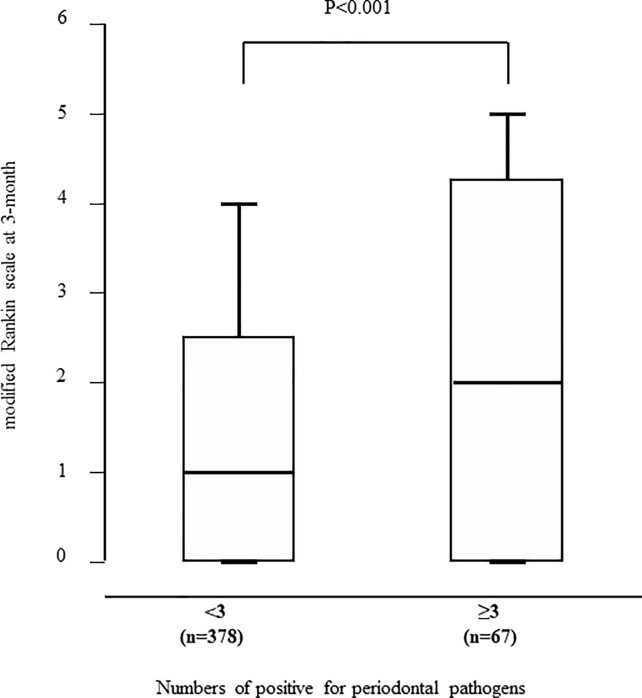
Several cohort studies have shown that periodontal disease is associated with an increased risk for stroke. However, it remains unclear whether serum antibody titers for a specific periodontal pathogen are associated with outcome after ischemic stroke, and which kinds of pathogens are associated with ischemic stroke. We examined the relationship between serum IgG titers to periodontal pathogens and outcome in ischemic stroke patients. A total of 445 patients with acute ischemic stroke (194 female [44.0%], mean age 71.9±12.3 years) were registered in this study. Serum IgG titers to 9 periodontal pathogens (Porphyromonas gingivalis, Aggregatibacter actinomycetemcomitans, Prevotella intermedia, Prevotella nigrescens, Fusobacterium nucleatum, Treponema denticola, Tannerella forsythensis, Campylobacter rectus, Eikenella corrodens) were evaluated using the enzyme-linked immunosorbent assay (ELISA) method. An unfavorable outcome was defined as a 3 or higher on the modified Rankin Scale. The proportion of patients with unfavorable outcome was 25.4% (113 patients). Based on multivariate logistic regression analysis, numbers of IgG antibodies positive for periodontal pathogens (odds ratio 1.20, 95% CI 1.02-1.41, p = 0.03) were independent predictors of unfavorable outcome in ischemic stroke patients.
多项队列研究表明,牙周病与中风风险增加有关。然而,目前尚不清楚特定牙周病原体的血清抗体滴度是否与缺血性中风的预后相关,以及哪些病原体与缺血性中风相关。我们研究了牙周病病原体血清 IgG 滴度与缺血性中风患者预后之间的关系。本研究共登记了 445 例急性缺血性中风患者(194 例女性[44.0%],平均年龄 71.9±12.3 岁)。采用酶联免疫吸附试验(ELISA)方法评估了 9 种牙周病原体(牙龈卟啉单胞菌、伴放线放线杆菌、中间普氏菌、黑色普氏菌、核梭杆菌、牙髓卟啉单胞菌、福赛坦纳氏菌、直肠弯曲杆菌、侵蚀艾肯菌)的血清 IgG 滴度。采用改良 Rankin 量表(mRS)将不良结局定义为 3 分或更高。不良结局患者比例为 25.4%(113 例)。基于多变量 logistic 回归分析,牙周病原体 IgG 抗体阳性数量(比值比 1.20,95%可信区间 1.02-1.41,p = 0.03)是缺血性中风患者不良结局的独立预测因子。