Oral Medicine and Diagnostic Sciences, College of Dentistry, University of Illinois Chicago, Chicago, IL, United States of America.
Restorative Dentistry, University of Illinois Chicago, Chicago, IL, United States of America.
PeerJ. 2023 Jul 14;11:e15502. doi: 10.7717/peerj.15502. eCollection 2023.
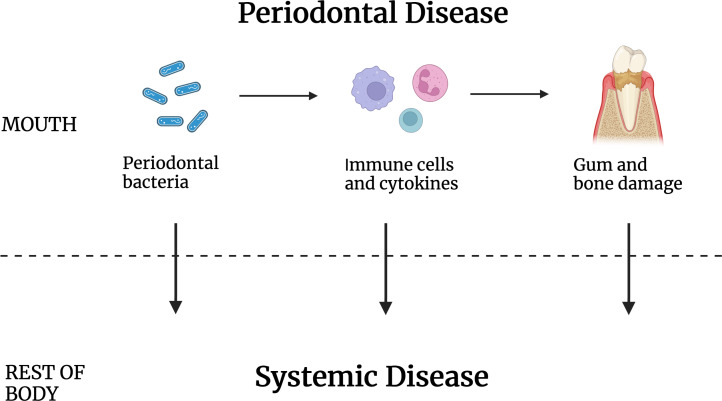
Periodontal disease is associated with systemic conditions such as diabetes, arthritis, and cardiovascular disease, all diseases with large inflammatory components. Some, but not all, reports show periopathogens and at higher levels orally in people with one of these chronic diseases and in people with more severe cases. These oral pathogens are thought to be positively associated with systemic inflammatory diseases through induction of oral inflammation that works to distort systemic inflammation or by directly inducing inflammation at distal sites in the body. This study aimed to determine if, among patients with severe periodontal disease, those with multi-morbidity (or many chronic diseases) showed higher levels of periodontal pathogens.
A total of 201 adult subjects, including 84 with severe periodontal disease were recruited between 1/2017 and 6/2019 at a city dental clinic. Electronic charts supplied self-reported diseases and conditions which informed a morbidity index based on the number of chronic diseases and conditions present. Salivary composition was determined by 16S rRNA gene sequencing.
As expected, patients with severe periodontal disease showed higher levels of periodontal pathogens in their saliva. Also, those with severe periodontal disease showed higher levels of multiple chronic diseases (multimorbidity). An examination of the 84 patients with severe periodontal disease revealed some subjects despite being of advanced age were free or nearly free of systemic disease. Surprisingly, the salivary microbiota of the least healthy of these 84 subjects, defined here as those with maximal multimorbidity, showed significantly lower relative numbers of periodontal pathogens, including and , after controlling for active caries, tobacco usage, age, and gender. Analysis of a control group with none to moderate periodontal disease revealed no association of multimorbidity or numbers of medications used and specific oral bacteria, indicating the importance of severe periodontal disease as a variable of interest.
The hypothesis that periodontal disease patients with higher levels of multimorbidity would have higher levels of oral periodontal pathogens is false. Multimorbidity is associated with a reduced relative number of periodontal pathogens and
牙周病与糖尿病、关节炎和心血管疾病等系统性疾病有关,所有这些疾病都有很大的炎症成分。一些(但不是全部)报告显示,患有这些慢性疾病之一的人和病情更严重的人口腔中这些牙周病原体的水平更高。这些口腔病原体被认为通过诱导口腔炎症与全身炎症呈正相关,口腔炎症会扭曲全身炎症,或通过直接在体内远端部位诱导炎症。本研究旨在确定在患有严重牙周病的患者中,是否患有多种疾病(或多种慢性疾病)的患者牙周病病原体水平更高。
201 名成年受试者,包括 84 名患有严重牙周病的受试者,于 2017 年 1 月至 2019 年 6 月在一家城市牙科诊所招募。电子病历提供了自我报告的疾病和状况,这些信息提供了基于存在的慢性疾病和状况数量的发病率指数。唾液成分通过 16S rRNA 基因测序确定。
正如预期的那样,患有严重牙周病的患者唾液中的牙周病病原体水平较高。此外,患有严重牙周病的患者患有多种慢性疾病(多种疾病)的水平较高。对 84 名患有严重牙周病的患者进行检查发现,尽管有些患者年龄较大,但他们没有或几乎没有全身疾病。令人惊讶的是,这些 84 名患者中健康状况最差的患者(这里定义为患有最大多种疾病的患者)的唾液微生物群中,包括 和 在内的牙周病原体的相对数量明显较低,在控制活动性龋齿、烟草使用、年龄和性别后。对无至中度牙周病的对照组进行分析表明,多种疾病或使用药物的数量与特定口腔细菌之间没有关联,这表明严重牙周病是一个重要的变量。
牙周病患者的多种疾病程度越高,其口腔牙周病原体水平越高的假设是错误的。多种疾病与牙周病原体的相对数量减少有关