Department of Traumatology and Acute Critical Medicine, Osaka University Graduate School of Medicine, Suita, Japan.
Department of Food Science, Faculty of Home Economics, Otsuma Women's University, Tokyo, Japan.
PLoS One. 2020 Aug 6;15(8):e0236560. doi: 10.1371/journal.pone.0236560. eCollection 2020.
Replacing traditional surveillance with syndromic surveillance is one of the major interests in public health. However, it is unclear whether the number of influenza patients is associated with the number of telephone triages in Japan.
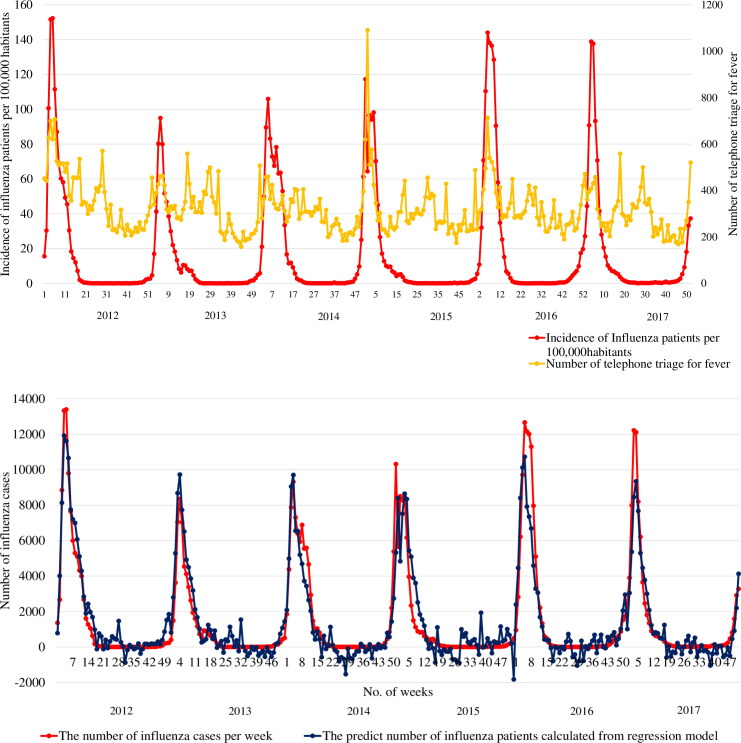
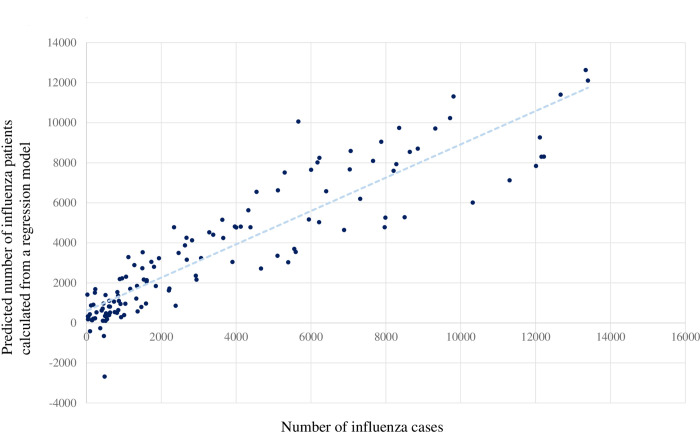
This retrospective, observational study was conducted over the six-year period between January 2012 to December 2017. We used the dataset of a telephone triage service in Osaka, Japan and the data on influenza patients published from the Information Center of Infectious Disease in Osaka prefecture. Using a linear regression model, we calculated Spearman's rank-order coefficient and R2 of the regression model to assess the relationship between the number of telephone triages for fever and the number of influenza patients in Osaka. Furthermore, we calculated Spearman's rank-order coefficient and R2 between the predicted weekly number of influenza patients from the linear regression model and the actual weekly number of influenza patients for influenza outbreak season (December-April).
There were 465,971 patients with influenza, and the number of telephone triages for fever was 420,928 among 1,065,628 total telephone triages during the study period. Our analysis showed that the Spearman rank-order coefficient was 0.932, and R2 and adjusted R2 were 0.869 and 0.842, respectively. The Spearman rank-order coefficient was 0.923 (P<0.001) and R2 was 0.832 in December-April (P<0.001).
We revealed a positive relationship in this population between the number of influenza patients and the number of telephone triages for fever.
用症候群监测替代传统监测是公共卫生领域的主要关注点之一。然而,目前尚不清楚日本的流感患者人数与电话分诊的数量是否有关。
本回顾性观察研究在 2012 年 1 月至 2017 年 12 月的六年期间进行。我们使用了日本大阪的电话分诊服务数据集和大阪府传染病信息中心公布的流感患者数据。我们使用线性回归模型计算了Spearman 秩相关系数和回归模型的 R2,以评估大阪发热电话分诊数量与流感患者数量之间的关系。此外,我们计算了线性回归模型预测的每周流感患者数量与流感流行季节(12 月至 4 月)实际每周流感患者数量之间的 Spearman 秩相关系数和 R2。
研究期间共出现了 465971 例流感患者,1065628 次电话分诊中发热电话分诊数量为 420928 次。分析显示,Spearman 秩相关系数为 0.932,R2 和调整 R2 分别为 0.869 和 0.842。12 月至 4 月期间的 Spearman 秩相关系数为 0.923(P<0.001),R2 为 0.832(P<0.001)。
在本研究人群中,流感患者数量与发热电话分诊数量之间存在正相关关系。