Zaraket Hassan, Saito Reiko
Department of Experimental Pathology, Immunology and Microbiology, Faculty of Medicine, American University of Beirut, Beirut, Lebanon ; Center for Infectious Diseases Research, Faculty of Medicine, American University of Beirut, Beirut, Lebanon.
Division of International Health, Graduate School of Medical and Dental Sciences, Niigata University, 1-757, Asahimachi-dori, Chuo-ku, Niigata City, Niigata Prefecture 951-8510 Japan.
Curr Treat Options Infect Dis. 2016;8(4):311-328. doi: 10.1007/s40506-016-0085-5. Epub 2016 Oct 10.
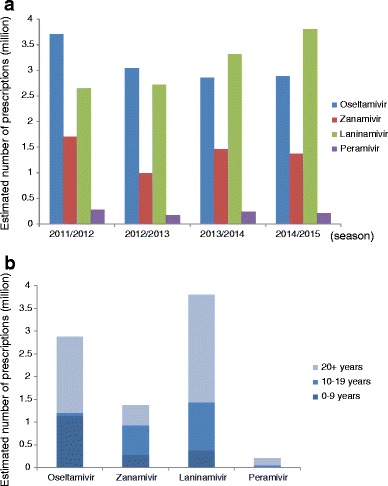
Influenza management and surveillance programs in Japan possess several unique features. The national influenza surveillance is affiliated with National Epidemiological Surveillance for Infectious Diseases (NESID) and features sentinel outpatient surveillance, virological surveillance, and reports on hospitalization, mortality, and influenza-associated encephalopathy. Of note, information on the number of student absences and class/grade/school closures due to influenza are also reported to the government and made publically available. A private online influenza surveillance portal by volunteer doctors provides a real-time information source for the Japanese clinicians and the general public. For influenza treatment, three classes of drugs are approved and covered by national medical insurance in Japan: M2 inhibitors, neuraminidase inhibitors (NAIs), and a polymerase inhibitor. Four NAIs, oseltamivir, zanamivir, laninamivir, and peramivir, are licensed in Japan and are prescribed to seven to eight million patients annually. NAIs are prescribed to any influenza outpatient rather than being limited to severe cases. The majority (80-95 %) of patients start the treatment within 48 h of onset. Laninamivir and peramivir were used almost solely in Japan, until the approval of the latter drug by the FDA. Observational studies showed that the two drugs have equal effectiveness as oseltamivir and zanamivir. The Japanese approach to influenza surveillance and management has facilitated bringing new influenza antivirals to the markets and has driven innovative research in this field. New classes of antivirals, including polymerase inhibitors and cap-dependent endonuclease inhibitor, provide novel tools for treatment of influenza in Japan and the rest of the world.
日本的流感管理和监测项目具有若干独特特征。国家流感监测隶属于国家传染病流行病学监测(NESID),其特点包括哨点门诊监测、病毒学监测以及关于住院、死亡率和流感相关脑病的报告。值得注意的是,因流感导致的学生缺勤人数以及班级/年级/学校停课信息也会上报给政府并向公众公开。一个由志愿医生参与的私人在线流感监测门户网站为日本临床医生和公众提供了实时信息来源。在日本,有三类药物被批准用于流感治疗并纳入国家医疗保险范围:M2抑制剂、神经氨酸酶抑制剂(NAIs)和一种聚合酶抑制剂。四种NAIs,即奥司他韦、扎那米韦、拉尼米韦和帕拉米韦,在日本获得许可,每年为700 - 800万患者开具处方。NAIs被用于任何流感门诊患者,而非仅限于重症病例。大多数(80 - 95%)患者在发病后48小时内开始治疗。在FDA批准帕拉米韦之前,拉尼米韦和帕拉米韦几乎仅在日本使用。观察性研究表明,这两种药物与奥司他韦和扎那米韦具有同等疗效。日本的流感监测和管理方式促进了新型流感抗病毒药物进入市场,并推动了该领域的创新性研究。包括聚合酶抑制剂和帽依赖性内切核酸酶抑制剂在内的新型抗病毒药物类别,为日本乃至世界其他地区的流感治疗提供了新工具。